
A customer lands on your website late at night with a real question and real intent. They may want pricing, need to know whether your service fits their situation, or hope to get a quick answer before deciding what to do next. They open the chat box expecting help, but instead get a generic reply that feels scripted and disconnected from what they actually asked. The response is fast, but not useful. At that moment, confidence starts to drop.
This is exactly why so many businesses want to automate customer support—and why so many get it wrong. Fast replies are useful, but speed alone does not create trust. If automation only delivers canned answers, weak routing, or robotic handoffs, it may reduce workload while quietly damaging the customer experience. The real challenge is not whether to use automated customer support, but how to automate customer support without losing clarity, relevance, and human judgment.
Why Fast Support Alone Is No Longer Enough
Fast replies are no longer a bonus in customer service. They are the baseline. Customers expect businesses to answer quickly across websites, live chat, and messaging apps, often at any hour. That is why more companies want to automate customer support. But speed alone does not create a good experience, and that is where many support systems begin to fail.
Rising Expectations for Instant, Always-On Customer Support
Customers now expect support to move as fast as the rest of digital life. If they can book, order, or message in seconds, they expect support to feel just as immediate. This is why businesses increasingly automate:
FAQs
scheduling
first-response coverage
after-hours inquiries
These are sensible use cases for automated customer support because they depend on speed, consistency, and availability. Still, a fast reply only works when it is also useful. If the answer is vague, generic, or poorly timed, the customer still leaves with a poor impression.
Where Traditional Automation Falls Short
Traditional automation often responds to keywords, not meaning. It works for simple requests, but real support conversations are rarely that neat. Customers may ask mixed questions, combine support with buying intent, or arrive frustrated and unsure. In those moments, rigid systems can misroute the conversation or give shallow replies, making support feel robotic instead of helpful.
Why Human Touch Still Matters in Service-Led Businesses
In service-led businesses, support is rarely just about one answer. A single conversation may include explanation, reassurance, pricing, qualification, booking, and next-step guidance. That is why human touch in customer service still matters. A real human touch service experience is not about sounding extra warm. It is about relevance, judgment, and timing.
What “Human Touch” Really Means in Customer Support
If speed is not enough, what do customers actually want? Not just friendliness. Human touch means the support experience feels relevant, thoughtful, and responsive to the real situation behind the question.
Empathy, Judgment, and Context—Not Just a Friendly Tone
Many teams think human touch simply means using a friendlier voice. Tone matters, but context matters more. Two customers may ask the same pricing question for different reasons:
one is casually comparing options
one is ready to book
one needs reassurance before moving forward
If all three get the same reply, the answer may sound polite, but it still feels weak. Human touch means recognizing differences in intent, urgency, and confidence.
When Customers Want Clarity, Reassurance, and Real Understanding
Customers often ask one thing while needing something deeper. A pricing question may really be about trust. A timing question may be about reliability. A process question may signal hesitation. Strong support looks beyond the visible question and responds to the real concern.
Why the Best Support Workflows Combine AI Speed with Human Decision-Making
The best systems do not choose between AI and people. They use both. AI is strong at speed, coverage, repetition, and routing. Humans are stronger at judgment, flexibility, emotional nuance, and complex cases. That is the right model for businesses that want to automate customer support well: use automation for predictable tasks, and keep people involved where trust and understanding matter most.
Which Customer Support Should Be Automated
Once a business decides to automate customer support, the next question is where automation actually helps. The goal is not to automate as much as possible. It is to automate the parts of support that benefit from speed, structure, and consistency, while leaving more sensitive or complex moments to people.
FAQs and Repetitive Questions
The best place to start is with simple, repeated requests that do not need much judgment. These often include:
business hours
location details
service availability
basic pricing
standard policies
simple process questions
These are strong use cases for automated customer support because customers usually want quick, accurate answers rather than a long conversation. When automation handles them well, it saves time for both customers and support teams.
Lead Capture and Routing
Not every visitor needs a full answer right away. Sometimes the most important first step is understanding what they want and guiding them into the right path. A good support system should tell the difference between support questions, consultation requests, booking intent, and follow-up needs.
This is a smarter way to automate customer support than giving every visitor the same opening reply. Good routing reduces confusion, improves handoffs, and makes the experience feel more relevant from the beginning.
Booking and Follow-Ups
Support often includes coordination, not just answers. Customers may want to book a session, confirm a time, get a reminder, or check the next step. These tasks are structured and repeatable, which makes them ideal for automation.
When handled well, automation reduces missed appointments, lowers manual admin work, and helps the service journey feel smoother and more organized.
After-Hours Coverage
One of the clearest benefits of automated customer support is that it keeps working when the team is offline. Many visitors come to a website outside business hours. If no reply appears, they may leave and never return.
An automated first response can welcome the visitor, capture the main question, and guide them into the next step. Even if a human replies later, the conversation has already been saved.
Which Customer Support Should Stay Human
Automation is useful, but not every part of support should be handled the same way. Some moments need judgment, flexibility, and emotional awareness.
Complaints and Sensitive Issues
When a customer is upset, frustrated, or emotionally sensitive, human support matters more. These conversations often need careful wording, tone adjustment, and flexibility. In these moments, human touch in customer service matters more than speed.
High-Value or Complex Inquiries
Some conversations involve bigger decisions. A customer may be close to booking or buying, but still have detailed questions. Others may have a case that does not fit a simple workflow. Here, automation can help identify the case early, but a real person should often handle the response.
Exceptions and Special Requests
No workflow can cover everything. Some customers ask for unusual timing, custom terms, or exceptions to standard policy. These cases require judgment. A strong system uses automation to collect context and route the case cleanly, instead of forcing every inquiry into the same flow.
The best answer to how to automate customer support is not to automate every interaction. It is to automate the predictable layers well, while keeping human attention where trust, nuance, and decision-making matter most.
This is also where Dealism fits naturally: instead of treating support as a stream of isolated replies, Dealism helps businesses structure conversations through intent recognition and live chat entry points, while still leaving room for human handoff when a case becomes sensitive, complex, or high-value. That balance is what makes automation more useful without making customer support feel less human.
Bringing Human-Centered Support Automation to Your Website with Dealism Live Chat
For businesses that want to automate customer support without making the experience feel cold or fragmented, the website should not be treated as the entire support environment. It should be treated as the first touchpoint. That is where Dealism Live Chat fits best. It is not designed as a traditional on-site customer service box where conversations stay trapped inside a website widget. Instead, it works more like a website-to-chat entry point that moves visitors into connected WhatsApp or Instagram conversations, where support, consultation, and follow-up can continue more naturally.
Why Dealism Live Chat Feels More Like a Support Workflow Than a Standard Chat Widget
Many live chat tools are limited by design. They appear as a pop-up, wait for a message, and provide a basic reply inside the page. That may be enough for simple website support, but it often breaks down when the conversation needs to continue, shift into qualification, or move toward booking or sales.
Dealism Live Chat is different because it is not just trying to keep users inside a website chat window. It is built around the idea that the real value of support is not the widget itself, but what happens next. Instead of acting like an isolated help box, it helps businesses turn a website visit into an active support or sales conversation. That makes it much better suited to businesses where customer questions are part of a longer journey, not a one-time exchange.
How Dealism Live Chat Captures, Qualifies, and Routes Customer Inquiries in Real Time
The value of Dealism Live Chat is not just faster replies. It is faster to understand.
Many website visitors do not arrive with a clean, simple support question. One message may include:
a pricing question
a fit or eligibility concern
booking intent
hesitation before taking action
This is where many standard chat widgets fall short. They can send a reply, but they cannot really judge what the visitor means.
Dealism works differently because it is built on a more complete conversation system, not just a reply tool. Its strengths include:
intent recognition, to identify whether the visitor needs support, consultation, booking, or follow-up
emotional context reading, to better handle uncertain or sensitive inquiries
knowledge base support, using uploaded FAQs, service details, and business information
continuous context understanding, so the conversation can move forward naturally
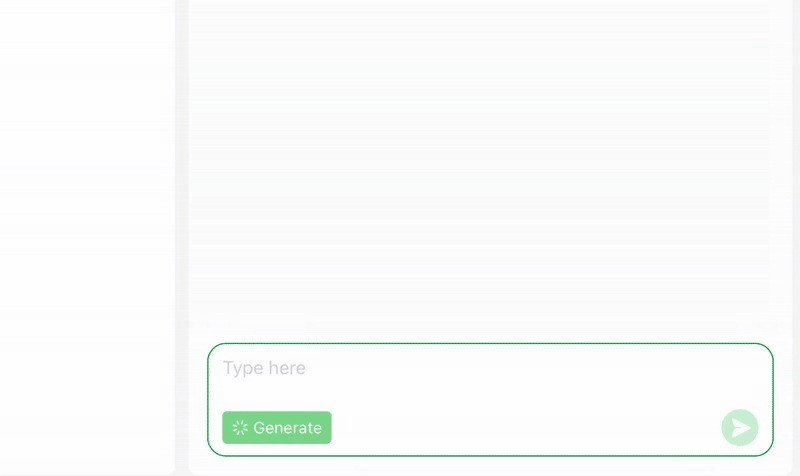
Because of this, Dealism Live Chat can do more than answer. It works as an AI sales agent at the entry point of the conversation—helping capture the inquiry, clarify the visitor’s need, and route them into the right next step, whether that is support, consultation, booking, or follow-up.
Where Dealism Live Chat Fits Best
Dealism Live Chat works especially well in service businesses where support and conversion often happen in the same conversation, such as:
clinics
therapy or counseling practices
beauty services
education consulting
other high-explanation businesses
Its advantage is that it does not stop at the website chat window. It can guide visitors into connected WhatsApp or Instagram conversations, where follow-up can continue more naturally. This makes it useful for businesses that want Auto reply for first-touch questions, AI Support for repeated service inquiries, and a more flexible service such as Online Booking System when the conversation turns into real booking intent.
When connected to Dealism’s wider workflow, Live Chat becomes more than a contact button. It helps businesses capture website inquiries, route them based on intent, continue conversations in WhatsApp or Instagram, and keep human takeover available for more sensitive or complex cases. In that setup, Live Chat can support everything from early Auto Reply and AI Support to qualification and booking-related follow-up, making it a more practical entry point for service, consultation, and action.
How to Set Up Dealism Live Chat Effectively
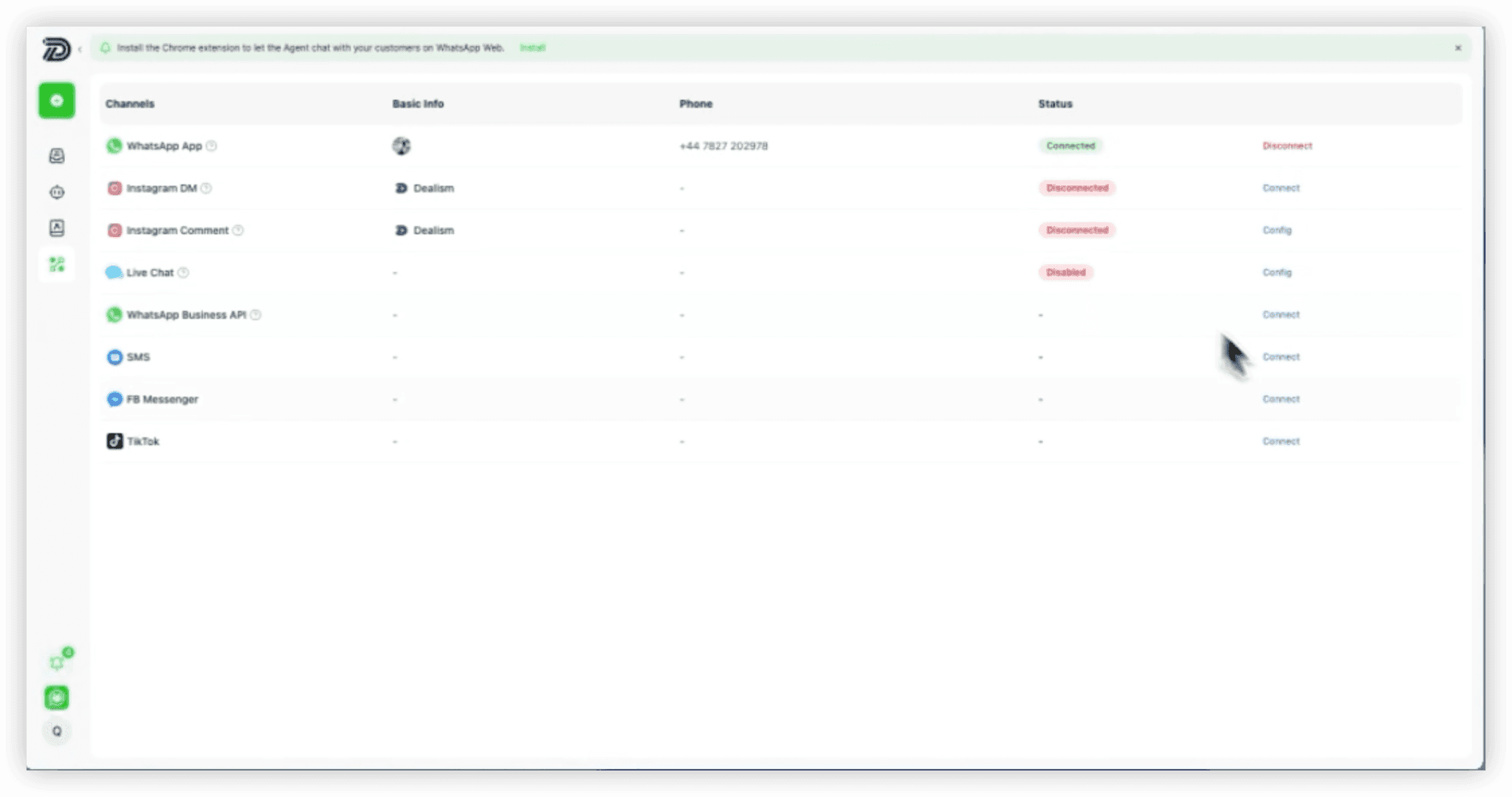
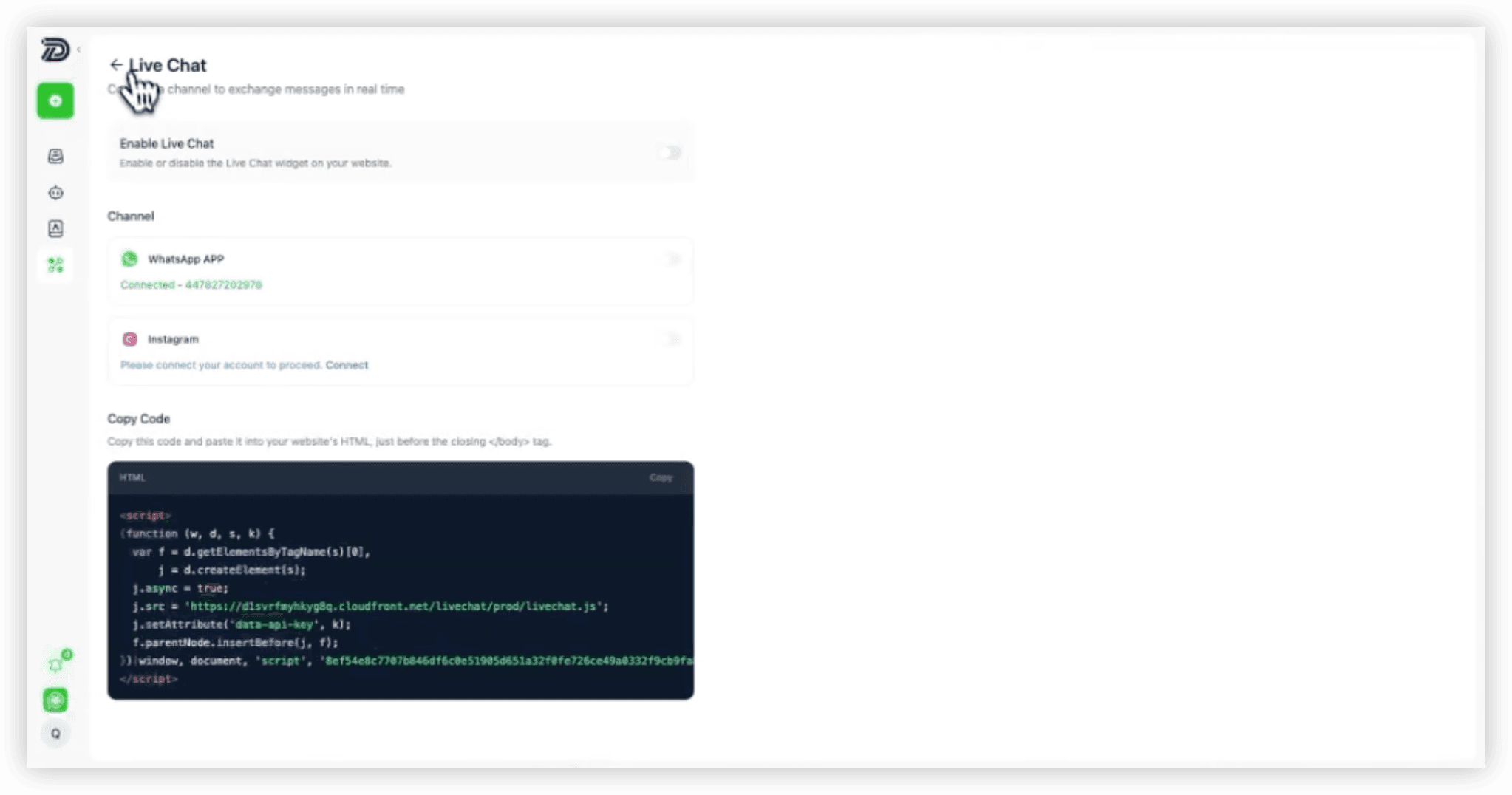
To use Dealism Live Chat well, setup matters. First, it depends on already connected WhatsApp or Instagram channels inside Dealism. Once configured, Dealism provides an embed code or script snippet that can be added to websites such as WordPress, Webflow, or other platforms that support script installation.
Building a More Human Support Workflow with Live Chat and Smart Handoff
Live chat works best when it is not treated as a dead-end website widget, but as the first step in a larger support journey. A stronger workflow captures intent the moment a visitor asks a question, responds quickly, and then guides the conversation into the right next step—whether that means continued messaging, booking, follow-up, or human support.
To make this work, businesses need more than automation rules. They need clear intent categories, clear boundaries for when AI should respond and when humans should step in, and strong context continuity across channels and handoffs. That is what makes automated customer support feel less robotic and more personal: not just faster replies, but a smoother system that reduces friction, protects the human touch in customer service, and helps customers feel understood from the first message to the next action.
Conclusion
In the end, the best way to automate customer support is not to remove people, but to build a system where automation handles speed, routing, and repetitive tasks while human judgment stays involved where it matters most. Strong automated customer support should still feel clear, relevant, and personal. Tools like Dealism make this more practical by helping businesses turn website inquiries into structured, more human support flows instead of isolated chat replies.