


Businesses today are expected to respond faster than ever. Customers visiting a website often want immediate answers before making a purchase, booking a service, or contacting a company. This is why live chat has become one of the most important communication tools for modern businesses.
However, not all live chat tools are equally useful. Many companies end up paying for bloated software filled with unnecessary features while still struggling with slow responses and missed leads.
Understanding which live chat features truly matter can help businesses improve customer experience, increase conversions, and simplify support operations.
Why Live Chat Matters More Than Ever
The importance of live chat on website experiences has grown significantly in recent years. Customers no longer want to wait hours for email replies or spend time navigating complicated phone systems. They expect fast and personalized communication directly from the website.
A well designed live chat system helps businesses:
Respond to leads in real time
Reduce customer frustration
Improve conversion rates
Capture inquiries outside business hours
Support customers across multiple channels
For many service businesses, live chat is now directly connected to sales performance rather than just customer support.
How Does a Live Chat Work?
At its core, live chat connects website visitors with human agents or AI powered assistants through a messaging interface embedded on a website.
A typical workflow looks like this:
A visitor opens the chat widget
The system collects the visitor’s question
The message is routed to a support agent or AI assistant
The conversation continues in real time
The chat may trigger actions like booking calls, qualifying leads, or creating follow ups
Modern chat systems can also integrate with platforms like WhatsApp, Instagram, CRM tools, and scheduling systems.
The best platforms are no longer just answering questions. They actively help businesses move conversations toward outcomes.
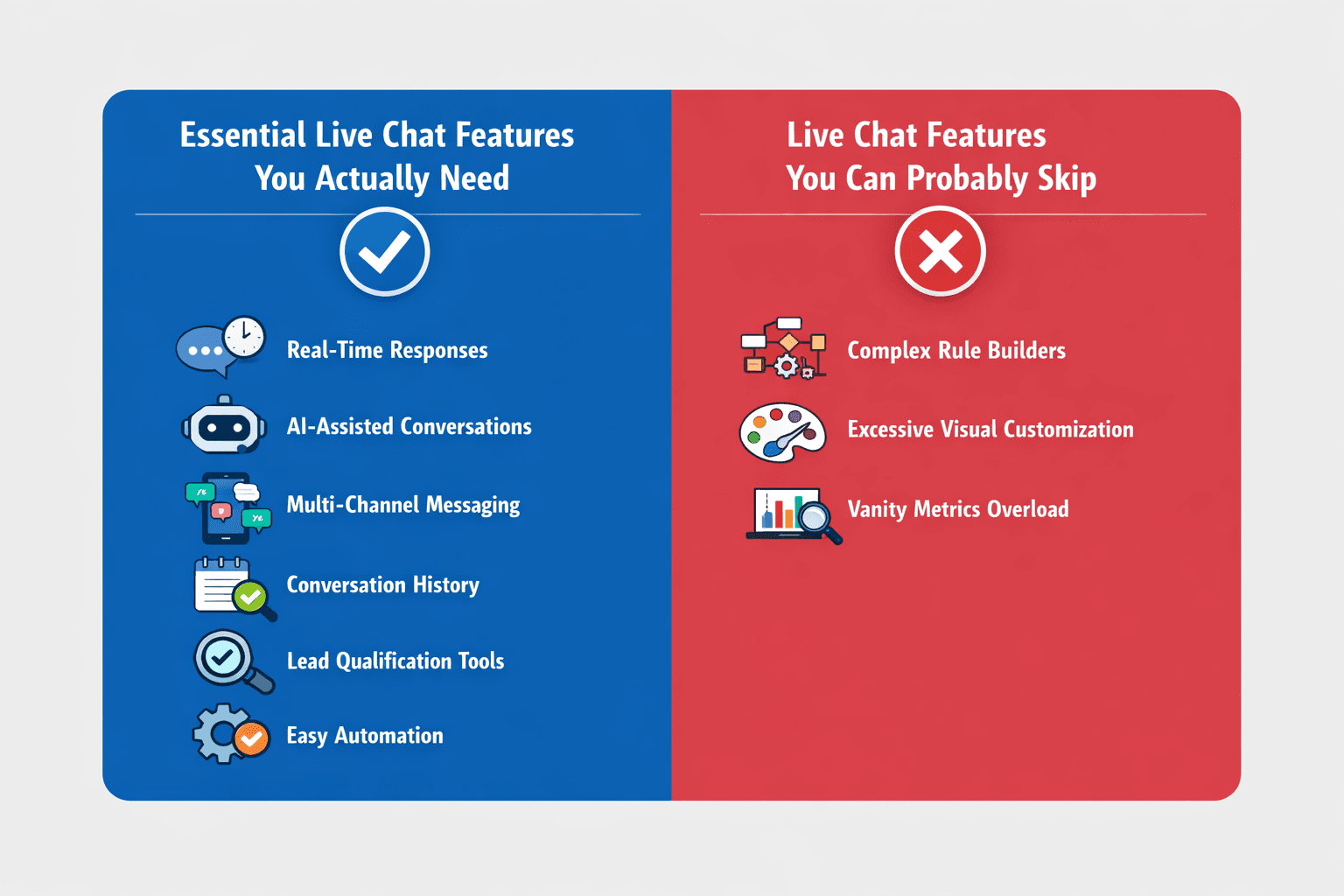
Essential Live Chat Features Businesses Actually Need
1. Real Time Response Capabilities
Speed is the foundation of good live chat.
Customers often leave websites within minutes if they cannot get answers quickly. Real time response tools help businesses engage visitors while they are still interested.
Key capabilities include:
Instant notifications
Mobile agent access
Automated first replies
Queue management
Even simple response automation can significantly improve customer satisfaction.
2. AI Assisted Conversation Handling
AI is now one of the most valuable live chat features available.
Instead of relying entirely on human agents, AI can:
Answer repetitive questions
Qualify leads
Detect buying intent
Recommend next actions
Collect customer information before handoff
This reduces workload while maintaining responsiveness.
Businesses that receive large volumes of inquiries often combine AI with human support teams for better scalability.
3. Multi Channel Messaging
Customers rarely stay on one platform anymore.
A modern live chat feature should support communication across channels such as:
Website chat
WhatsApp
Instagram DMs
Facebook Messenger
SMS
This creates a unified communication workflow instead of forcing teams to switch between multiple inboxes.
4. Conversation History and Context
One of the worst customer experiences is repeating the same information multiple times.
A good chat platform stores conversation history so agents and AI systems can continue conversations with full context.
This becomes especially important for:
Sales consultations
Healthcare communication
Service businesses
Appointment based companies
Persistent context improves personalization and efficiency.
5. Lead Qualification Tools
Not every visitor is ready to buy immediately.
Strong chat tool features help businesses identify high intent leads through automated qualification questions and behavioral analysis.
For example, the system might detect:
Pricing related questions
Repeat visits
Service specific interest
Urgent support needs
This helps teams prioritize valuable conversations instead of treating every inquiry equally.
6. Automation Without Complex Setup
Many businesses avoid automation because traditional systems feel difficult to configure.
Modern platforms are simplifying this process through conversational AI interfaces instead of complicated workflows.
This is especially important for small businesses and non technical teams that need fast deployment without dedicated operations staff.
Live Chat Features You Can Probably Skip
Not every feature improves performance. Some tools include unnecessary functionality that adds complexity without improving results.
Overly Complicated Rule Builders
Large workflow builders often require constant maintenance and technical expertise.
Many businesses end up abandoning these systems because updating them becomes too time consuming.
Excessive Visual Customization
Custom colors and animations may look impressive initially, but they rarely improve conversions.
Speed, responsiveness, and clarity matter far more than advanced visual effects.
Vanity Analytics
Some platforms overwhelm teams with dashboards filled with metrics that do not affect actual business outcomes.
Instead of tracking dozens of numbers, businesses should focus on:
Response speed
Qualified leads
Conversion rates
Customer satisfaction
Follow up completion
Why Businesses Are Combining AI with Live Chat Outsourcing
As customer expectations continue rising, many businesses are realizing that maintaining 24 hour responsiveness internally is difficult.
This is why many companies are exploring live chat outsourcing strategies combined with AI powered systems.
Rather than hiring large support teams, businesses can use AI to handle repetitive conversations while human operators focus on complex situations and closing opportunities.
This hybrid approach improves scalability without dramatically increasing operational costs.
How Dealism Fits the Modern Live Chat Workflow
Dealism positions itself differently from traditional chat software. Instead of acting like a simple support widget, it focuses on turning conversations into actionable sales workflows.
The platform is built around the idea that messaging conversations should drive business outcomes, not just answer questions.
Key advantages include:
AI driven lead qualification
Cross platform messaging support
Intelligent follow up recommendations
Simplified automation workflows
Conversation based sales management
AI assisted customer engagement
Unlike many traditional systems, Dealism reduces the need for complex workflow configuration. Businesses interact with AI agents conversationally rather than building rigid rule based automations.
How Dealism's built-in "ChatGPT for sales" Expands the Experience
Dealism's built-in "ChatGPT for sales" functions as a built-in sales AI assistant within the Dealism ecosystem.
Instead of managing one chatbot at a time, Dealism's built-in "ChatGPT for sales" helps businesses coordinate multiple AI sales agents across platforms like WhatsApp and Instagram.
This is particularly useful for businesses handling:
High inquiry volumes
Social media leads
Multi step sales conversations
Follow up heavy workflows
Dealism's built-in "ChatGPT for sales" also lowers the barrier for non technical business owners by simplifying agent management through natural language interaction instead of complicated backend systems.
Dealism vs Traditional Live Chat Platforms
Feature | Traditional Live Chat Tools | Dealism + Dealism's built-in "ChatGPT for sales" |
Real time chat | Yes | Yes |
AI lead qualification | Limited | Advanced |
Multi channel messaging | Sometimes fragmented | Unified workflow |
Automation setup | Complex rule builders | Conversational management |
Sales focused workflows | Often missing | Core functionality |
AI follow up suggestions | Rare | Built in |
Instagram and WhatsApp integration | Partial | Strong support |
Human and AI collaboration | Basic | Designed hybrid workflow |
Ease of use for non technical teams | Moderate to difficult | Simplified |
Choosing Live Chat Features That Actually Drive Results
The best live chat systems are not the ones with the longest feature lists. They are the ones that help businesses respond faster, qualify leads better, and move conversations toward action.
Companies should prioritize platforms that combine:
AI assisted communication
Multi channel support
Sales workflow integration
Simplicity
Scalable automation
As customer communication continues shifting toward messaging based interactions, businesses that treat live chat as a revenue generating workflow rather than a support add on will have a significant advantage.