Published

If you're searching for sales techniques for beginners, you probably don’t want to become a “salesperson.”
You just want customers to stop disappearing.
Your WhatsApp is buzzing while you're treating patients, running appointments, packing orders, or talking to another client. Someone comments under your Instagram Reel asking for pricing. A new lead lands on your website live chat. You see the notifications hours later — and by then, the conversation is already dead.
This is what selling looks like for most small businesses now.
Not cold calls.
Not complicated funnels.
Not giant CRM dashboards.
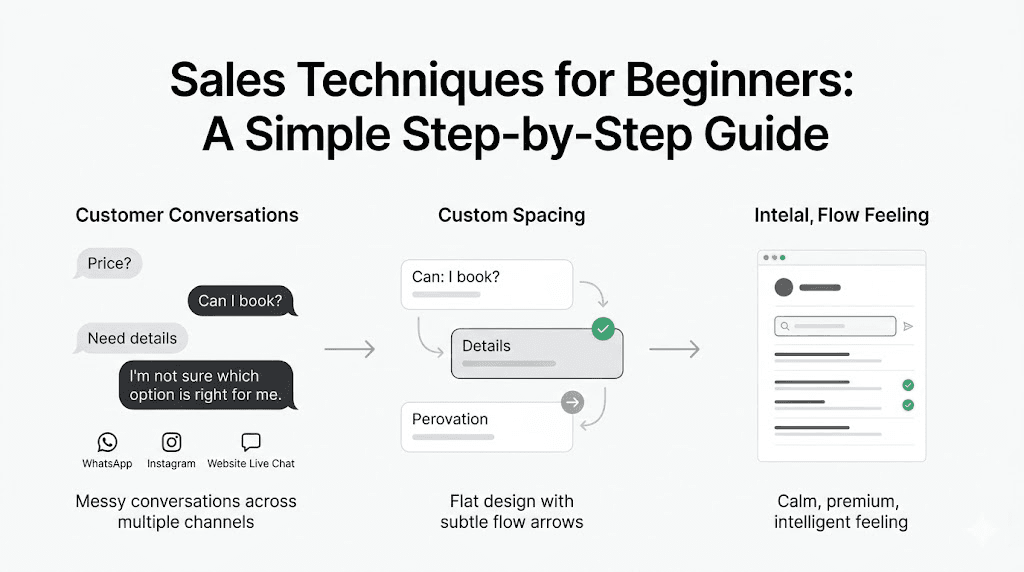
Just hundreds of small conversations happening across WhatsApp, Instagram, and website chat windows.
And most beginners are not failing because they don’t know “sales psychology.”
They’re failing because nobody is consistently handling the conversation.
The Real Beginner Sales Problem
Most sales tips for beginners focus on persuasion:
objection handling
closing techniques
negotiation frameworks
sales scripts
But small businesses rarely lose customers because they failed a closing line.
They lose customers because:
replies come too late
inquiries get ignored
nobody follows up
customers feel misunderstood
staff answer questions without guiding decisions
Especially in service businesses, customers are rarely looking for “information.”
They are looking for confidence.
A patient messaging a clinic is not simply asking:
“Do you have availability?”
They may actually mean:
“Am I choosing the right treatment?”
“Can somebody understand my situation?”
“Is this worth the money?”
“Can I trust this business?”
That’s why modern selling is shifting away from scripts and toward conversation quality.
The businesses winning today are not necessarily the ones with the best salespeople.
They are the ones that handle conversations better.
Sales Starts the Moment Someone Sends a Message
Most businesses still think chat is “customer support.”
But chat is now the front line of sales.
The moment someone:
sends a WhatsApp message
replies to an Instagram Story
comments on a Reel
opens your website live chat
they are already inside your sales process.
The problem is that most small business owners are trying to manage all of this manually while also running the business itself.
So conversations pile up.
Leads go cold.
Revenue quietly leaks in the background.
This is where businesses begin looking for a real system.
It’s not just about setting up automated replies to clear notifications; it’s about having a teammate who can reply to inquiries with actual judgment.
Because when you stop leaving people on read, you naturally acquire customers and increase sales without changing your lifestyle.
That’s the shift most beginner sales advice completely misses.
Beginners Don’t Need More “Automation”
Most tools promise automation.
But small businesses usually don’t need another robotic workflow.
They need someone — or something — capable of understanding what the customer actually wants.
Traditional chatbots were designed to answer questions.
Real conversations don’t work like that.
Customers hesitate.
They change direction.
They ask vague questions.
They explain emotions instead of clear requests.
A lead says:
“I’m not sure which option is right for me.”
A traditional bot replies:
“Choose Package A or Package B.”
That’s not selling.
That’s menu navigation.
Good sales conversations require judgment.
The best salespeople do not instantly push customers toward checkout or booking links. They first clarify intent, reduce uncertainty, and guide the next step naturally.
That is why the future of beginner-friendly selling is shifting toward AI sales teammates instead of rigid automation systems.
Vibe Selling: Why Good Conversations Convert Better
Most beginners think sales is about saying the perfect thing.
In reality, sales is usually about understanding the right moment.
This is where Vibe Selling changes the game.
Instead of forcing scripts, good conversational selling focuses on:
emotional context
customer hesitation
intent clarification
natural guidance
trust before pressure
For example, a clinic should not instantly throw a booking calendar at every lead.
A smarter conversation looks like this:
understand the patient concern
identify urgency
clarify budget or limitations
match the correct service
then guide the booking
The conversation itself becomes pre-qualification.
Instead of:
“Reply → schedule”
the flow becomes:
“Understand → clarify → qualify → guide → convert”
Traditional bots look at your calendar and ask:
“When do you want to book?”
A Dealism Agent looks at the business goal and asks:
“What do you actually need?”
That’s the difference.
It’s not a scheduling tool performing admin work.
It’s an AI sales teammate performing pre-qualification so businesses stop wasting time on the wrong leads.
How AI Sales Teammates Help Beginners Increase Sales
Many business owners think they need to become better at selling.
But most of the time, they simply need help handling conversations consistently.
That’s where Dealism works differently from traditional chat tools or heavy CRM systems.
Instead of acting like a chatbot waiting for commands, Dealism behaves more like an AI colleague inside your messaging channels.
It helps businesses:
reply to inquiries instantly
continue conversations naturally
identify high-intent leads
qualify customers before booking
guide people toward action
The important difference is this:
Dealism is not trying to “reply faster.”
It is trying to move the business process forward.
That distinction matters enormously for clinics, consultants, beauty businesses, coaches, local ecommerce sellers, and other SMBs operating through messaging platforms.
Turning Instagram Comments Into Customer Conversations
Most businesses still treat Instagram comments as engagement metrics.
But comments are often buying signals.
Someone comments:
“Price?”
“How do I order?”
“Can I book?”
“Need details.”
That is not passive engagement.
That is customer intent happening in public.
With Dealism, you’re not setting up a rigid workflow or another automated DM blast.
You’re deploying an AI sales teammate that monitors conversations continuously.
The moment someone comments under a Reel or post, the Agent can step in immediately:
start the DM conversation
send clickable call-to-action links
answer follow-up questions
qualify the customer
guide the next action naturally
Instead of:
Content → silence
the flow becomes:
Content → conversation → qualification → action
For beginners trying to acquire customers consistently, this changes social media from “marketing activity” into an actual sales channel.
Website Live Chat Should Feel Like a Real Conversation
Most website live chats still behave like dead support boxes.
A visitor types a message.
Nobody replies.
The tab gets closed forever.
Modern conversational selling works differently.
Instead of forcing people into cold forms or support tickets, businesses can place live chat directly on their website and connect visitors instantly to WhatsApp or Instagram conversations.
That matters because customers already live inside messaging apps.
And when conversations continue naturally inside familiar channels, businesses get:
faster replies
higher trust
more qualified leads
better conversion rates
More importantly, anonymous traffic becomes an actual relationship.
Data Integrity vs. Business Action
Most sales advice tells beginners to set up a heavy CRM system as early as possible.
But for many growing businesses, a CRM becomes more burden than efficiency.
Having perfect dashboards and neatly organized records does not mean your business is moving.
A CRM records what happened in the past.
An AI sales agent takes action in the present.
That is the difference between documenting conversations and actually moving deals forward.
Final Thoughts
The best sales techniques for beginners are no longer about memorizing scripts or learning aggressive persuasion tactics.
They are about building a system that can:
reply before leads disappear
clarify customer intent
perform pre-qualification
guide decisions naturally
follow up consistently
turn conversations into business actions
Today, conversations are no longer just “customer support.”
They are the business process itself.
That is why more SMBs are moving away from rigid chatbots and overloaded CRM workflows toward AI sales teammates that can actually handle the front line of customer interaction.
Platforms like Dealism are built around this exact shift:
Not bots.
Not dashboards.
Not “automation for automation’s sake.”
Just AI agents that understand context, make business judgments, and turn messy conversations into real customer actions.