Published
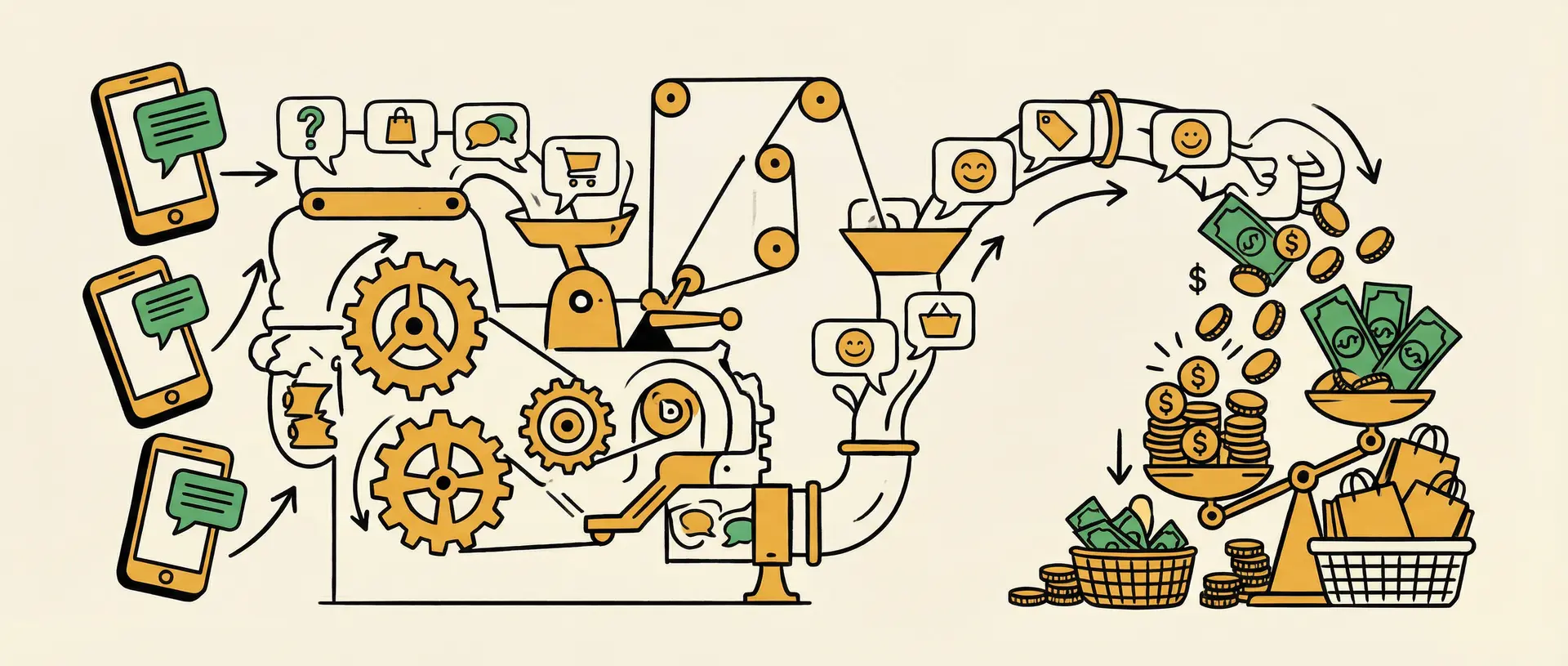
For millions of businesses, WhatsApp has evolved far beyond a messaging app. Today, it serves as a primary channel for customer communication, lead generation, sales, and customer support. Whether someone is asking about a product, booking an appointment, or requesting after-sales assistance, customers increasingly expect fast and personalized responses through messaging apps.
Meeting those expectations manually becomes difficult as conversations grow. Sales and support teams spend hours answering repetitive questions, qualifying leads, and following up with prospects. While these tasks are essential, they can quickly become overwhelming as a business scales.
This is where WhatsApp marketing automation makes a significant difference.
Instead of simply sending automated replies, modern WhatsApp automation helps businesses engage customers at the right moment, qualify leads, deliver personalized recommendations, and guide conversations toward meaningful outcomes. Combined with artificial intelligence, automation can understand customer intent, recommend the next best action, and even support sales decisions in real time.
In this guide, you'll learn what WhatsApp marketing automation is, how it works, its biggest benefits, common use cases, and how to choose the right solution for your business.
What Is WhatsApp Marketing Automation?
WhatsApp marketing automation is the use of software, workflows, and AI technologies to automate customer interactions on WhatsApp. Rather than relying on employees to respond to every message manually, businesses can automate repetitive communication while maintaining a personalized customer experience.
A modern automation platform can help businesses:
Respond instantly to customer inquiries
Qualify leads automatically
Answer frequently asked questions
Schedule appointments
Send order confirmations and delivery updates
Recommend products based on customer interests
Follow up with prospects who haven't completed a purchase
Route conversations to the appropriate sales or support representative
Unlike traditional rule-based chatbots that rely on predefined keywords, today's AI-powered automation platforms understand conversational context. They recognize customer intent, ask follow-up questions naturally, and adapt their responses based on the flow of the conversation.
The result is a smoother customer experience that feels more like talking to a knowledgeable sales representative than interacting with a scripted bot.
Benefits of WhatsApp Marketing Automation
Businesses across industries are adopting WhatsApp marketing automation because it helps them respond faster, improve customer experiences, and scale conversations without significantly increasing operational costs. As customer expectations continue to rise, automation has become a competitive advantage rather than simply a productivity tool.
Higher Customer Engagement
WhatsApp has become one of the world's most widely used messaging platforms, with more than 2 billion monthly active users. Unlike email, which often suffers from low open rates, WhatsApp messages are typically opened within minutes. Industry reports frequently estimate open rates of 90% or higher, making WhatsApp one of the most effective channels for customer communication.
Because conversations take place in a familiar messaging environment, customers are generally more willing to respond, ask questions, and continue interacting with businesses.
Faster Response Times
Modern consumers expect immediate answers when they contact a business. Delayed responses can easily lead to lost opportunities, especially in competitive industries.
WhatsApp marketing automation allows businesses to reply instantly, even outside business hours. Whether a customer is requesting pricing information, checking product availability, or booking an appointment, automation ensures that no inquiry goes unanswered.
Better Lead Qualification
Sales representatives often spend valuable time asking the same introductory questions.
Automation can qualify leads automatically by collecting information such as customer needs, budget, preferred products, location, and purchase timeline before a salesperson joins the conversation.
For example, a dental clinic can automatically ask patients which treatment they are interested in, whether they are new patients, and their preferred appointment dates. By the time staff members take over, they already have the information needed to provide personalized recommendations.
Consistent Customer Experiences
Customers expect consistent service regardless of when they reach out. Automation ensures that every customer receives accurate information, standardized responses, and timely follow-ups.
This consistency improves customer satisfaction while reducing human error.
Lower Operating Costs
As message volumes grow, hiring additional customer service agents becomes increasingly expensive.
Automation handles repetitive conversations such as FAQs, appointment confirmations, order updates, and lead qualification, allowing existing teams to focus on higher-value tasks without sacrificing service quality.
Personalized Conversations at Scale
One of the biggest advantages of AI-powered WhatsApp marketing automation is its ability to personalize conversations for thousands of customers simultaneously.
Instead of sending identical responses to every user, modern AI systems understand customer intent, remember previous interactions, and recommend relevant products or services based on each customer's unique needs.
This level of personalization helps businesses build stronger relationships while increasing conversion rates.
How Does WhatsApp Marketing Automation Work?
Although every platform works differently, most WhatsApp automation solutions follow a similar process.
Step 1: A Customer Starts the Conversation
Many businesses create these entry points using a WhatsApp Link Generator, allowing customers to start a conversation with a single click instead of manually saving a phone number.
A customer may initiate a conversation by:
Clicking a WhatsApp link
Scanning a QR code
Visiting your website
Responding to an advertisement
Contacting your business directly through WhatsApp
This creates a natural entry point into an automated conversation.
Step 2: Automation Identifies Customer Intent
Instead of simply recognizing keywords, modern AI systems analyze the customer's message to understand what they actually want.
For example, the system may determine whether the customer wants to:
Learn about a product
Request pricing
Book a consultation
Receive technical support
Track an order
Understanding intent allows automation to provide more relevant responses.
Step 3: Personalized Conversations Begin
Based on the customer's goal, automation asks follow-up questions and collects useful information.
For example, a dental clinic might ask:
Which treatment are you interested in?
Have you visited us before?
Which location is most convenient?
What dates work best for you?
Each answer helps the conversation move naturally toward the next step.
Step 4: AI Recommends the Next Best Action
Rather than ending with an answer, advanced automation guides customers toward a decision.
Depending on the situation, it may:
Recommend a product
Schedule an appointment
Offer a limited-time promotion
Connect the customer with a sales representative
Generate a quotation
Share payment instructions
The objective is not simply to answer questions but to help customers complete meaningful actions.
Common Use Cases of WhatsApp Marketing Automation
Businesses across industries are using WhatsApp marketing automation to improve efficiency while creating better customer experiences. Although the workflows vary by industry, the goal is the same: respond faster, reduce manual work, and guide customers toward taking action.
Lead Qualification
Sales teams often spend a significant amount of time asking the same introductory questions before understanding whether a prospect is a good fit.
With WhatsApp marketing automation, businesses can automatically collect information such as customer needs, budget, preferred products, location, and purchase timeline before handing the conversation to a sales representative.
For example, a real estate agency can ask buyers about their preferred neighborhood, budget range, property type, and desired move-in date. By the time an agent joins the conversation, they already have the information needed to recommend suitable listings.
Customer Support
Many customer inquiries are repetitive, including questions about business hours, shipping, pricing, return policies, or product availability.
Automation can answer these frequently asked questions instantly while allowing human agents to focus on more complex customer issues. This improves response speed and reduces support workloads.
Appointment Scheduling
Businesses such as dental clinics, beauty salons, fitness studios, and consulting firms often rely on appointments.
Instead of requiring customers to call during business hours, WhatsApp automation can guide them through the booking process, confirm appointments, send reminders, and handle rescheduling requests automatically.
This helps reduce missed appointments while improving the overall customer experience.
Order Updates
Customers frequently ask where their orders are or when they will arrive.
Automation can proactively send order confirmations, shipping notifications, delivery updates, and tracking information, reducing the need for customers to contact support.
Personalized Product Recommendations
Modern AI-powered automation can recommend products based on customer preferences and previous conversations.
For example, an online beauty retailer can suggest skincare products based on a customer's skin concerns, while a fashion store can recommend matching accessories after a purchase. Personalized recommendations create a more engaging shopping experience and often increase average order value.
WhatsApp Automation vs Traditional CRM Automation
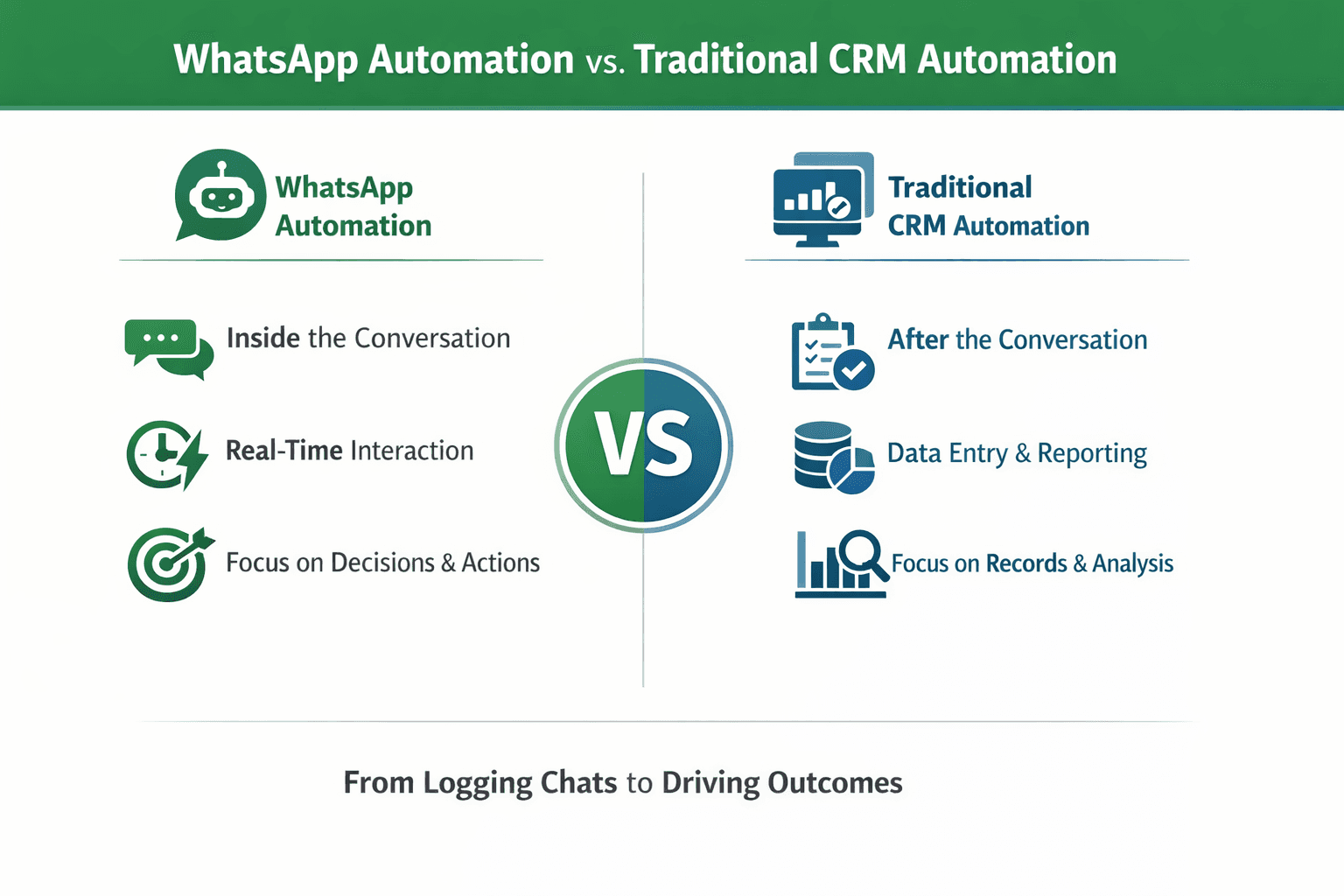
Although both solutions help businesses improve customer relationships, they serve different purposes.
Traditional CRM systems focus on organizing customer information, tracking sales pipelines, and generating reports. They record what has already happened and help businesses manage customer data over time.
WhatsApp marketing automation focuses on what is happening right now. It actively participates in customer conversations, answers questions, qualifies leads, and encourages customers to take the next step.
Think of it this way:
A CRM helps businesses manage customer relationships.
WhatsApp marketing automation helps businesses build those relationships through real-time conversations.
The greatest results often come from combining both approaches. Automation handles customer interactions while the CRM stores valuable customer information for long-term relationship management.
Best Practices for WhatsApp Marketing Automation
Keep Conversations Natural
Customers prefer conversations that feel genuine rather than scripted.
Avoid sending long blocks of promotional text. Instead, use concise, conversational language and ask relevant follow-up questions that keep the interaction flowing naturally.
Personalize Every Interaction
Whenever possible, personalize messages using customer names, purchase history, browsing behavior, or previous conversations.
Relevant recommendations feel helpful rather than promotional and encourage higher engagement.
Respect Customer Consent
Always obtain customer permission before sending promotional messages and follow WhatsApp Business Platform policies.
Sending unsolicited messages can damage customer trust and negatively affect campaign performance.
Know When to Involve Human Agents
Automation should improve conversations, not replace human expertise.
Complex support requests, sensitive situations, or high-value sales opportunities should be transferred smoothly to experienced team members.
Measure Performance
Track key performance indicators such as:
Response time
Lead qualification rate
Conversation completion rate
Appointment booking rate
Conversion rate
Customer satisfaction
Reviewing these metrics regularly helps identify opportunities for optimization.
Common Mistakes Businesses Make
Many businesses invest in automation but fail to achieve the expected results because they focus only on technology rather than customer experience.
Some of the most common mistakes include:
Using Rule-Based Chatbots for Every Situation
Traditional chatbots can answer simple questions but often struggle when customers ask unexpected or complex questions.
Modern AI-powered automation provides more flexible and natural conversations.
Sending Too Many Promotional Messages
Customers appreciate helpful conversations, not constant advertising.
Focus on delivering value before promoting products or services.
Ignoring Conversation Context
Every customer has different goals.
Automation should recognize previous interactions and continue the conversation naturally instead of restarting from the beginning each time.
Forgetting About Human Support
Customers should always have an easy way to speak with a real person when necessary.
The best automation solutions work alongside human teams rather than replacing them completely.
Choosing the Right WhatsApp Marketing Automation Platform
Not all automation platforms offer the same capabilities. When evaluating a solution, look beyond basic automation and consider whether the platform can support your business as customer conversations become more complex.
Key features to look for include:
AI-powered conversations instead of simple keyword-based replies
Easy integration with your CRM and existing business tools
Multi-user collaboration for sales and support teams
Analytics and performance reporting
Knowledge base integration for accurate responses
Personalized workflows based on customer behavior
Scalability as your business grows
Compliance with WhatsApp Business Platform policies
The best platforms do more than automate replies. They understand customer intent, adapt conversations in real time, and help guide customers toward meaningful actions such as scheduling appointments, requesting quotations, or completing purchases.
For businesses that are new to conversational automation or need additional implementation support, partnering with a live chat agency can help accelerate deployment, optimize customer journeys, and integrate AI into existing sales and support workflows. Combining the right technology with expert guidance often leads to faster adoption and better long-term results.
How Dealism Redefines WhatsApp Marketing Automation
Many WhatsApp automation tools are designed to automate repetitive tasks. They can send predefined replies, trigger workflows, or route conversations based on simple rules. While these features improve efficiency, they often struggle when conversations become more complex or require judgment.
Dealism takes a different approach.
Instead of functioning as a traditional chatbot or CRM, Dealism is an AI Vibe-Selling Agent platform built around the idea of conversation to execution. Rather than simply responding to messages, it understands customer intent, identifies buying signals, asks clarifying questions, and helps move conversations toward meaningful business outcomes.
At the center of this experience is DealOnca, Dealism's AI Sales Director. Designed for businesses that rely on WhatsApp, Instagram, and other messaging channels to generate leads, DealOnca goes beyond answering questions. It analyzes conversations, understands customer intent, recommends the next best action, and helps sales teams close more deals with less manual effort.
Unlike traditional automation tools that rely on rigid workflows, DealOnca continuously learns from business knowledge and customer interactions. It can automatically qualify leads, recommend products or services, generate personalized responses, and escalate complex conversations to human agents when needed. This allows businesses to provide faster, more consistent, and more personalized customer experiences across every stage of the sales journey.
DealOnca also includes practical features that help businesses scale their sales operations, including Agent Manager for managing AI agents, Instant Knowledge Integration for quickly connecting business knowledge, Smart Reporting & Initiative for actionable conversation insights, and Multichannel Funnel support that keeps customer interactions consistent across WhatsApp, Instagram, and other messaging platforms.
For example, instead of replying with a generic product list, DealOnca can identify what a customer is actually looking for, ask follow-up questions, address concerns, and guide the conversation toward booking a consultation or completing a purchase. The result is a more natural conversation that feels less like interacting with a chatbot and more like speaking with an experienced sales representative.
As customer expectations continue to rise, businesses need more than automated replies. They need automation that understands context, supports decision-making, and drives measurable business outcomes. By combining AI with real-time messaging, Dealism helps businesses turn everyday conversations into qualified leads, shorter sales cycles, and higher conversion rates—all without sacrificing the personal experience customers expect.
Businesses that want to explore Dealism's plans can visit the pricing page to compare available options and choose the solution that best fits their needs.
Frequently Asked Questions
What is WhatsApp marketing automation?
WhatsApp marketing automation uses software and AI to automate customer conversations, lead qualification, follow-ups, and other communication tasks on WhatsApp while maintaining a personalized experience.
Is WhatsApp marketing automation suitable for small businesses?
Yes. Small businesses can use automation to respond to customers faster, reduce repetitive work, schedule appointments, and generate more qualified leads without expanding their teams.
What's the difference between WhatsApp automation and a chatbot?
Traditional chatbots typically follow predefined rules and keywords. Modern WhatsApp marketing automation uses AI to understand customer intent, adapt conversations, and recommend the next best action.
Do I need the WhatsApp Business API?
It depends on your business size and automation needs. Businesses handling large conversation volumes or integrating with CRM systems often benefit from the WhatsApp Business Platform, while smaller businesses may start with simpler automation tools.
Can WhatsApp marketing automation increase sales?
Yes. By responding instantly, qualifying leads, providing personalized recommendations, and following up with prospects, automation can shorten the sales cycle and improve conversion rates.
How can AI improve WhatsApp marketing automation?
AI helps businesses understand customer intent, personalize conversations, recommend products or services, identify buying signals, and support better decision-making throughout the customer journey.