
How to Automate Repetitive Customer Service Questions with AI
Every day, small business owners lose hours answering the same repetitive DMs. Questions about pricing, availability, or services may seem simple, but when they arrive continuously across WhatsApp and Instagram, they drain attention and slow response times.
For service-based SMBs — clinics, coaches, wellness centers, and local operators — this creates a quiet but costly problem. Leads cool down while businesses respond manually, and valuable time is spent answering the same questions again and again.
What looks like a communication issue is actually a customer service workflow problem.
Why "Just Reply Faster" Doesn't Work
The most obvious solution is to reply faster. Many businesses attempt to solve the issue by hiring someone to monitor messages, creating FAQ pages, or installing chatbots.
Yet these approaches rarely solve the underlying problem.
Traditional chatbots can handle predictable questions like opening hours or location details, but many businesses are now exploring AI sales agents as alternatives to traditional chatbot automation. The moment a conversation becomes slightly nuanced, the system breaks.
A customer asking about availability might need urgent help. Someone asking about pricing may actually be comparing multiple options before making a decision.
In other words, the problem isn't just answering messages quickly. The real challenge is judgment — understanding what the customer actually needs and deciding what should happen next.
Instead of simply replying, someone must evaluate the message:
Is this urgent?
Does this lead match our services?
Who should handle it?
What should happen next in the conversation?
This decision layer is the step most automation tools skip.
Common Customer Service Questions Businesses Should Automate
Small businesses receive the same customer service questions every day. While simple individually, answering them manually consumes valuable time and slows response speed.
Questions like:
"What are your prices?"
"Do you have availability this week?"
"Which service should I choose?"
"Can I reschedule my appointment?"
These questions may appear straightforward, but the intent behind them often differs.
A pricing question may signal that a customer is comparing services. An availability question might indicate urgency. Someone asking which service to choose may simply need guidance before booking.
Most automation systems treat these inquiries as static questions that require static answers.
Dealism approaches them differently. Instead of replying with scripted responses, the AI agent interprets the intent behind each message and guides the conversation toward a meaningful outcome.
The Fundamental Shift: Conversation as Business Process
Most tools treat customer messages as support tickets.
Dealism treats them as part of the business process.
Each incoming message becomes an opportunity to:
clarify what the customer actually needs
assess urgency and priority
match the inquiry to the right service or person
guide the conversation toward a concrete next step
In this model, the conversation itself becomes the workflow.
It acts as a triage system, a qualification engine, and a booking process — all inside the same thread.
This is the difference between answering messages and moving the business forward.
What AI-Powered Customer Question Automation Looks Like
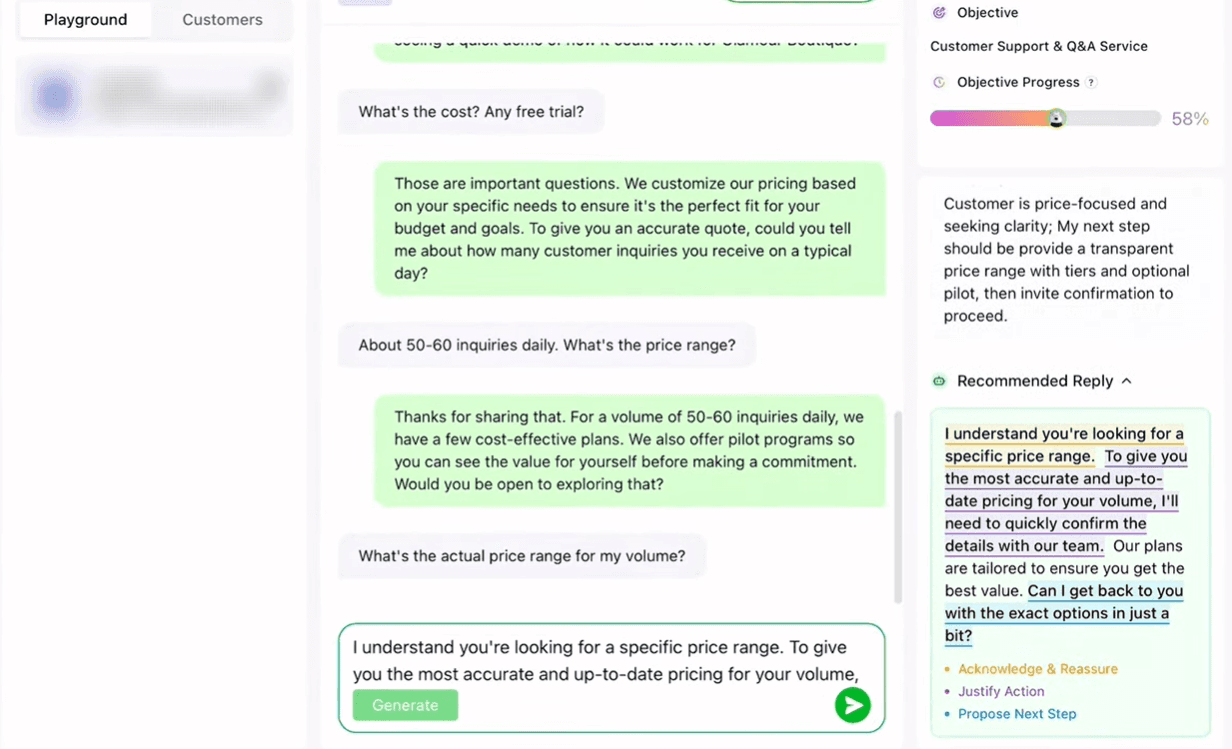
Automating customer service questions with AI isn't simply about faster replies. It's about making better decisions in real time.
Consider a few real-world examples.
Dental Clinic
A clinic may receive several messages within an hour: one asking about braces, another about routine cleaning, and a third reporting a chipped tooth.
Instead of manually reviewing each message, an AI agent analyzes the context. The chipped tooth is flagged as urgent and routed to the earliest appointment slot, while routine inquiries follow the normal scheduling process.
The conversation itself performs the triage.
Online Course Creator
When a coach launches a new course on Instagram, dozens of direct messages often arrive asking about pricing, schedules, or prerequisites — a pattern increasingly handled by AI sales agents inside WhatsApp and social messaging channels.
Rather than manually responding to each inquiry, the AI agent asks a few natural qualifying questions, determines which program fits the student best, and prepares the conversation for conversion.
By the time the coach reviews the message thread, the lead is already qualified and ready to move forward.
Wellness Center
A wellness center offering multiple therapies often struggles to match the right client with the right practitioner.
With AI managing intake conversations, the chat becomes an intelligent triage system. The agent gathers relevant details, checks practitioner availability, and confirms appointments within the same conversation.
What was once a series of manual steps becomes a seamless workflow.
The Step Most Automation Tools Skip: Pre-Judgment
Most automation systems jump directly to execution — a limitation common before the emergence of agentic AI systems.
Book the appointment.
Send the confirmation.
Close the ticket.
But in service businesses, the most valuable step occurs before any of these actions.
Understanding what the customer actually needs.
Consider a message like:
"I have some pain in my jaw."
Automatically sending a booking link may not be the correct response. The better approach is to ask a few clarifying questions:
When did the pain start?
Is it sharp or dull?
Are you experiencing pain right now?
Have you seen a dentist about this before?
Only after gathering this information can the system determine the appropriate next step.
This pre-judgment stage:
reduces mismatched bookings
lowers no-show rates
improves the overall customer experience
separates urgent cases from routine inquiries
We Call This Vibe Selling
At Dealism, we describe this approach as Vibe Selling.
Instead of relying on rigid scripts or rule-based flows, Dealism agents interpret the intent within conversations. They ask clarifying questions naturally, adapt to context, and guide customers toward the next step without sounding automated.
Traditional chatbots process messages mechanically.
Dealism processes intent, context, and conversational momentum.
As a result, interactions feel helpful rather than scripted, and customers move smoothly toward decisions.
This Is Not a CRM (And You Don't Need One Yet)
CRM systems solve a record-keeping problem. They track who you spoke to, what was discussed, and what happened next.
This is valuable for large sales teams that require coordination.
But for a solo consultant or a small clinic, CRM software often introduces additional data entry rather than additional revenue.
Dealism solves a different challenge.
Instead of documenting conversations after they happen, the platform moves conversations forward in real time.
By the time a customer reaches you, the inquiry has already been understood, qualified, and directed toward a clear next step.
There are no half-answered messages, no forgotten follow-ups, and no cold leads buried in an inbox.
Dealism operates at the stage before a CRM becomes necessary.
You Don't Need to Be a Salesperson — Or a Developer
One of the biggest barriers SMB owners face with automation tools is complexity.
Traditional systems require building workflows, defining rules, and scripting possible scenarios.
Dealism takes a different approach.
Using the platform feels less like configuring software and more like onboarding a new team member.
You simply provide:
basic information about your business
the services you offer
the outcomes you want, such as bookings or qualified leads
From there, the AI agent determines how to guide conversations toward those outcomes.
There is no need to design scripts or map decision trees. You describe what success looks like, and the agent executes the process.
When AI Handles the Questions, You Handle the Business
When repetitive customer service questions are automated effectively, several changes happen immediately.
Response times drop to seconds, even outside business hours. Research analyzing more than 1.25 million sales leads found that companies responding within one hour were nearly seven times more likely to have meaningful conversations with potential customers, a widely cited finding from the Harvard Business Review lead response study.
Lead quality also improves. Because every inquiry is qualified before reaching you, the conversations you handle are already warm and ready to close.
Missed opportunities decrease as well. Conversations continue even when you're busy serving another client.
Multilingual communication becomes effortless. The system can detect a customer's language and continue the conversation seamlessly across WhatsApp or other messaging channels.
Most importantly, your time returns to what only you can do — closing deals, delivering services, and growing the business.
For many small service businesses, this shift is more than a productivity improvement.
It is what allows the business to scale beyond the owner's available time.