
Conversational AI for Customer Service: Why SMBs Are Swapping Bots for Execution Agents
Introduction: The Hidden Cost of "Just Replying"
For small and medium-sized businesses (SMBs), the dream of using conversational AI for customer service often turns into a management nightmare. You implement a chatbot to save time, but instead, you spend hours fixing broken workflows or dealing with frustrated customers who feel trapped in a rigid menu.
In 2026, the market has shifted. Business owners in medical clinics, consulting, and private sales no longer need chatbots that simply repeat FAQs. They need conversational AI agents that understand the nuance of a conversation and move the needle toward a business outcome. This is the shift from "Support" to "Execution."
Ever missed a lead because your bot didn’t understand a simple sentence? This is the reality SMBs face daily.
1. Beyond Keywords: The Power of Semantic Understanding
Most tools marketed as the best conversational AI for customer service are still secretly powered by simple keyword triggers rather than real semantic understanding. If a patient types “I need to see a doctor” instead of “Book appointment”, a traditional bot fails.
Semantic vs. Keyword-Based AI
Keyword Bots: Rely on exact matches. They are rigid, easy to break, and feel robotic.
Semantic Agents (Dealism): Use large language models (LLMs) to understand intent, context, and emotion. Whether a customer is anxious, hurried, or curious, the agent detects the "vibe" and adjusts its tone.
For a dental clinic or a therapy practice, this isn’t just a technical detail—it’s the difference between a patient feeling cared for or feeling like a ticket number.
Example:
Customer: “I’m feeling stressed and need a session soon.”
Keyword bot: “Book a session here”
Dealism agent: “I understand. Would you like to speak to a counselor today or tomorrow morning?”
This is Vibe Selling: using natural dialogue to clarify needs before pushing for a sale.
2. Simple Onboarding: Nocode, No Workflow
The best conversational AI for enhancing customer service experience isn’t complicated. SMBs often don’t have the time or expertise for coding or designing complex workflows. Dealism embraces a no-code, no-workflow onboarding approach:
How It Works
Context Injection: Provide your business background and list of services.
Goal Setting: Tell the agent what result you want — more consultations booked, leads qualified, or orders confirmed.
Autonomous Execution: The agent figures out the conversation path. It asks clarifying questions, handles objections, and schedules appointments — without any manual workflow design.
Example for a local beauty salon:
Customer: “Do you have facial treatments this week?”
Dealism agent: “Yes, I see openings on Tuesday at 3 PM and Thursday at 10 AM. Which works best for you?”
This removes friction. SMB owners don’t need to know sales techniques or workflow logic. They just define desired outcomes, and the AI executes.
3. Dealing with the "Messy Middle": Conversation as Action
The biggest pain point for SMBs isn’t “not replying”—it’s the Messy Middle: a customer asks a question, the business responds, and then the conversation goes cold.
Turning Messy Chats into Structured Actions
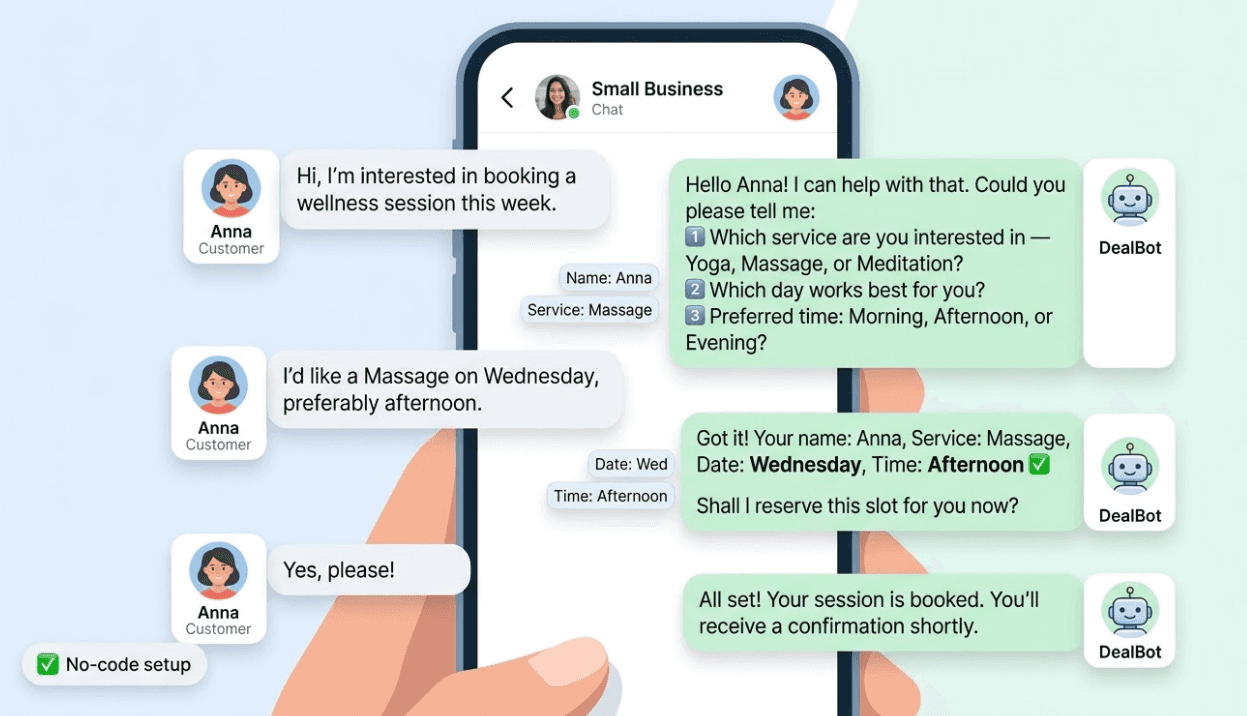
Pre-qualification (Triage): The agent acts as a digital front desk. In a medical setting, it asks the right clarifying questions: general check-up or specialist, urgency, preferred times.
Automatic Follow-ups: Leads that go cold on WhatsApp or Instagram DM are re-engaged naturally, reducing lost opportunities.
Instant Execution: Beyond info-sharing, the agent executes actions. “I can see a slot at 9 AM tomorrow, should I put your name down?”
Industry Example – Online Course Sales:
Customer: “What’s the price for your advanced photography course?”
Dealism agent: “The advanced course is $499. Are you looking to start next month or later?”
This clarifies intent, qualifies the lead, and nudges them toward a decision without human intervention.
4. Why Semantic AI Creates Better Customer Service Experiences
Great customer service isn’t just about replying faster — it’s about understanding what the customer actually needs. This is where semantic conversational AI for customer service creates a better experience.
Traditional bots rely on keyword triggers. If a customer’s message doesn’t match the expected phrase, the system may return irrelevant answers or force the user into rigid menus. The conversation quickly becomes frustrating.
Semantic AI works differently. Instead of scanning for specific words, it interprets the intent and context behind a message. Whether a customer writes “I need to reschedule my appointment” or “Something came up today, can I move my session?”, the agent understands that both mean the same thing.
For customers, the experience feels smoother and more natural. They don’t need to repeat themselves or guess the right keywords. The conversation simply moves forward toward a solution.
For SMBs, this is what truly defines the best conversational AI for enhancing customer service experience: technology that understands people, not just phrases.
5. The Anti-CRM Stance: Why Action Trumps Data Entry
A common mistake when searching for the best conversational AI agents for customer service is looking for deep CRM integration. For most SMBs, a CRM is a data graveyard: information goes in, but no revenue comes out.
Dealism is not a CRM. It is an AI Colleague.
CRM: Focuses on records — who didn’t buy.
Dealism: Focuses on actions — ensures every conversation progresses toward a decision.
IM channels like WhatsApp or Instagram effectively become your system of record and your revenue engine. Many SMBs find that once the agent is running, a full CRM is optional.
6. Industry Use Cases: Conversational AI in the Wild
Medical & Wellness Clinics
Triage layer to pre-qualify patient needs before staff intervention.
Handles scheduling conflicts and follow-ups across multiple practitioners.
Education & Consulting
High-volume DM pipeline managed autonomously.
Only warm leads handed to humans, reducing wasted time.
Local E-commerce & Private Sales
Responds to inquiries instantly, even at 2 AM, in multiple languages.
Converts curiosity into checkout efficiently, boosting sales.
7. Technical Edge Without the "Tech Speak"
While the technology behind Dealism involves multi-session context, semantic analysis, and multilingual support, the experience for SMBs is simple:
Continuous Context: Remembers what the customer said three days ago.
Intent Recognition: Differentiates complaints from queries.
Global Reach: Communicates in the customer’s language while maintaining brand tone.
This keeps operations smooth without requiring technical expertise.
Conclusion: Stop Botting, Start Executing
The era of the “dumb chatbot” is over. SMBs searching for the best conversational AI for customer service should stop looking for tools that just reply. They need agents that decide, clarify, and act.
Dealism turns overwhelming chat windows into a structured, revenue-generating system. Every “Hello” on WhatsApp now has a path to “Thank you for your business.”
No more missed leads. No more endless message juggling. Just results.
It’s time to hire your first AI Agent and turn conversations into action.