

Conversational Marketing for Small Businesses: The Complete Guide in 2026
What Is Conversational Marketing
Conversational marketing is a strategy where businesses interact with customers through real-time conversations instead of traditional lead forms. Using live chat, messaging apps, or conversational AI marketing tools, companies can communicate instantly and respond to customer needs faster.
What is conversational marketing aiming to achieve? The goal is to start a dialogue, understand customer intent, and guide them toward a purchase decision. Instead of waiting for follow-up emails or sales calls, businesses can engage visitors the moment they show interest. Compared with traditional marketing, conversational marketing emphasizes two-way communication and instant engagement.
Compared with traditional marketing, conversational marketing focuses on two-way communication and immediate engagement.
Traditional Marketing | Conversational Marketing |
One-way communication | Two-way conversations |
Lead forms collect contacts | Real-time chat and messaging |
Long sales cycles | Faster decision-making |
Delayed responses | Instant engagement |
For small businesses, this approach reduces friction in the buying journey. Customers receive answers quickly, which helps improve engagement and conversion rates.
To understand why this approach works so well, it helps to look at the basic workflow behind conversational marketing.
How Conversational Marketing Works
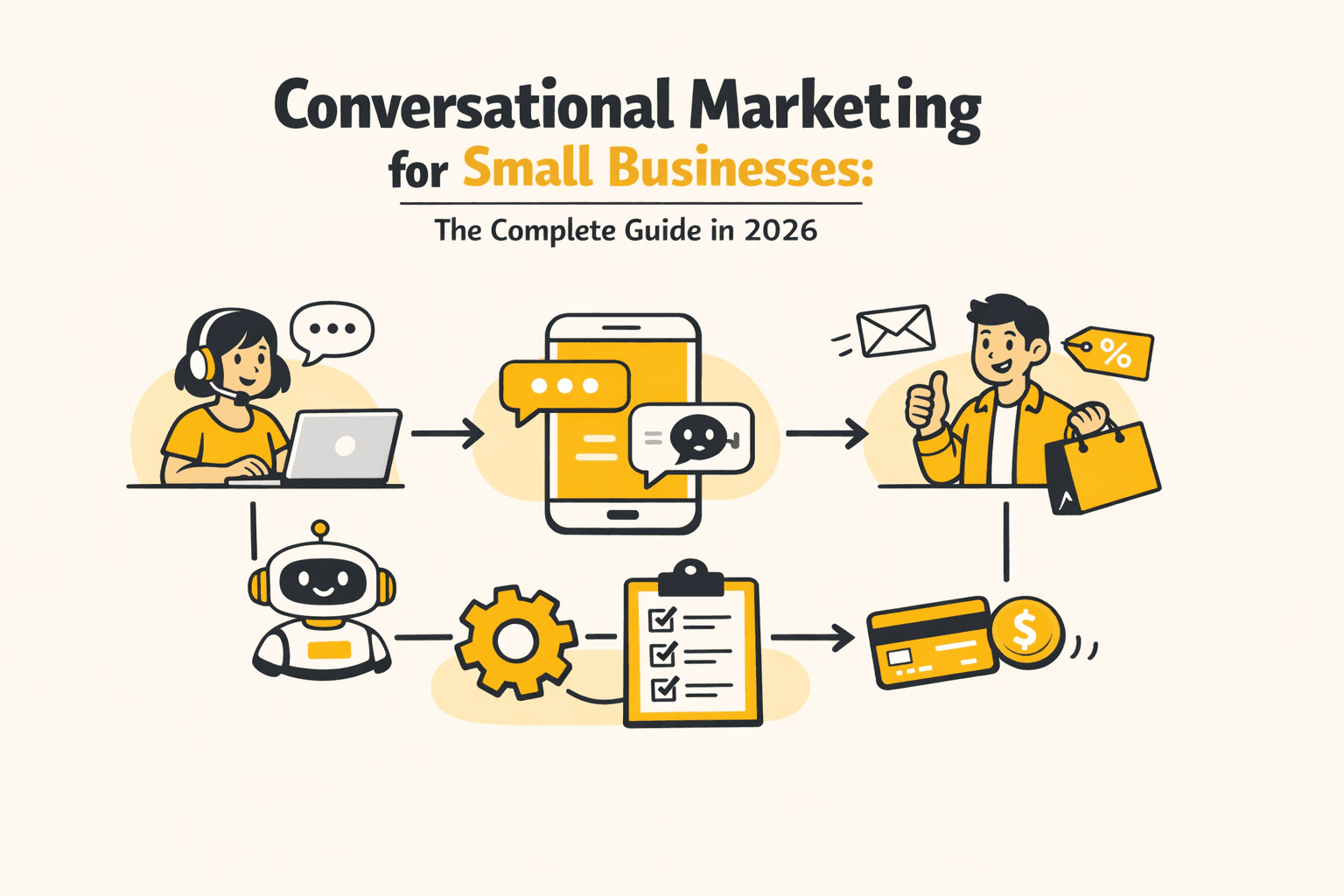
Conversational marketing follows a simple interaction flow that moves customers from interest to action through real-time, two-way communication.
Typical conversational marketing process
A user visits a website, landing page, or advertisement.
A chat widget or messaging prompt appears.
An AI assistant or support agent starts a conversation.
The system asks questions to understand the customer’s needs.
Products or services are recommended based on the conversation.
The customer completes a purchase, booking, or inquiry.
This process changes the traditional marketing funnel into a conversation funnel. Instead of collecting leads first and responding later, businesses guide customers through the decision process in real time.
Why Conversational Marketing Is Important for Small Businesses
Messaging platforms such as WhatsApp, Instagram, and Facebook Messenger have become major communication channels worldwide. Customers increasingly use these apps not only for personal communication but also to ask questions, discover products, and contact businesses.
For small businesses, this shift in customer behavior is especially important because responding quickly to inquiries can directly affect whether a lead converts. Conversational marketing including Instagram automation, enables businesses to engage customers instantly through chat and messaging apps, automate common interactions, and guide them toward the next step without requiring a large support team.
Benefits of Conversational Marketing
Conversational marketing provides several important benefits for small businesses.
Higher Conversion Rates
When customers receive answers immediately, they are more likely to continue the buying process. Real-time conversations reduce uncertainty and help users make decisions faster.
Many businesses report significantly higher conversion rates from messaging conversations compared to traditional website forms.
Channel | Typical Conversion Rate |
Website forms | ~2–3% |
Messaging conversations | ~10–20% |
While results vary by industry, conversational interactions often generate more qualified leads and higher purchase intent.
24/7 Customer Support With Automation
Conversational AI marketing tools allow businesses to provide support even outside working hours.
AI chatbots can automatically:
Answer frequently asked questions
Recommend products or services
Collect customer details
Schedule appointment
This ensures businesses can respond to customers 24 hours a day without increasing staffing costs.
Lower Customer Acquisition Costs
Conversational marketing can also improve advertising efficiency.
When businesses engage customers through chat, they can qualify leads faster and reduce wasted marketing spend. This helps improve overall marketing ROI and customer acquisition efficiency.
Conversational Marketing Channels for Small Businesses
Small businesses can start conversational marketing through several communication channels. The most effective approach is usually to focus on platforms where customers already spend their time and combine multiple channels to create a smoother customer journey.
Messaging Apps
Messaging apps are one of the most important channels for conversational marketing. Since customers already use these platforms daily, conversations feel natural and immediate.
Channel | Typical Use Case |
Customer support and direct sales conversations | |
Instagram DM | Social commerce and product inquiries |
Facebook Messenger | Lead generation and customer engagement |
For small businesses that rely on social media traffic, messaging apps are often the fastest way to start real conversations with potential customers.
Website Live Chat
Website live chat allows businesses to interact with visitors while they are browsing products or services. Instead of leaving the website to ask questions, users can communicate instantly through a chat window.
Live chat is commonly used to:
Answer product or service questions
Collect contact information from potential leads
Guide visitors toward the right product or offer
For small businesses, live chat helps capture customer interest at the exact moment they are considering a purchase.
SMS and Email Messaging
SMS and email can also support conversational marketing, particularly for follow-ups and ongoing communication.
Channel | Advantage |
SMS | High open rates and fast delivery |
Suitable for longer messages and detailed information |
Many businesses use SMS for quick notifications and reminders, while email is better for deeper communication. When combined with messaging apps and live chat, these channels help create a multi-channel conversational marketing strategy that keeps customers engaged throughout their journey.
Conversational Marketing Tools
To manage customer conversations at scale, businesses rely on conversational marketing tools. These platforms help automate responses, organize interactions, and support sales conversations across messaging channels. Most tools fall into three main categories, each designed for different needs.
Chatbot and Flow Automation Tools
Flow-based chatbot tools automate conversations through predefined message sequences. They rely on triggers, keywords, and structured flows to guide users through simple interactions.
Popular tools include ManyChat, BotConversa, and Chatfuel.
Read more: ManyChat Review (2026)
Best ManyChat Alternatives for AI-Powered Sales Automation (2026)
ManyChat Review (2026)
Typical flow:
User message → Keyword detected → Automation triggered → Prewritten message → User selects an option → Next automated step
Key features:
Keyword triggers
Visual flow builders
Button-based responses
Predefined conversation paths
These tools are often used for social media auto-replies, DM automation, marketing campaigns, and creator engagement. However, because conversations follow fixed paths, they can feel mechanical and may struggle with complex questions or real customer intent.
Live Chat and CRM Messaging Tools
Another category focuses on customer support and relationship management by combining live chat with CRM data.
Examples include Intercom, Drift, and HubSpot messaging tools.
Typical workflow:
Customer asks a question → Human agent replies → Conversation stored in CRM → Sales team follows up
Key capabilities include:
Human customer support
CRM integration
Customer data management
Website chat widgets
These tools work well for SaaS companies, B2B sales teams, and businesses with dedicated support staff. However, they rely heavily on human agents, which can make scaling conversations difficult.
AI Conversational Sales Agents
A newer category focuses on AI-driven sales conversations. Instead of only following predefined flows or relying on human agents, these systems use AI to understand intent and guide customers toward decisions.
Platforms such as Dealism represent this newer category by using AI to understand customer intent and support more natural sales conversations.
Typical process:
Customer message → AI identifies intent → Asks clarifying questions → Recommends solutions → Handles objections → Moves toward purchase
Key capabilities include:
Context and intent understanding
Smart responses and recommendations
Conversation-driven sales workflows
Unlike traditional tools that only automate replies, AI conversational agents help businesses turn conversations into real business actions, such as qualifying leads and guiding customers toward a purchase.
How Small Businesses Can Start Conversational Marketing
Small businesses can start conversational marketing without complex funnels or large sales teams by using an AI sales agent to manage customer conversations on messaging platforms like WhatsApp, Instagram, or web chat. Tools like Dealism help turn everyday chats into structured actions such as answering questions, qualifying leads, and guiding customers toward booking or purchasing.
Below is a simple step-by-step approach small businesses can follow.
Step 1: Create Your AI Sales Agent
The first step is setting up an AI agent to handle customer conversations. With platforms like Dealism, businesses can quickly create an AI assistant that responds to inquiries and starts conversations with potential customers.
The agent’s role depends on the business type:
A dental clinic may create an AI appointment assistant
A training center may create an AI enrollment advisor
An online store may create an AI shopping assistant
This AI agent acts as the first responder, engaging customers instantly without requiring a human team to reply to every message.
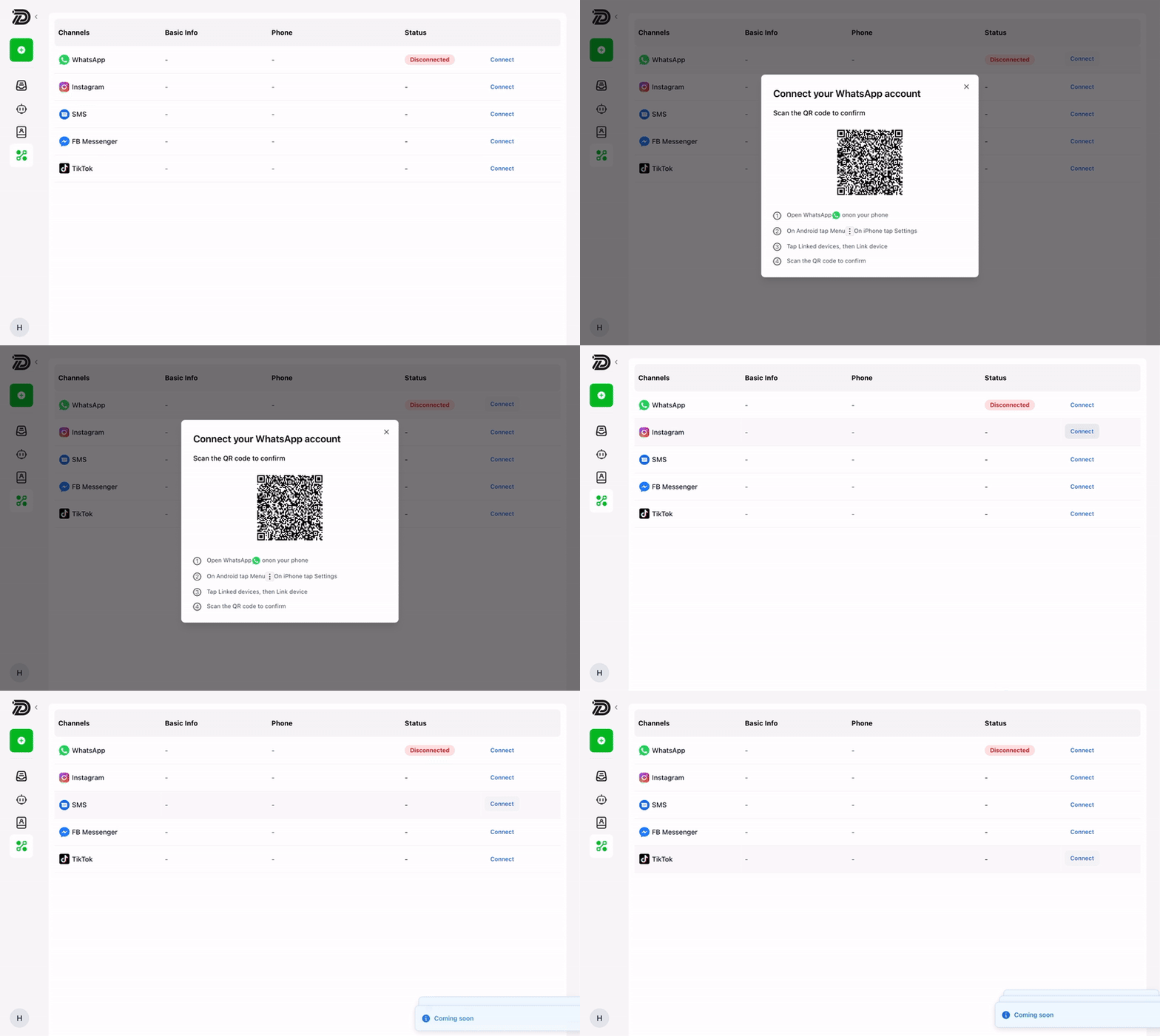
Step 2: Connect Messaging Channels
Next, businesses link the AI agent to their communication channels:
WhatsApp
Instagram Direct Messages
Website live chat
Once connected, the AI can automatically receive messages, respond instantly, and continue conversations even outside business hours, turning messaging apps into automated sales and engagement channels.

Step 3: Add Business Knowledge
Once channels are connected, the AI agent needs information to respond effectively. Businesses typically provide:
Company and service details
Product descriptions
Frequently asked questions
Pricing or scheduling information
This knowledge base allows the AI to answer questions naturally and guide customers toward the next step in the buying process.
Step 4: Test Conversations
Before going live, test the AI agent using a simulation or playground environment to ensure:
It understands common customer questions
Responses are clear and accurate
Conversations guide users toward booking or purchasing
Testing ensures the conversational flow feels natural for real customers.
Step 5: Monitor and Improve Conversations
After conversations begin, businesses can track interactions through a dashboard that shows conversation history and customer progress. Over time, they can refine responses, update knowledge, and improve conversation strategies.
By gradually optimizing these interactions, small businesses can turn everyday customer conversations into a scalable engagement and conversion system.
Check out our full guide to conversational marketing for small businesses.

Conversational Marketing Challenges
While conversational marketing offers many benefits, small businesses should also be aware of several common challenges. With the right strategy and tools, these issues can usually be managed effectively.
Challenge | Solution |
Privacy concerns | Obtain clear user consent and follow data protection rules |
Poor automation experience | Improve chatbot design and use smarter AI tools such as Dealism |
Over-messaging | Control message frequency and avoid spam-like communication |
By addressing these challenges early, businesses can create conversations that feel helpful rather than intrusive.
The Future of Conversational Marketing
Conversational marketing is increasingly evolving toward AI sales agents that can understand customer intent and guide conversations toward real act
ions. Platforms like Dealism help businesses automate sales conversations while keeping interactions natural and personalized.