For many small businesses, Instagram is no longer just a social platform—it’s a sales channel. A large share of customer questions now happens inside DMs, where speed matters. Slow replies often mean missed opportunities.
That’s why people compare chatbot vs live chat or ask questions like do you prefer chatbot or live chat and live chat agents vs chatbots. But the real challenge isn’t choosing one over the other. It’s how to handle conversations at scale without losing the human touch.
What Is Instagram Live Chat?
If you’re wondering about whatsapp live chat, it simply means real people replying to messages in real time. On Instagram, this usually refers to you or your team manually responding to DMs.
Live chat is often used when businesses want to create a more personal and direct connection with customers. Because responses come from humans, conversations feel more natural and flexible.
Advantages of Live Chat
Builds strong trust and credibility with customers
More effective for closing deals, especially high-value ones
Handles emotional or complex conversations better
Limitations of Live Chat
Not scalable, since it depends on time and team size
Cannot operate 24/7 without hiring more staff
Slower response times during busy periods
For small businesses, live chat is most effective in the final stage of a sale, where human interaction can help convert interest into a decision—but it is less efficient for handling large volumes of incoming messages.
What Is an Instagram Chatbot?
To understand bots meaning in chat, a chatbot is a tool that automatically replies to messages based on predefined rules or AI.
On Instagram, chatbots are commonly used to handle incoming DMs without human involvement, especially for repetitive or simple questions.
There are two main types of chatbots:
Rule-based bots: follow fixed scripts or keyword triggers
AI chatbots: more flexible, but still limited in understanding deeper context
Advantages of Chatbots
Provide instant replies to every message
Can handle a large number of conversations at once
Available 24/7 without additional cost
Limitations of Chatbots
Limited understanding of real user intent
Struggle with complex or multi-step conversations
This creates a common gap for many businesses: Most chatbots can reply—but very few can actually move a conversation forward.
Instagram Chatbot vs Live Chat: Key Differences
To better understand chatbot vs live chat, it helps to compare them across the areas that matter most to small businesses—speed, cost, scalability, and conversion ability.
Here’s a simple breakdown:
Feature | Chatbot | Live Chat |
Response speed | Instant | Depends on human |
Scalability | High | Low |
Personalization | Limited | High |
Cost | Low | High |
Conversion ability | Low | High |
Decision-making | ❌ | ✅ |
In simple terms:
Chatbots are fast and scalable, but often limited in depth
Live chat is flexible and persuasive, but difficult to scale
For small businesses, this creates a clear trade-off between efficiency and effectiveness—one that neither solution fully resolves on its own.
Pros and Cons for Small Businesses
When evaluating chatbot vs live chat, small businesses need to look beyond features and focus on real operational impact—time, cost, and ability to convert conversations into sales.
Live Chat Pros & Cons
Pros:
Builds stronger trust and human connection
More effective at handling objections and closing deals
Better for complex or high-value conversations
Cons:
Requires a dedicated team or constant availability
Time-consuming, especially with increasing message volume
Difficult to scale without increasing costs
Live chat works well when conversations are fewer but more valuable. However, as message volume grows, it quickly becomes overwhelming for small teams.
Chatbot Pros & Cons
Pros:
Available 24/7 with instant responses
Handles large volumes of messages efficiently
Reduces workload for repetitive questions
Cons:
Often feels robotic or scripted
Struggles to adapt to real customer intent
Limited ability to guide users toward a purchase
Chatbots are useful for managing incoming traffic, but they rarely improve conversion outcomes on their own.
Key Insight for Small Businesses
Most small businesses operate with:
Limited staff
Little or no sales training
A high volume of repetitive messages
This creates a gap between handling conversations and actually converting them.
So when people compare live chat agents vs chatbots, they often focus on surface-level differences like speed or cost. But the deeper issue is this:
One helps you talk. The other helps you scale. Neither truly helps you sell.
That’s why many businesses find themselves stuck—either overwhelmed by messages or missing opportunities—leading to a new question:
Is there a way to handle conversations efficiently and still drive conversions?
A Better Approach: AI-Powered Conversation Agents
Instead of choosing between chatbot and live chat, many small businesses are now turning to a new approach: AI-powered conversation agents.
This model is designed to solve the core limitation of chatbot vs live chat—the trade-off between scalability and conversion. Instead of picking one, AI agents combine the strengths of both.
What Is Dealism (AI Instagram DM Agent)
Dealism is not just another chatbot. It is an AI-native conversation agent built specifically for messaging environments where real sales happen, such as:
Instagram
WhatsApp
Web chat
Unlike traditional tools, Dealism focuses on understanding and action, not just replying.
It can:
Understand user intent instead of relying on keywords
Remember past conversations and context
Actively guide users toward decisions and outcomes
In simple terms:
It doesn’t just reply—it helps move conversations toward a result.
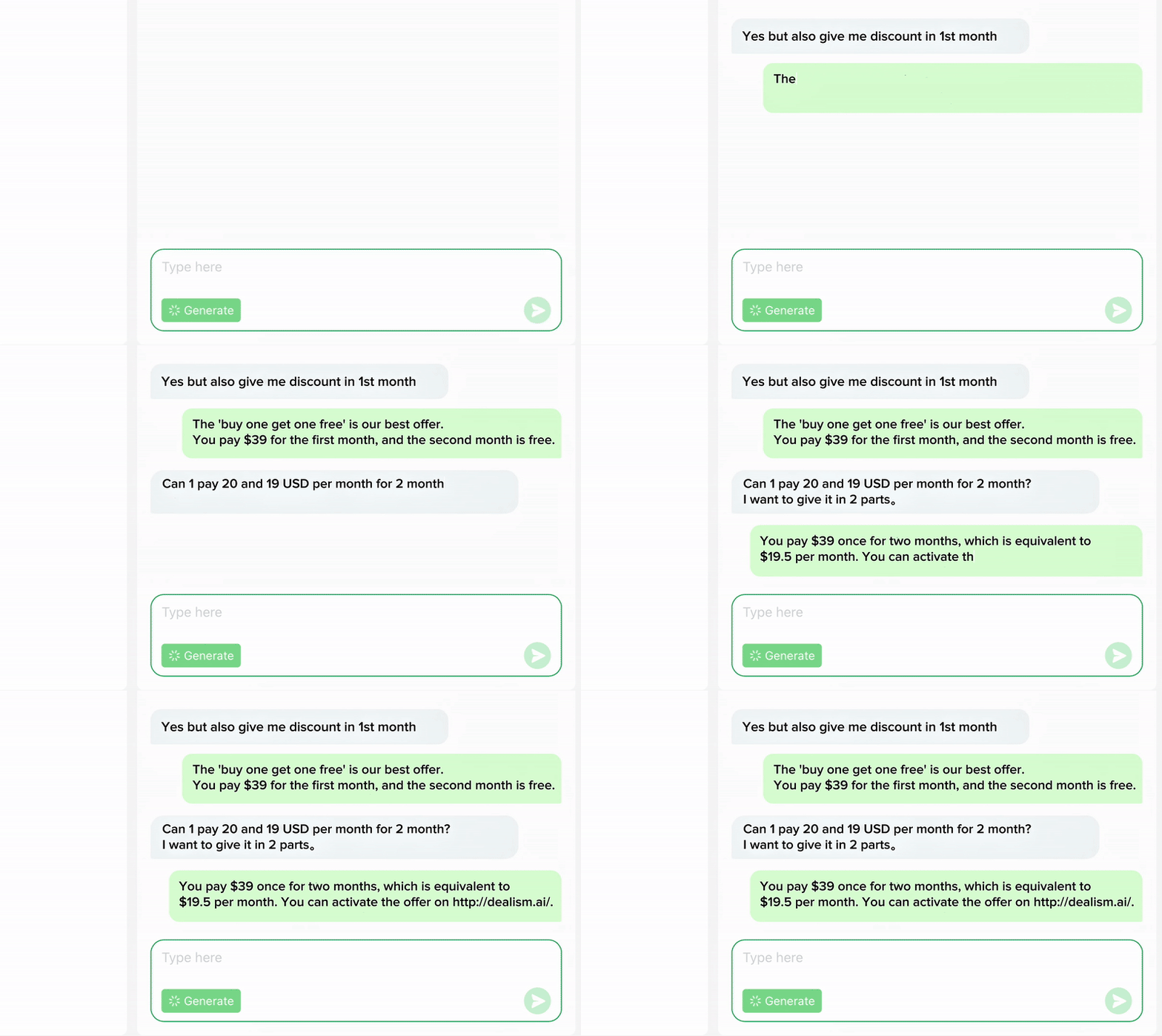
How Dealism Works in Real Instagram Conversations
To understand the difference, let’s compare how traditional tools and AI agents handle real situations.
Scenario 1: Customer asks for price
Chatbot: sends a fixed reply with pricing
Dealism:
Understands whether the user is comparing or ready to buy
Asks relevant follow-up questions
Positions the offer and guides toward purchase
👉 Result: Not just answering—but progressing the conversation.
Scenario 2: Customer is unsure
Chatbot: gives a generic or repetitive response
Dealism:
Detects hesitation or uncertainty
Adjusts tone based on the situation
Builds confidence through natural conversation
Moves the user closer to a decision
👉 Result: Simulates a real sales interaction, not just support.
Scenario 3: High volume of DMs
Chatbot: sends the same template repeatedly
Dealism:
Personalizes responses for each user
Categorizes and scores leads automatically
Prioritizes high-value conversations
👉 Result: Handles scale without losing quality.
For a detailed walkthrough on how to set up smart Auto Reply workflows and maximize engagement, check out our Dealism Guides.
Why This Matters for Small Businesses
For small teams, the biggest challenge isn’t just replying to messages—it’s turning those conversations into revenue.
Traditional comparisons like live chat agents vs chatbots focus on speed and cost. But what actually matters is:
Can you respond instantly?
Can you understand the customer?
Can you guide them to take action?
This is where AI agents stand out.
They combine:
The speed and availability of chatbots
The understanding and persuasion of live chat
The Real Shift: From Replying to Converting
The biggest shift is not technological—it’s strategic.
Old model:
Chatbot = reply
Live chat = talk
New model:
AI agent = handle + understand + Improve Conversion
This is why the traditional difference between chatbot and live chat is becoming less relevant. Businesses are no longer choosing between tools—they are adopting systems that can manage the entire conversation flow.
When Does Dealism Make the Most Sense?
Dealism is especially valuable if you:
Receive a high volume of Instagram DMs
Don’t have a dedicated sales team
Want to improve conversion without increasing workload
Need both automation and personalization
Want the system to self-learn and optimize responses over time
For many small businesses, this means finally solving the gap that neither chatbots nor live chat could fully address.
Conclusion
The debate between chatbot vs live chat is starting to feel outdated. Chatbots can reply instantly but often lack depth, while live chat is personal and persuasive but hard to scale. For small businesses, the real solution is finding a way to combine speed, understanding, and conversion in the future.
AI agents with smart auto reply features like Dealism make that possible. They can handle messages at scale, remember past conversations, and guide customers toward a decision—all without adding more work for your team. Instead of asking do you prefer chatbot or live chat, the smarter question is how to turn every Instagram conversation into real business results.