
Choosing the right chatbot platform can significantly impact how you engage customers, automate conversations, and drive conversions. In this detailed ManyChat vs Chatfuel comparison, we break down their features, pricing, ease of use, and real-world use cases so you can make an informed decision.
Both platforms are popular for building chatbots on channels like Facebook Messenger and Instagram, but they take different approaches when it comes to automation, flexibility, and scalability.
What Are ManyChat and Chatfuel?
ManyChat and Chatfuel are two of the most widely used chatbot platforms for social media automation.
ManyChat, which we have already introduced in detail in our previous guide, is designed for marketing automation. It helps businesses automate conversations across Instagram, Messenger, SMS, and email using visual flow builders. It is beginner friendly and widely adopted by ecommerce brands and small businesses.

Chatfuel, on the other hand, is an earlier platform known for AI driven automation and deeper integration capabilities. It focuses on advanced conditional flows, API integrations, and CRM style data handling, making it ideal for agencies or businesses that need more control over automation logic. You can explore its capabilities on the official site .
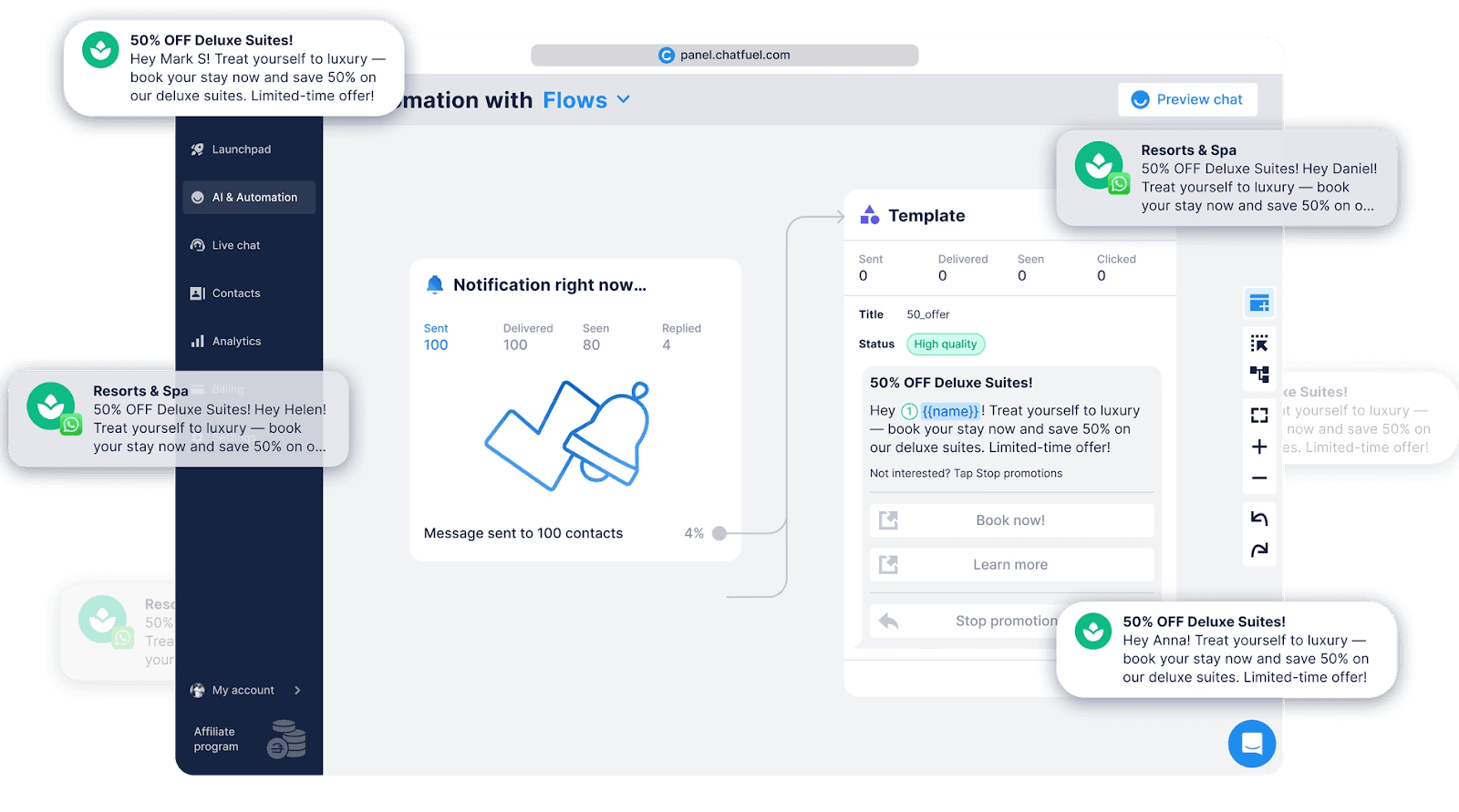
ManyChat vs Chatfuel Comparison
When comparing ManyChat vs Chatfuel, the differences come down to usability, automation style, and pricing flexibility.
1. Ease of Use
ManyChat offers a highly visual drag and drop builder
Ideal for beginners and non technical users
Pre built templates for quick setup
Chatfuel has a steeper learning curve but offers more flexibility in logic design and API integrations.
👉 Verdict: ManyChat is better for beginners, while Chatfuel suits advanced users.
2. Features and Automation
ManyChat focuses on marketing automation:
Broadcast messaging
Funnel building
Lead capture and nurturing
Multi channel messaging including SMS and email
Chatfuel leans more toward AI and backend logic:
AI powered responses
Advanced conditional flows
API integrations for custom workflows
CRM style data handling
👉 Verdict: ManyChat is better for marketing. Chatfuel is stronger for technical automation.
3. Pricing
If you are evaluating chatfuel vs manychat pricing, here is the key difference:
ManyChat has a free plan with scalable pricing based on contacts
Chatfuel pricing is typically higher and based on features and usage
For more details, you can check and .
👉 Verdict: ManyChat is more affordable for small businesses.
4. Channels Supported
ManyChat supports:
Instagram
Facebook Messenger
SMS
Email
Chatfuel supports:
Facebook Messenger
Instagram
WhatsApp
👉 Verdict: ManyChat offers broader channel coverage.
Feature | ManyChat | Chatfuel |
Ease of Use | Highly visual drag & drop builder, beginner friendly | Moderate complexity, more technical |
Automation Style | Flow based, marketing funnels | Logic & API based, AI driven |
Channels Supported | Instagram, Messenger, SMS, Email | Instagram, Messenger, WhatsApp |
Pricing | Free plan + scalable paid plans | Typically higher, feature based |
Templates | Pre built marketing templates | Requires more custom setup |
Best For | Marketing funnels, lead generation | Advanced automation, API integration |
Chatfuel vs ManyChat Review: Which One Should You Choose?
If your business focuses on marketing funnels, lead generation, and social media engagement, ManyChat is typically the better choice.
If you need deeper customization, API integrations, and AI driven workflows, Chatfuel may be more suitable.
In real world usage:
Ecommerce brands often prefer ManyChat
Agencies and developers lean toward Chatfuel
A Smarter Alternative: Dealism
While ManyChat and Chatfuel are powerful, they both rely on a core assumption: you must design the conversation in advance.
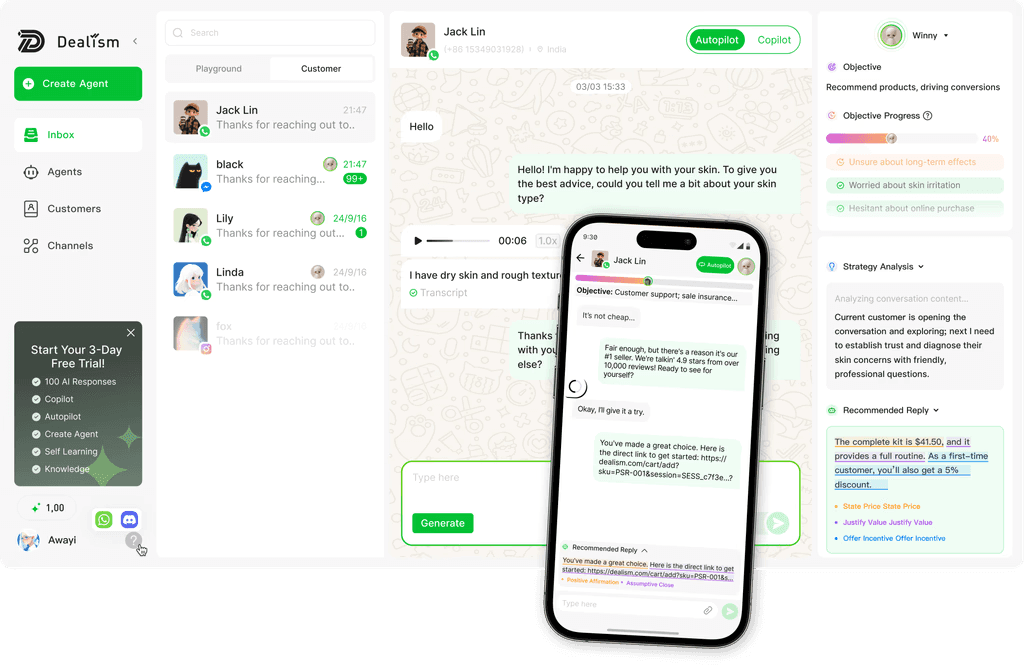
This means mapping user journeys, building decision trees, maintaining flows, and constantly optimizing logic. For many businesses, especially service based ones, this becomes a bottleneck rather than a solution.
Dealism represents a shift from chatbot building to outcome driven execution.
Instead of asking you to define every possible path, Dealism uses AI to understand user intent, context, and emotional signals in real time, then decides what to do next.
This includes:
Interpreting vague or unstructured customer messages
Identifying buying signals and hesitation points
Dynamically guiding conversations toward decisions
Triggering actions instead of just sending replies
Unlike traditional chatbot tools, Dealism is not trying to simulate conversations. It is designed to move them forward.
This is especially important in modern sales environments where:
Customers do not follow linear funnels
Conversations happen across multiple channels
Decisions are influenced by timing, tone, and context
In many cases, businesses using flow based tools end up recreating complex logic that still fails when users go off script.
Dealism removes that fragility by replacing rigid flows with adaptive intelligence, making it a strong choice for founders, local service providers, and teams that want results without managing automation systems.
ManyChat vs Chatfuel vs Dealism
Here is how all three platforms compare when viewed side by side.
Key Differences Explained
ManyChat and Chatfuel are both chatbot builders. You design the logic, and the system follows it.
Dealism removes that burden by handling conversations dynamically, making it especially useful for service based businesses and founders who do not want to manage automation flows.
Comparison Table
Feature | ManyChat | Chatfuel | Dealism |
Core Type | Chatbot builder | Chatbot builder | AI sales agent |
Ease of Use | Very beginner friendly | Moderate complexity | No setup flows needed |
Automation Style | Flow based | Logic and API based | Intent driven |
Channels | IG, Messenger, SMS, Email | IG, Messenger, WhatsApp | Multi channel messaging |
Best For | Marketing funnels | Advanced automation | Sales conversations |
Setup Effort | Medium | High | Low |
Real Time Decision Making | Limited | Limited | Strong |
Why Sales Execution Matters More Than Automation Tools
Traditional chatbot platforms like ManyChat and Chatfuel are built to automate predefined interactions. They work well when customer journeys are predictable and structured.
But real customer conversations rarely follow scripts.
What businesses increasingly need is not just automation, but execution. The ability to understand, decide, and act within a conversation.
That is the key difference in today’s landscape. Tools that only automate responses are being replaced by systems that can actually move deals forward.
If your goal is to turn conversations into outcomes, choosing the right platform is no longer about features. It is about how much of the sales process you are ready to delegate.


