

AI Chat Sales Automation: How Conversational Marketing Turns Chats into Real Business Actions
In many small businesses today, the most important marketing channel is not email, advertising, or landing pages. It is messaging conversations. Customers ask questions through WhatsApp, Instagram DMs, and other instant messaging platforms before making a decision.
This shift has pushed businesses toward Conversational Marketing, where real-time conversations become the path from curiosity to purchase.
Yet most companies are not built to manage these conversations effectively. Messages arrive constantly, customers repeat the same questions, and promising discussions often end without a clear outcome.
The problem is rarely lack of demand.
The real problem is that no system exists to understand conversations and move them forward.
AI chat sales automation is emerging to solve exactly this challenge.
Why Messaging Conversations Are the Closest Point to Sales
For small and medium-sized service businesses, messaging platforms are often the closest point to conversion.
A patient asks a clinic about symptoms.
A student asks about available courses.
A customer asks a store about pricing.
These are not casual messages. They are decision-stage conversations.
Yet most businesses treat messaging channels like support inboxes. Staff answer questions when they have time, often repeating the same explanations throughout the day.
Many customers disappear not because they lost interest — but because the conversation simply stopped.
One of the biggest advantages of automation in marketing conversations is ensuring that every inquiry continues toward a meaningful next step.
However, traditional marketing automation was never designed for real conversations.
The Limits of Traditional Marketing Automation
Most automation tools rely on rule trees and keyword triggers.
If a message contains “price,” the system sends a price list.
If it detects “appointment,” it sends a booking link.
This works only when conversations follow predictable patterns.
In reality, customers rarely communicate so clearly. They ask incomplete questions, express uncertainty, or describe problems without knowing what they need.
For example:
“I’m not sure which treatment I need, but I’ve had this issue for months.”
A keyword-based chatbot cannot interpret that message.
Many companies attempt to fix this by adding CRM systems, but this often creates another problem. For small businesses, CRM software frequently becomes more about recording data than moving conversations forward.
Recording conversations does not grow a business.
Moving them forward does.
From Chatbots to AI Agents That Make Decisions
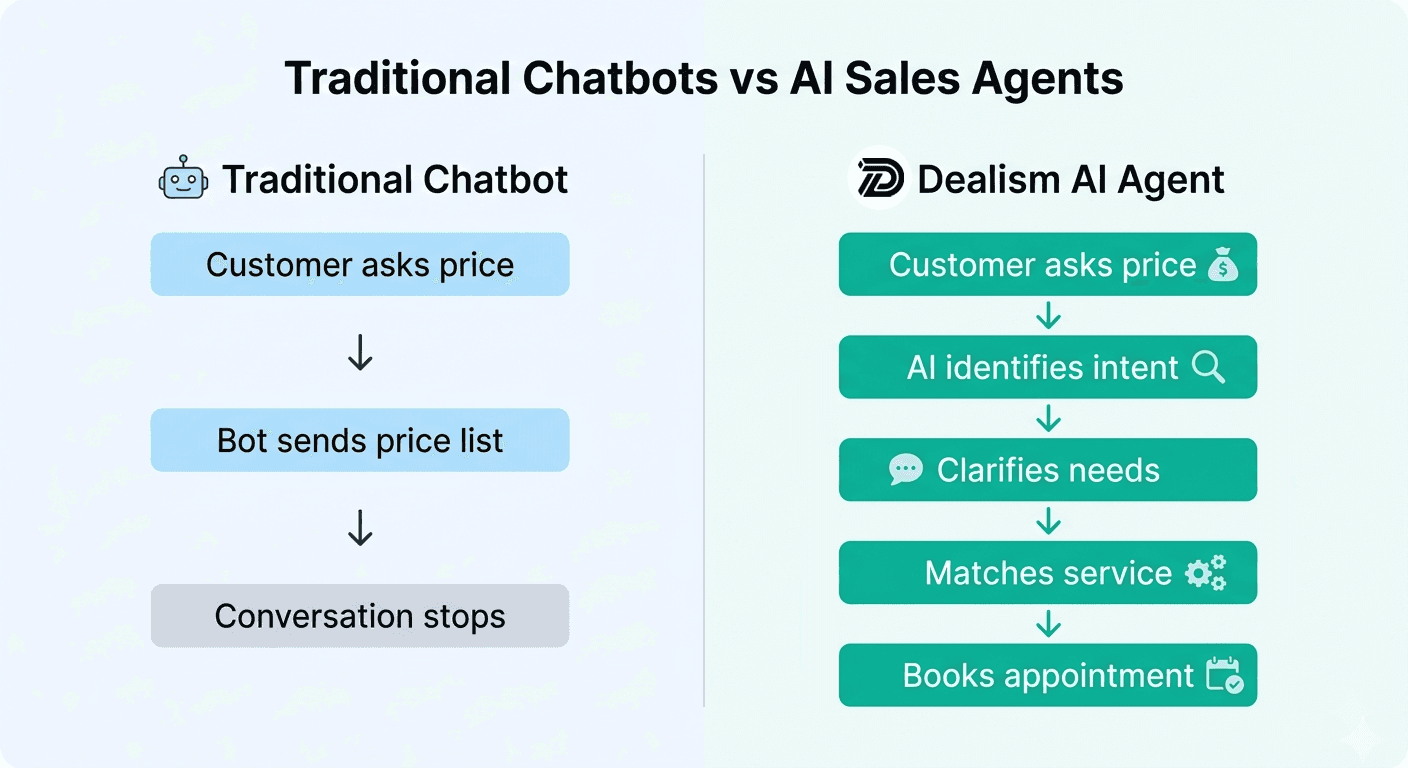
The next evolution of conversational marketing is not better chatbots, but AI agents capable of making contextual decisions.
A traditional chatbot interaction looks like this:
Customer asks about price →
Bot sends price list →
Conversation ends.
An AI agent works differently.
Customer asks about price →
System identifies potential intent →
Clarifies needs →
Matches the correct service →
Guides the conversation toward booking.
Instead of acting as a response machine, the system performs triage within the conversation.
It functions like a specialized consultant who evaluates the inquiry before it ever reaches your desk.
Platforms like Dealism AI Agent Platform follow this approach. Rather than acting as a chatbot or CRM, the system operates as an AI execution agent inside messaging platforms such as WhatsApp or Instagram.
Conversations become the starting point of business decisions.
Zero-Workflow Automation for Small Businesses
A major barrier to automation has always been complexity. Traditional systems require businesses to design workflows, build rule trees, and maintain automation logic.
Most small business owners simply do not have the time for this.
Modern AI systems are shifting toward zero-workflow automation.
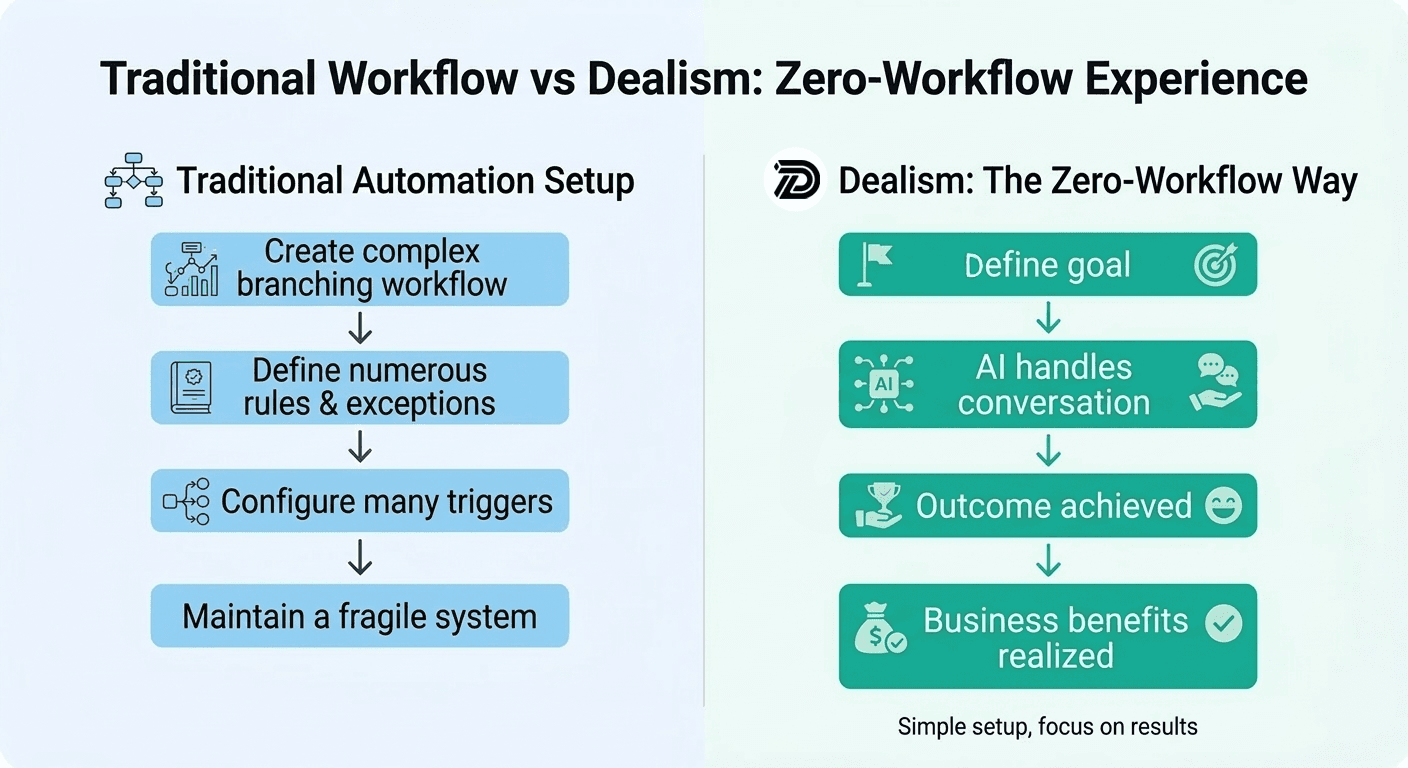
Instead of designing automation logic, businesses provide only a few pieces of information:
available services
operating hours
pricing or consultation options
the desired outcome (appointment, inquiry qualification, purchase)
The AI agent then manages the conversation dynamically.
Instead of designing workflows, owners simply define the result they want.
Imagine a medical aesthetic clinic.
A typical chatbot might send a booking link immediately.
A Dealism agent does something different.
It asks about the customer’s skin concerns, identifies the appropriate specialist, checks availability, and then confirms the appointment.
This is action — not just a reply.
Vibe-Selling: Making Conversations Feel Natural
Automation often fails because it feels robotic.
Customers quickly recognize scripted responses, which can reduce trust and engagement.
A newer concept known as Vibe-Selling focuses on something different: understanding the emotional tone of conversations.
Instead of pushing links or scripted replies, AI agents detect signals such as hesitation, uncertainty, or curiosity.
They respond by clarifying needs and guiding decisions naturally.
For small businesses without trained sales teams, this approach is extremely valuable. Owners do not need to memorize sales scripts or design funnels.
The conversation itself becomes the selling process.
Selling happens through understanding, not pressure.
Best Practices for Improving Sales Conversion Rates with Marketing Automation in 2026
Businesses successfully using conversational automation follow several key principles.
• Clarify needs before pushing actions.
Customers respond better when the system first understands their situation.
• Maintain conversation continuity.
Messaging conversations often span hours or days, so systems must remember context.
• Use follow-ups intelligently.
Many customers disappear simply because conversations pause.
Companies are increasingly exploring how to integrate conversation insights with marketing automation without adding operational complexity.
The goal is no longer just managing leads. It is understanding customer intent in real time.
The Future of Conversational Marketing
Messaging has become the most natural way for customers to interact with businesses.
Yet most organizations still treat messaging like a support channel rather than an operational system.
AI chat sales automation changes this by turning unstructured chats into structured outcomes.
Instead of acting as support inboxes, messaging platforms become environments where real decisions happen.
In simple terms, AI chat sales automation represents a fundamental shift in how businesses operate inside messaging conversations.
When conversations can understand context, clarify intent, and trigger real actions, chat stops being passive communication.
For more insights, visit the Dealism Blog. Chat becomes the engine that drives customer decisions and business growth.