

Chat Marketing Automation for Small Businesses
How Messaging Apps Became the New Sales Funnel
For many small businesses, chat marketing automation has quietly become the most important marketing infrastructure. Customers increasingly start their buying journey inside messaging platforms like WhatsApp or Instagram. Instead of filling out forms or scheduling calls, they send a message — and that conversation often becomes the beginning of a sale.
Chat marketing automation is the use of AI systems to understand, guide, and convert customer conversations inside messaging platforms like WhatsApp and Instagram.
The Hidden Problem of Chat Marketing Automation: Chat Chaos
As businesses grow, conversations quickly become difficult to manage.
Messages arrive faster than teams can respond. The same questions repeat throughout the day. Many small businesses struggle with handling repetitive customer questions across WhatsApp or Instagram. Customers ask about services without fully understanding their needs. Many conversations end without clear decisions or follow-ups.
At first glance, this appears to be a response-time problem.
In reality, the challenge is decision-making inside the conversation.
Most customers start with incomplete information. They need clarification before choosing a service, booking an appointment, or making a purchase. When nobody guides that process, conversations stall.
The problem is not that someone failed to reply.
The problem is that the conversation never moved toward a decision.
Why Traditional Chatbots Fail in Chat Marketing
Many businesses attempt to solve this using chatbot marketing tools. However, traditional chatbots often fail to manage real customer conversations effectively.
Traditional chatbots usually rely on keyword triggers. If a message includes “price,” the system sends a price list. If it detects “appointment,” it sends a booking link.
This approach works only when conversations follow predictable patterns.
In real situations, customers communicate with uncertainty. A message like:
“I’m thinking about booking something next week, but I’m not sure which treatment is right.”
contains several possible intentions — advice, information, or booking.
Rule-based chatbots cannot reliably interpret this context. As a result, the system often sends irrelevant information or passes the conversation to a human agent.
Some companies then introduce CRM platforms to manage conversations, but for small teams, CRM systems often add complexity rather than solving the core problem. AI customer inquiry management solutions are helping small businesses manage messy chats and drive real outcomes.
This is where modern chat marketing automation becomes essential.
Traditional Chatbots vs AI Chat Automation
Modern chat automation for small businesses is moving beyond keyword bots.
Instead of reacting to triggers, AI agents analyze context and guide conversations step by step.
The difference between traditional chatbots and modern AI chat automation is how conversations are handled.
Traditional Chatbot | AI Chat Automation |
Triggered by keywords | Understands intent and context |
Sends scripted replies | Holds multi-step conversations |
Answers basic questions | Asks clarifying questions |
Escalates to humans | Guides users toward decisions |
In simple terms:
A chatbot replies.
An AI agent executes a process through conversation.
While many seek the best automated response categorization for chatbots companies, real business value comes from more than just sorting messages—it comes from executio
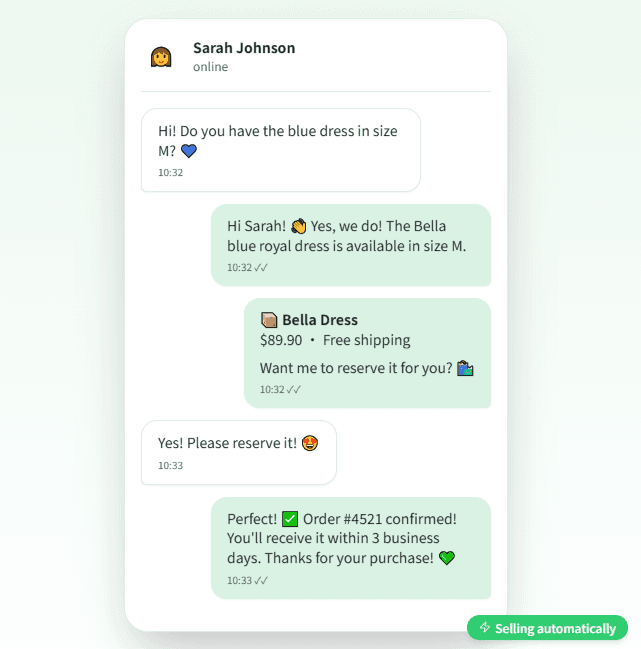
Example of Chat Automation for Small Business: A Dental Clinic
Customer message on WhatsApp:
“Hi, I’ve had a toothache for two days. I’m not sure if I need a cleaning or something more serious.”
Traditional chatbot
The system detects the word “tooth” and sends a price list for dental services. The patient receives a menu of treatments but still does not know which option is appropriate.
Many conversations stop here.
AI conversation agent
Instead of sending a list, the agent asks:
“Is the pain sharp or constant? And is it on one side or multiple teeth?”
Based on the response, the system can guide the patient toward:
• an urgent appointment
• a diagnostic consultation
• a routine cleaning
The conversation becomes a guided decision process, not just an automated reply.
What Dealism Is
Dealism is designed around this new model of conversational marketing automation.
It operates as an AI Vibe-Selling Agent inside messaging platforms such as WhatsApp and Instagram.
Dealism is not a CRM system and not a traditional chatbot builder.
Instead, the platform functions more like a digital team member that reads conversations, understands context, asks clarifying questions, and guides customers toward the correct next step.
The focus is not only responding to messages.
The focus is what happens after the conversation begins.
The Vibe Selling Method
Dealism operates using a framework called Vibe Selling.
Rather than following scripts, the AI analyzes the practical and emotional context of each conversation. The agent attempts to understand what the customer truly needs before guiding them to the next action.
This may involve recommending the right service, clarifying a request, or directing the customer to booking.
For many small businesses, this transforms chat from a support channel into a structured decision engine.
Why Dealism Is Not a CRM
Traditional business software focuses on storing information.
CRM platforms rely on fields, records, and manual updates. While useful for large organizations, they often create unnecessary overhead for smaller teams.
Most small businesses do not need perfectly organized databases.
They need conversations that lead to results.
Dealism therefore focuses on execution rather than documentation. Instead of forcing teams to maintain complex records, the system works directly within chat conversations where the relevant context already exists.
The Bottom Line
Messaging platforms have become the closest point to a transaction for many businesses.
Customers ask questions, compare options, and make decisions directly inside chat. Without structure, these conversations quickly become chaotic.
Chat marketing automation transforms unstructured messaging into a system that guides customer decisions.
Dealism approaches this challenge by treating conversation not as support, but as business execution.
Instead of simply replying to messages, the system clarifies needs, guides decisions, and turns conversations into real business outcomes through chat marketing automation.