Published

For small and medium-sized service businesses (SMBs), traffic is rarely the real bottleneck. Ads work. Instagram Reels bring attention. Websites receive inquiries. WhatsApp and Instagram DMs are constantly active.
Yet leads still don’t convert.
Not because people aren’t interested — but because decisions are not made inside conversations fast enough.
Most businesses lose sales in a very specific place:
Between “I’m interested” and “Let me think about it.”
Converting leads into sales is not a marketing problem. It is a conversation execution problem.
If you want to increase sales, you must rethink three things:
how you reply to inquiries
how you use automated replies
Not as separate tasks — but as one continuous system where conversations move toward action.
Step 1: Acquire Customers Where Conversations Begin, Not Where Funnels End
Modern customer acquisition no longer ends on landing pages or forms. It starts — and often ends — inside messaging environments:
WhatsApp
Instagram DMs
Website live chat
These are not “support channels.” They are transaction environments.
The problem is not lack of traffic. The problem is that most SMBs fail to turn attention into structured conversations.
To acquire customers effectively, you need to remove friction between discovery and dialogue.
Turn passive attention into immediate conversations
When someone engages with your content, they are already signaling intent. The question is whether your system reacts in real time.
For example, Instagram engagement can become a direct entry point into sales conversations. A comment on a Reel is not just social interaction — it is a trigger for a structured follow-up conversation inside DM.
Instead of waiting for users to message you, the system initiates the conversation and guides them toward the next step.
Remove friction from website entry points
Most live chat tools fail because they isolate the conversation from where users actually are.
A modern system embeds conversation directly into the website experience and connects it to messaging apps like WhatsApp or Instagram. The user does not “open a support chat” — they simply start a conversation that continues across channels.
At this stage, acquisition is no longer about capturing leads.
It is about starting decision-capable conversations.
Step 2: Reply to Inquiries with Pre-Judgment, Not Just Information
Most businesses respond to inquiries in one of two ways:
too slow
or too neutral
Both lead to the same outcome: lost momentum.
A lead asking:
“How much is this?”
“Do you have availability?”
is not asking for information.
They are asking for direction.
Speed matters, but speed without judgment does not convert.
To convert leads, every reply must do more than respond — it must move the conversation forward.
Instead of treating inquiries as support tickets, treat them as live decision points.
A strong reply does three things:
Understands intent behind the question
Clarifies missing context
Moves toward the next action
This is the shift most businesses miss.
Because in high-conversion systems:
Conversation is not communication. Conversation is decision-making.
Once you adopt this lens, replies stop being reactive and become part of the sales process itself.
Step 3: Stop Automating Replies — Start Vibe Selling
To scale conversations, automation is necessary. But most automation fails because it copies human scripts instead of understanding human intent.
Rule-based chatbots operate on keywords. CRMs store what already happened. Neither influences what happens next.
That gap is where sales are lost.
A different approach is needed.
Vibe Selling is not a technique — it is a decision layer
Vibe Selling is not about scripts or tone. It is about what happens inside the conversation in real time:
understanding context
interpreting intent
resolving ambiguity
and moving toward action
It is not messaging.
It is decision execution inside conversation.
To understand the shift clearly:
Chatbots → respond mechanically to inputs
CRMs → record outcomes after the fact
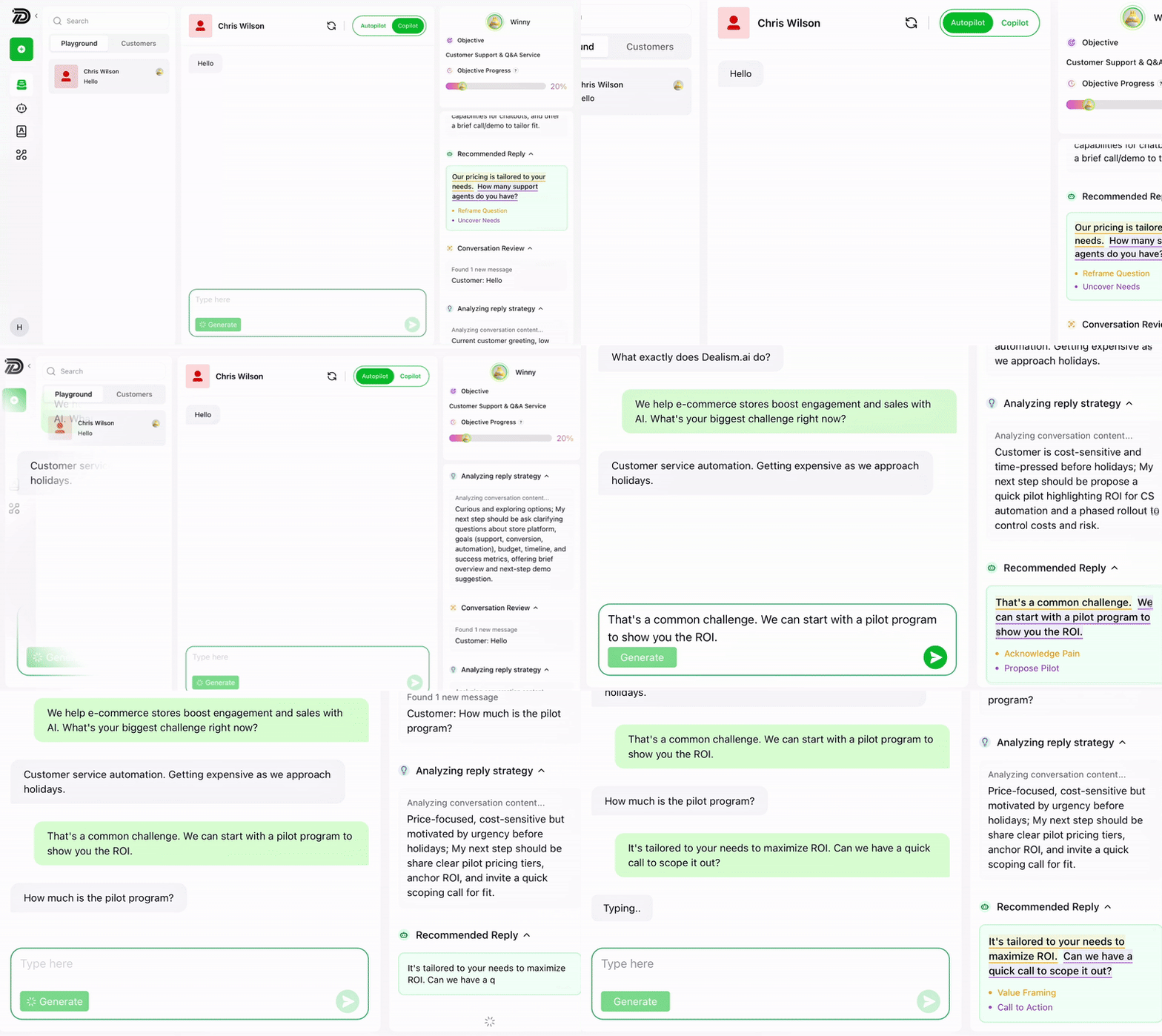
Dealism → makes decisions and moves the deal forward in real time
Only one of these systems actually influences conversion while the conversation is still alive.
An intelligent conversational agent operates like a capable human colleague embedded in your business. It understands ongoing context, distinguishes high-intent buyers from casual inquiries, and handles objections dynamically — without breaking the natural flow of conversation or exposing itself as automation.
This is not about replying faster.
It is about ensuring no conversation stays undecided.
Step 4: You Don’t Need a Sales Cadence. You Need a Decision System.
Traditional sales thinking relies on stages, pipelines, CRM tracking, and structured follow-ups.
But for SMBs and service-based businesses, this creates more overhead than results.
Because the real issue is not tracking leads.
It is moving leads forward.
You do not need complex sales methodologies. You do not need SOP-heavy training systems. You do not need manual follow-up routines.
You need a system where progress happens automatically inside conversations.
A decision system removes friction at every step:
No manual follow-ups required — conversations re-engage naturally when users go silent
No rigid scripts — the system adapts based on context and intent
No CRM dependency — progress is embedded in conversation flow, not external tools
Instead of managing sales, you define outcomes:
booking
payment
qualification
The system handles execution.
Not as assistance.
But as action.
You are no longer running a sales process.
You are defining what the conversation must achieve.
Conclusion: Conversations Are the New Execution Layer
SMBs do not lose leads because they lack traffic or response speed.
They lose leads because no one is making decisions inside the conversation itself.
Once conversations are treated as a structured execution system, everything changes:
Reply → Understand → Decide → Act
becomes a continuous flow, not a manual process.
You don’t need a larger sales team. You don’t need heavier CRM systems. You don’t need more complex funnels.
You need a system where conversations are capable of producing outcomes on their own.
Dealism is not a messaging tool. It is not a chatbot. It is not a CRM replacement.
It is a conversation execution system.
It turns messy, unpredictable chats into structured, decision-driven business actions — where every conversation has momentum, direction, and outcome.
Because in modern business, sales is no longer something you manage.
It is something that happens inside the conversation — or not at all.