
Your WhatsApp is chiming. Instagram DMs are piling up. A potential customer reaches out asking about your service, and your team replies as quickly as possible. Everything seems to be going smoothly.
Then the friction hits:
“It’s too expensive.”
“Let me think about it and get back to you.”
“I need to check with my partner first.”
And just like that, the conversation goes cold. The prospect vanishes.
For most small and medium-sized service businesses (SMBs)—whether you run a medical clinic, a therapy practice, a coaching center, or a local e-commerce brand—this is the real bottleneck. Your issue isn't a lack of traffic or leads; it's that promising conversations start, stall, and never turn into real action.
When revenue leaks here, owners often think they need better sales objection handling techniques, sharper scripts, or relentless follow-up. But in reality, most objections happen because the conversation never fully understood the customer’s context in the first place.
Why Traditional "Automated Replies" and Heavy CRMs Fail
In chat-based sales, there is rarely a structured corporate pipeline. Instead, businesses struggle with fast but chaotic text exchanges, scattered questions, and inconsistent follow-ups.
To fix this, most merchants try two traditional tools, both of which miss the mark:
1. Legacy Automated Replies (The Dumb Bots)
Many businesses set up instant, rigid auto-responders. The problem is simple: they are completely generic, they don’t detect buying intent, and they cannot adapt to a human conversation.
When a client hesitates, a rigid automated reply simply dumps a cold wall of text or a generic link. The customer immediately feels ignored:
“This is just a robot that doesn't understand my problem.”
2. Over-engineered CRM Systems
Other businesses try to solve the chaos by buying heavy CRM software. Suddenly, your small team is spending more time managing pipelines, updating tags, and filling out dashboards than actually talking to people.
CRMs are great for storing historical data, but they don’t move a conversation forward.
For an overworked SMB owner, a heavy CRM is a burden, not efficiency. Data integrity doesn’t mean your business is actually running.
The Hard Truth:
You don't need a system that simply records your dropped deals. You need an execution layer that stops them from dropping in the first place.
Objection Handling is Actually “Missing Context Detection”
In messaging-first commerce, when a customer says “it’s too expensive,” it is rarely a hard rejection. It is an unfinished conversation.
It usually means one of three things:
The customer is still unsure about what exactly they need
The true value of your service hasn't been connected to their situation
The next step feels too heavy or unclear
Therefore, the goal of modern sales objection handling techniques is not to “convince” or push harder.
High-pressure persuasion breaks the vibe and drives chat users away.
The real job is to remove uncertainty through structured clarification.
How an AI Agent Transforms Your Conversation Flow
This is where the entire model shifts.
Instead of you or your front-desk staff manually scrambling to reply to inquiries between tasks, a dedicated AI sales agent takes over the execution.
Imagine an AI colleague that doesn't just send static templates, but actually understands the emotional context and intent behind every message.
When a customer says “I’ll think about it,” the agent doesn’t panic or push. It treats it as missing context and responds naturally:
It clarifies what they are comparing the service with
It identifies the outcome they are actually trying to achieve
It detects whether price, timing, or uncertainty is the real barrier
You don't need to train your team on complex sales psychology or write endless SOPs.
Just like “Vibe Coding” allows people to build software without writing code, you can outsource your sales execution.
You simply provide:
Background information
Pricing and services
Desired outcome (e.g., booking a consultation)
The AI agent runs the entire conversation flow by itself.
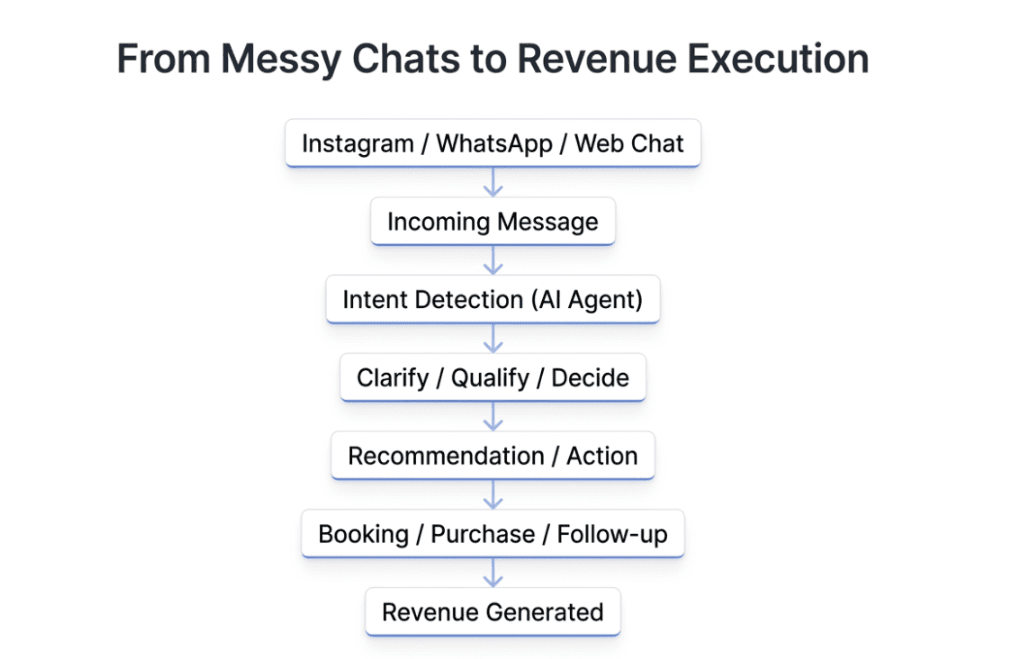
From Messy DMs to Structured Revenue Flow
To consistently acquire customers and increase sales, your conversations cannot exist in isolation.
They need to become a structured execution flow across every entry point where customers already are:
Instagram Comments to DM
When a user comments on your post or Reel, an automated trigger sends a direct message instantly with a clear action link (e.g., “Get your free trial + Click Here”).
This captures high-intent leads at the exact moment of interest.
Website Live Chat to WhatsApp
Instead of forcing visitors to fill out forms, a simple embedded live chat lets them start a conversation directly via WhatsApp or Instagram.
No friction. No delay.
Once the customer enters the chat, the AI agent:
Identifies intent level
Filters high-value prospects from casual inquiries
Answers questions using your business knowledge
Follows up automatically when users go silent
Conclusion: Stop Managing Data. Start Running Conversations.
Many businesses assume that replying faster is the secret to conversion. It isn’t.
Fast replies without decision logic only increase chaos—leading to confused customers, unqualified bookings, and wasted time.
What actually matters is whether the conversation knows how to guide the user toward a decision.
This is exactly what Dealism was built for.
Dealism brings together messaging automation, Unified Inbox, CRM, AI Agent, and an AI workspace (DealOnca) for small businesses that sell through conversation — with unlimited Active Contacts on the Free plan.
Its AI Customer Agent uses business knowledge and conversation context to answer questions, clarify needs, handle common objections, and recommend the next step.
Across Instagram, WhatsApp, and Live Chat, the Agent can:
Understands context
Clarifies customer needs
Handles objections naturally
Moves conversations toward action
Stop letting messy chat windows dictate your revenue.
Dealism’s free plan includes unlimited active contacts, unlimited workflows, one AI Customer Agent, core CRM and 50 AI credits you can claim every day.