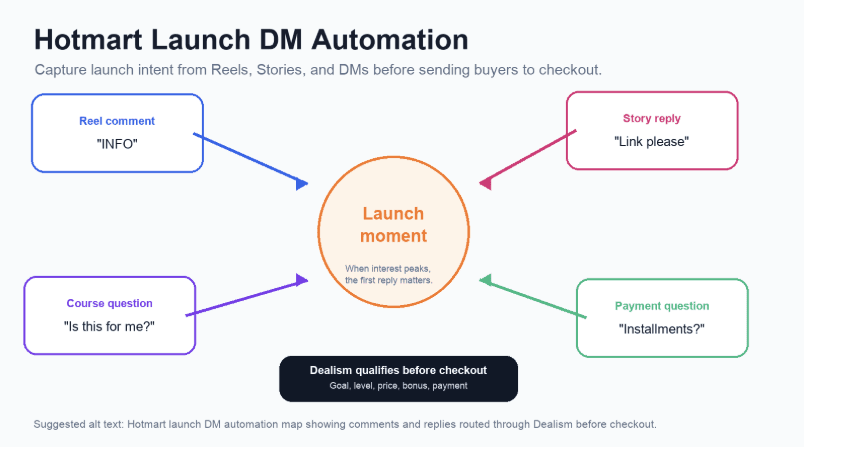
Most Hotmart creators already know the pattern: a Reel or Story goes out, the comments fill up with "link please" and "how much," and by the time a creator gets around to replying by hand, the moment that made someone want to buy has usually passed. Automating that first reply — on comments, Story replies, and DMs — is how creators keep that moment alive long enough to get someone to checkout. For the mechanics of how comment-to-DM automation actually works, see Dealism's Instagram DM automation guide.
What Is Hotmart and What Are Creators Trying to Solve?
Hotmart is a global platform for creators who sell digital products — online courses, memberships, ebooks, and events — built around three roles: the creator who builds the product, the affiliate who promotes it for a commission, and the buyer. Hotmart's own help center states the platform has over 500,000 registered products and sales in more than 188 countries, and it handles the parts of the business creators would rather not build themselves: hosting, checkout, payment processing in local currencies, and a members area to deliver the course once it's purchased.
What Hotmart doesn't handle is the conversation that happens before someone gets to that checkout link. That gap matters more for Hotmart creators than for a typical store, because so much of the platform's creator base is concentrated in Brazil and the wider LatAm region, where audience-building and selling both lean heavily on Instagram and WhatsApp rather than a single storefront. A Hotmart Company press release covering its creator-earnings milestones (2024) notes that roughly one in five economically active Brazilians has purchased a product from a creator through Hotmart — which gives some sense of how much of that buying journey starts as a social media conversation, not a cold visit to a sales page.
Why Does Instagram DM Automation Matter for Hotmart Launches?
Course launches are bursty by nature: a creator might get a handful of comments most days and then a flood of them the moment a Reel about the course takes off or a launch goes live. Answering that flood by hand isn't just slow, it's where sales quietly leak — someone comments "interested," doesn't get a reply for six hours, and by then either bought from someone else's content or simply moved on.
The data on this is fairly consistent across independent sources. A course-launch benchmark study by CreatorFlow (May 2026) found that comment-to-DM funnels for course offers priced $97–$997 convert at an end-to-end rate of roughly 1.5–4% from comment to sale — modest-sounding, but consistently ahead of sending the same traffic to a landing page cold. Separately, Manychat's research on course-creator DM funnels found that leads qualified through a DM conversation convert at 12–20%, compared to roughly 10% for a typical landing page. Neither number is a guarantee — both depend heavily on audience size, price point, and how well the automated flow actually qualifies people — but the direction is the same: a conversation converts better than a link, if someone is there to have it.
There's also a platform mechanic that's easy to miss: Instagram limits how long a business can keep messaging someone after their last reply (the messaging window closes after 24 hours for promotional content). That's part of why many creator-focused DM flows try to capture an email address early in the conversation — it's the one channel that survives after Instagram's window closes, which matters a lot for a multi-day or multi-week launch.
What Instagram DM Tools Do Hotmart Creators Compare?
Hotmart doesn't have a native Instagram automation feature, so creators comparing tools are generally choosing between standalone platforms rather than something built into Hotmart itself. The market splits roughly into two camps: simple keyword-triggered bots that fire a fixed reply, and AI-driven tools that can hold a longer qualifying conversation before pointing someone to a checkout link. Dealism's comparison of free Instagram DM bots is a reasonable starting point for testing the basics.
The trade-off is the same one that shows up across creator tooling generally: keyword bots are quick to configure but only handle the exact phrasing you anticipated, which is a real limitation when questions arrive in a mix of Portuguese, Spanish, and English, as they often do for Hotmart's LatAm-heavy creator base. AI-driven tools cost more but tend to hold up better across that variation and can carry a conversation from "is this the right course for me" through a qualifying question to a checkout link, rather than breaking the moment someone phrases things unexpectedly.
Why Do Hotmart Creators Choose Dealism?
Hotmart already handles checkout, payment, and content delivery well — that's not the layer that needs fixing. What's missing is what happens between a comment and a click: qualifying whether someone is a fit, answering the two or three questions they always ask (price, payment plan, what's included), and getting them a checkout link before the moment passes. That's the layer Dealism adds. It replies to comments and DMs instantly, asks a follow-up question a creator would ask themselves (budget, experience level, what they're trying to achieve), and then sends the person to the right Hotmart checkout link or into a WhatsApp conversation for a longer, higher-touch close.
This works as a "1+1 > 2" pairing rather than a replacement for anything Hotmart does — Dealism isn't a checkout page or a members area, and it doesn't try to be. Its job is the conversation before the sale, which is exactly the part a launch-day flood of comments makes hardest to keep up with manually. For more on how that workflow is structured, see the Instagram DM automation guide or Dealism's Instagram messaging product page.
How Do You Set Up Dealism for a Hotmart Launch?
A typical setup for a Hotmart creator's launch looks like this:
Pick the entry point for the launch. Most creators use a comment keyword tied to the launch Reel or Story ("WAITLIST," "COURSE," "INFO") so the automation only fires on launch-relevant content.
Add one qualifying question. A single question — budget range, experience level, or what result they're looking for — is usually enough to separate a curious scroller from someone ready to buy.
Write the first automated reply around the real question. Price, what's included, and payment plan options are the three questions almost every launch gets, so lead with those instead of a generic "thanks for your interest."
Add the checkout or waitlist link once the qualifying question is answered, rather than sending it on the very first message.
Capture an email if the launch runs more than a day or two, since Instagram's messaging window closes after 24 hours of inactivity and email is what keeps the conversation alive past that point.
Add one follow-up, timed to the launch's urgency (a bonus expiring, cart closing) rather than a generic reminder — a single well-placed nudge tends to outperform repeated messages.
Set a handoff rule for anything that needs a real conversation — a payment plan negotiation, an affiliate partnership question, a refund request — routing those to a human or to WhatsApp instead of automated replies.
Test the flow on your own comments and DMs before the launch goes live.
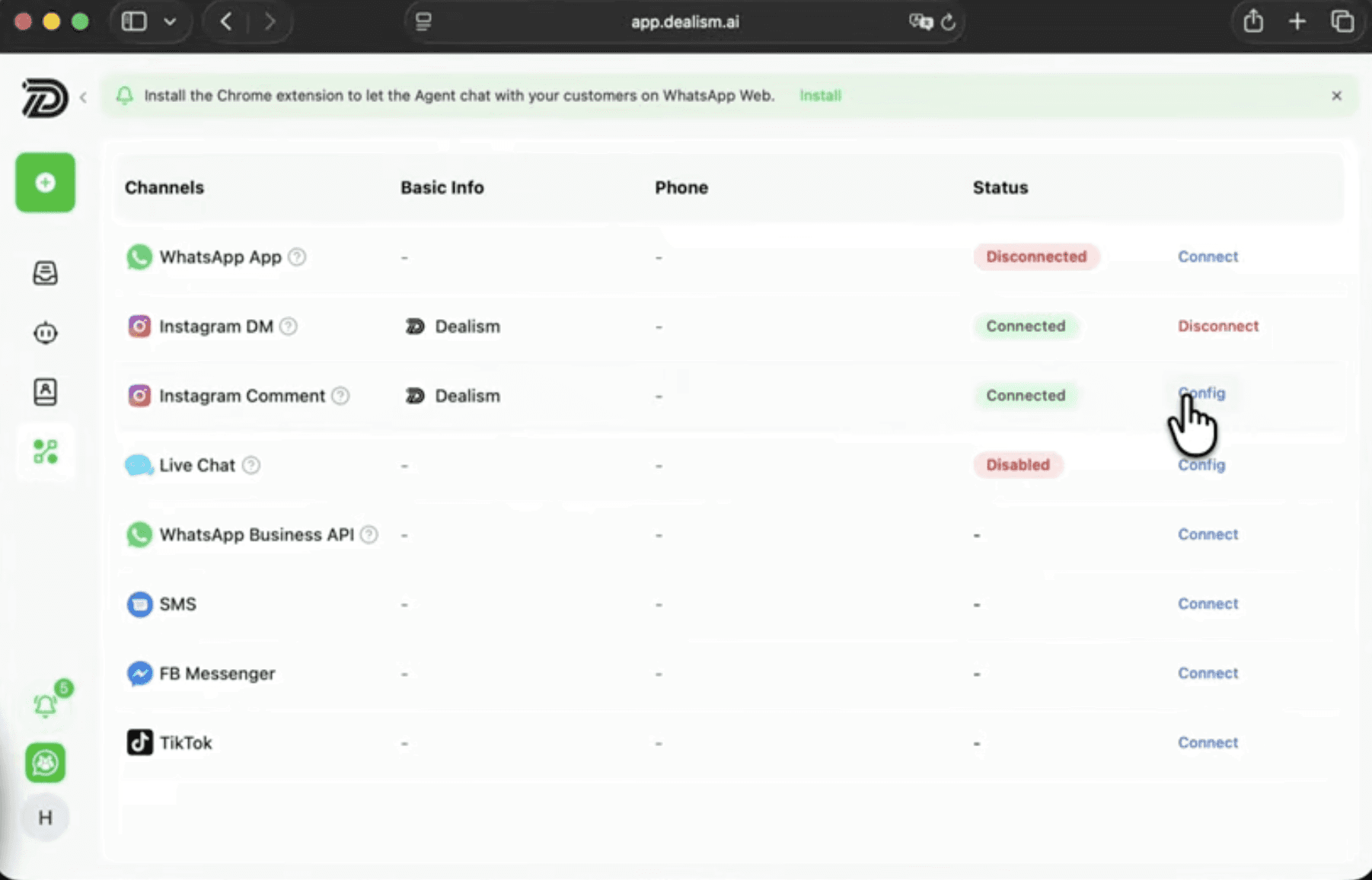
Throughout this, Dealism can support sending checkout links, discount codes, and WhatsApp handoffs depending on your setup — it does not automatically sync Hotmart order status, member area access, or affiliate commission data, so confirm purchases and grant access through Hotmart itself. For the comment-automation piece specifically, Dealism's Instagram comment auto-reply setup guide walks through the configuration step by step, and if a meaningful share of your launch conversations move to WhatsApp for a closer, Dealism's WhatsApp automation guide covers that handoff.
Where Can You Find DM Scripts for a Launch?
Rather than rewriting generic launch scripts here, start from copy that's already built around real buyer questions. Dealism's Instagram welcome message examples article has 30+ adaptable templates for greetings, offers, and qualifying questions — swap in your course name, price, and bonus details and most of them will fit a launch flow with minimal editing.
FAQ About Instagram DM Automation for Hotmart
Does Dealism integrate directly with my Hotmart checkout or members area? No. Dealism can send buyers a link to your Hotmart checkout page and support the conversation that leads up to it, but it does not automatically sync order status, grant members-area access, or track affiliate commissions unless that's separately confirmed for your setup.
Should a lead go to checkout, WhatsApp, or a human? Straightforward questions about price or what's included usually convert fine with a direct checkout link. Anything involving a payment-plan negotiation, a refund, or a higher-ticket decision tends to close better on WhatsApp or with the creator directly.
Does this work for affiliates promoting a Hotmart product, not just the original creator? The same comment-to-DM pattern can work for an affiliate's own Instagram content, but the automation itself has to be set up on the affiliate's account and point to their own affiliate checkout link — Dealism doesn't manage affiliate link generation or commission tracking.
Do I need coding skills to set this up? No. Setup is generally handled by describing your launch, offer, and rules in plain language rather than building flowcharts, though testing the flow with real questions before launch day is still worth doing.
What if most of my sales conversations end up on WhatsApp instead of Instagram? That's common for Hotmart's Brazil- and LatAm-based creators. See Dealism's WhatsApp auto-reply feature for how the Instagram-to-WhatsApp handoff is typically set up.
How Can Hotmart Creators Get Started With Dealism?
If your last launch had a flood of comments and DMs you couldn't get to in time, that's the clearest sign it's worth automating the first reply before the next one. Start by mapping the two or three questions every launch gets, decide which leads should go straight to checkout and which need a WhatsApp conversation or a human, and set up Dealism to handle that first layer while you focus on the content. Independent research on the broader creator economy backs the scale of the opportunity: a Fundação Getulio Vargas study cited alongside Goldman Sachs Research puts the global creator economy at roughly $250 billion today, with projections reaching $480 billion within the next few years — a big enough shift that the first reply to a comment is no longer a small detail.