

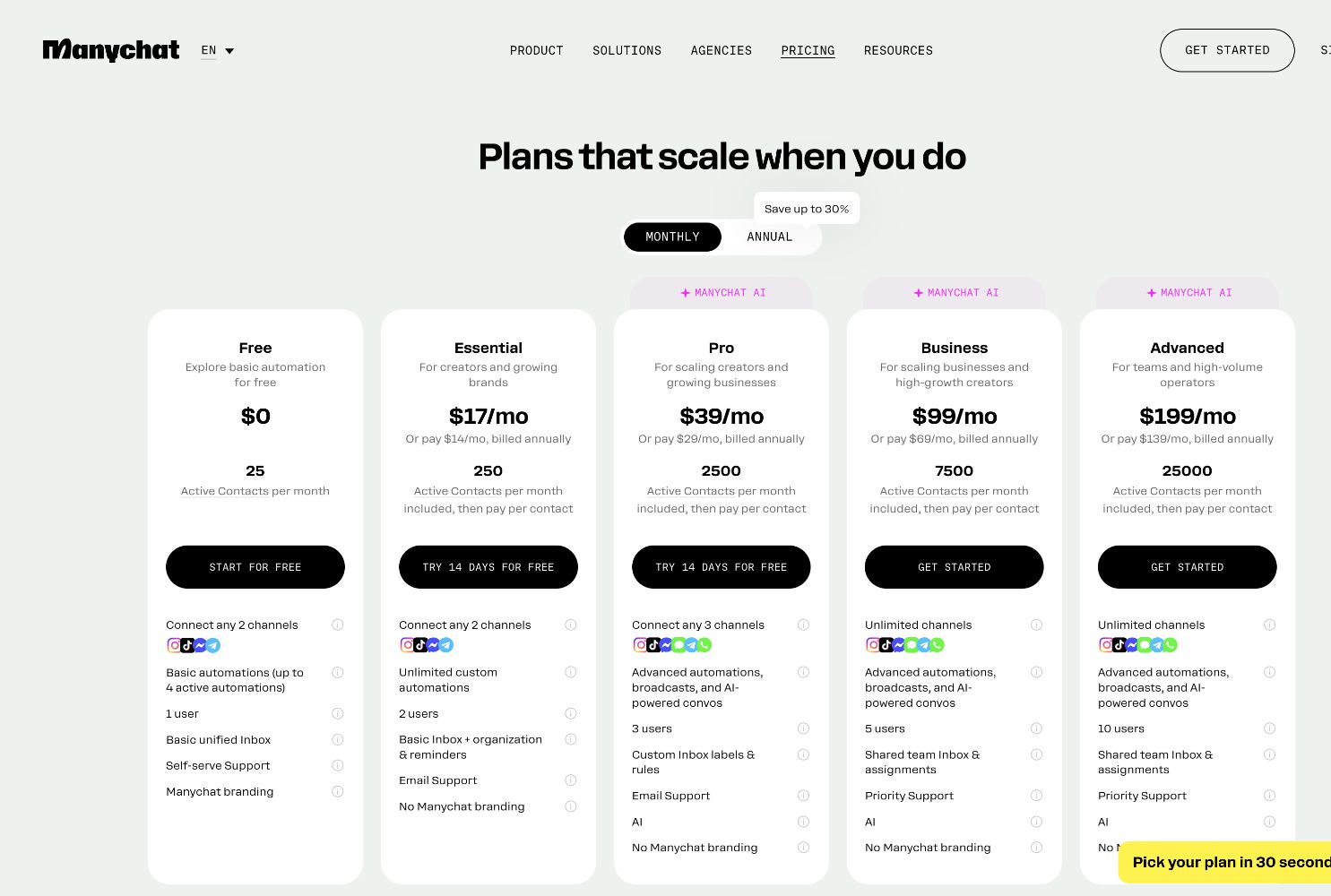
ManyChat has five plans, with monthly base prices from $0 to $199 and lower monthly-equivalent annual rates. The most economical plan also depends on Active Contacts, overages, channels, automation, and team access.
This guide explains ManyChat's current pricing model as checked in August 2026. Pricing and availability can vary by country and account, so confirm the final offer inside ManyChat before buying.
👉 Want a result based on your own usage? Use the free ManyChat pricing calculator to compare compatible plans and overages.
ManyChat Pricing in 2026 at a Glance
ManyChat's current public pricing starts with these allowances:
Free: $0 with 25 Monthly Active Contacts, basic automation, one user, and up to two eligible channels.
Essential: $17 monthly or $14 per month with annual billing, including 250 Active Contacts.
Pro: $39 monthly or $29 per month annually, including 2,500 Active Contacts, AI-powered conversations, broadcasts, and up to three eligible channels.
Business: $99 monthly or $69 per month annually, including 7,500 Active Contacts, unlimited eligible channels, and five users.
Advanced: $199 monthly or $139 per month annually, including 25,000 Active Contacts, unlimited eligible channels, and ten users.
Paid plans charge for contacts beyond their allowance. The official ManyChat pricing page is the source of truth for availability and rates.
What Changed in ManyChat's 2026 Pricing?
The most important change is the move from cumulative stored contacts to Monthly Active Contacts. Under the new model introduced on March 2, 2026, inactive people can remain in your database without counting toward that month's allowance. They count when they interact through ManyChat during the current billing period.
This corrects a common misconception found in older pricing guides: your entire historical contact list is no longer automatically the monthly billing meter under the new plans.
Availability is not identical for every account. ManyChat says the new plans apply by default to accounts created on or after March 2, 2026. Migration for older accounts is rolling out by country, so a legacy account may still display a different structure.
What Is a ManyChat Active Contact?
An Active Contact is a person who sends or receives a message through ManyChat during the billing month. That activity can happen through automations, AI, broadcasts, DMs, comments, Story replies, or Inbox conversations.
The same identified person can exchange multiple messages and still count once for that month. At the next billing cycle, the Active Contact count resets. Someone who remains stored but does not interact in the new month does not count toward that month's allowance.
Follower count is therefore not Active Contact count. A creator may have 100,000 followers but only 2,000 people who interact through ManyChat in a particular month.
Cross-channel identity can complicate the count. ManyChat notes that someone using multiple platforms may count separately, although matching phone numbers or email addresses can sometimes allow the platform to recognize one person. See the official Active Contacts explanation for the latest rules.
What Each ManyChat Plan Is Designed For
Free
Free is a testing tier. Its 25 Monthly Active Contacts, one user, and limited live automations can validate a basic workflow but not sustain high volume.
Essential
Essential includes 250 Active Contacts and unlimited custom automations, without the AI, premium-channel, or larger-team requirements that trigger higher plans.
Pro
Pro includes 2,500 Active Contacts, AI conversations, broadcasts, three eligible channels, and three users. Current pricing includes AI rather than selling the legacy $29 add-on.
Business
Business includes 7,500 Active Contacts, unlimited eligible channels, and five users. It can beat Pro plus a large overage.
Advanced
Advanced includes 25,000 Active Contacts, unlimited eligible channels, ten users, and the lowest published overage rate.
How ManyChat Overage Pricing Works
Each paid plan has a base allowance. When the monthly Active Contact count exceeds it, ManyChat adds a per-contact overage.
For monthly subscriptions, the published rates are:
Essential: $0.10 per additional Active Contact
Pro: $0.05
Business: $0.025
Advanced: $0.004
For annual subscriptions, the published monthly overage rates are lower:
Essential: $0.082
Pro: $0.038
Business: $0.018
Advanced: $0.0028
The basic formula is:
Monthly subscription estimate = Base price + Additional Active Contacts × Overage rate
ManyChat sends notifications as usage reaches 70%, 90%, and 100% of the allowance. It also allows an overage threshold, contrary to older claims that spending cannot be capped. The company's current pricing and overage explanation describes how these controls work.
What You Actually Pay at Different Contact Volumes
The lowest base plan is not always the lowest total. These examples assume the selected features are available on the recommended plan and exclude taxes and channel usage charges.
1,000 Monthly Active Contacts
On monthly billing, Essential would cost $17 plus $75 for 750 additional contacts, totaling $92. Pro includes all 1,000 contacts and costs $39, making Pro the lower estimate.
With annual billing, Essential would be approximately $75.50 per month, while Pro's monthly equivalent is $29. Pro remains lower.
6,000 Monthly Active Contacts
Monthly Pro would cost $39 plus $175 for 3,500 additional contacts, totaling $214. Business includes 6,000 contacts for $99, so Business is lower.
With annual billing, Pro would be approximately $162 per month, while Business is $69 monthly equivalent.
25,000 Monthly Active Contacts
Monthly Business would cost $99 plus $437.50 for 17,500 additional contacts, totaling $536.50. Advanced includes 25,000 contacts for $199.
With annual billing, Business would be approximately $384 monthly equivalent, compared with $139 for Advanced.
Compare the full formula rather than choosing a plan only by its allowance.
Costs Not Included in the Subscription Estimate
ManyChat's subscription is not necessarily the entire messaging budget.
WhatsApp and Meta charges: WhatsApp Business messaging fees can apply separately, particularly to template messages. The amount depends on message category, destination country, and current Meta rules.
SMS usage: Sending SMS can create additional provider or channel charges.
Email volume: Paid plans include email allowances, but sending beyond them may introduce additional costs.
Taxes and currency conversion: The final bill can vary with billing country, tax treatment, currency, and card-provider fees.
Implementation: Templates, agencies, consultants, integrations, and internal maintenance time are outside the software subscription.
These costs are not necessarily hidden; most are documented. But they sit outside the base price and should be included in a realistic budget.
Is ManyChat Still Free in 2026?
Yes, but the Free plan is designed mainly for testing. It includes 25 Monthly Active Contacts rather than the old cumulative 1,000-contact allowance. The limit resets monthly, but 25 active people is still restrictive for an account running regular comment-to-DM campaigns.
If you are comparing entry-level options, the free Instagram DM bots guide explains how different tools limit contacts, messages, automations, or AI features.
Is ManyChat Worth the Price?
ManyChat fits structured comment-to-DM flows, broadcasts, giveaways, link delivery, and multichannel automation.
For unpredictable conversations, also consider the work required to build flows, maintain branches, review handoffs, and handle unanticipated questions.
Dealism approaches the workflow through an AI customer agent that can answer questions, collect needs, qualify intent, and transfer complex conversations to people. Its automation platform supports customer conversations on Instagram and WhatsApp.
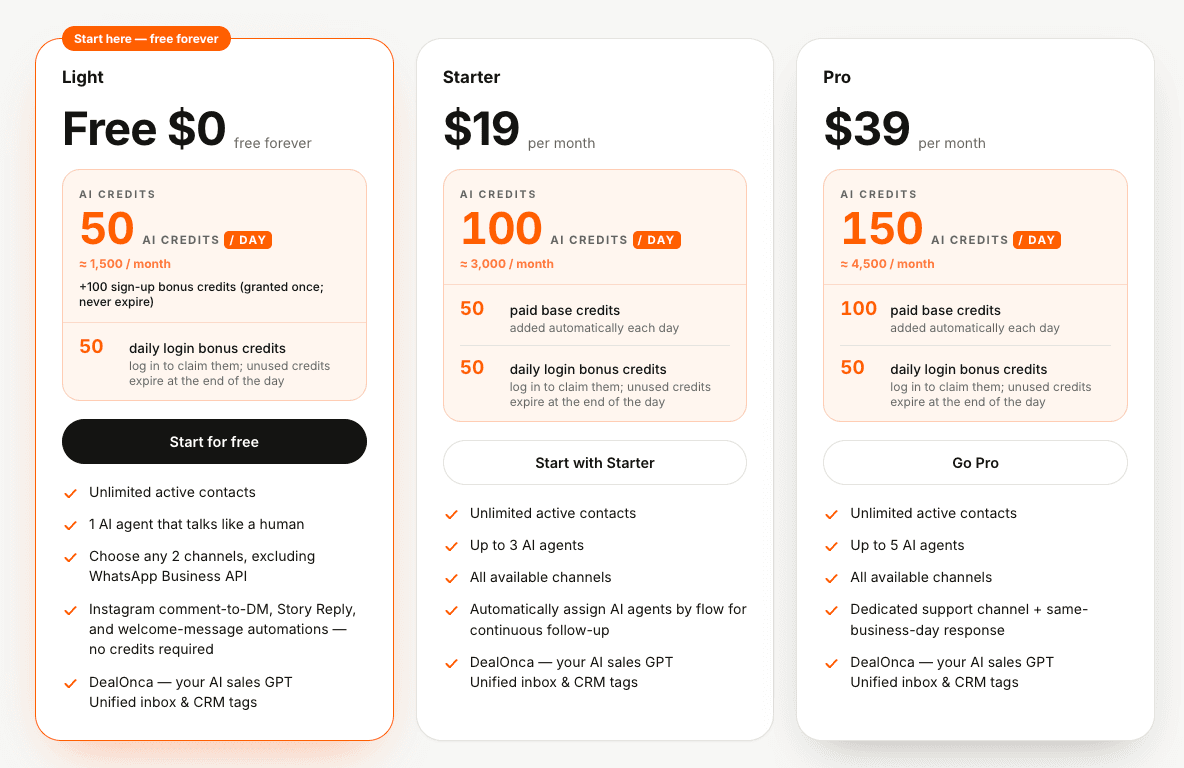
Active Contacts and AI replies are different units, so neither is universally cheaper. Estimate both realistically. For feature-level evaluation, see Dealism vs ManyChat.
Frequently Asked Questions
How much does ManyChat cost per month?
Free costs $0. Paid monthly bases are $17, $39, $99, and $199, before Active Contact overages.
Is ManyChat AI included in the price?
Under the current new-plan model, AI-powered conversations are included from Pro upward. Older accounts or legacy documentation may show a separate AI add-on.
Do Active Contacts reset every month?
Yes. They are recalculated each billing cycle, including for annual subscribers.
What happens when I exceed the contact allowance?
Paid plans apply a per-contact overage. ManyChat sends usage alerts and allows users to configure an overage threshold.
Does ManyChat charge separately for WhatsApp?
The ManyChat plan provides channel access where included, but Meta or WhatsApp messaging charges may still apply separately.
Is annual billing cheaper?
Annual billing has lower published base and overage rates, but it requires a longer commitment. Compare the annual total against realistic monthly contact volume before committing.
What is the cheapest plan at 10,000 Active Contacts?
Using current published rates and no additional feature constraints, monthly Business is approximately $161.50: the $99 base plus 2,500 overage contacts at $0.025. That is lower than the $199 Advanced base. Annual Business is approximately $114 monthly equivalent, also below Advanced at $139.
Use the ManyChat cost calculator for your own contact, channel, automation, and team requirements. You can also review Dealism pricing, explore other free tools, or build an AI agent to test a reply-based workflow.