Published
Mar 22, 2026

How to Do Market Research for a Small Business
Launching a business without understanding your market can lead to costly mistakes. Market research for small business helps entrepreneurs identify customer needs, evaluate demand, and develop strategies that actually work.
For small teams with limited resources, research doesn't have to involve expensive consultants. Learning how to do market research for a small business allows you to gather meaningful insights using affordable tools, customer conversations, and publicly available data.
According to U.S. Small Business Administration, market research helps businesses understand their industry, competitors, and potential customers before investing heavily in a new idea. You can explore their guide on U.S. Small Business Administration market research and competitive analysis to see how entrepreneurs evaluate markets before launching a company.
When done correctly, market research reduces uncertainty and helps businesses focus their efforts on opportunities with real demand.
Why Market Research Matters for Small Businesses
For entrepreneurs, understanding the market is often the difference between building a sustainable business and running out of resources too early. Many startups fail not because they lack effort or innovation, but because they struggle to achieve strong product-market fit.
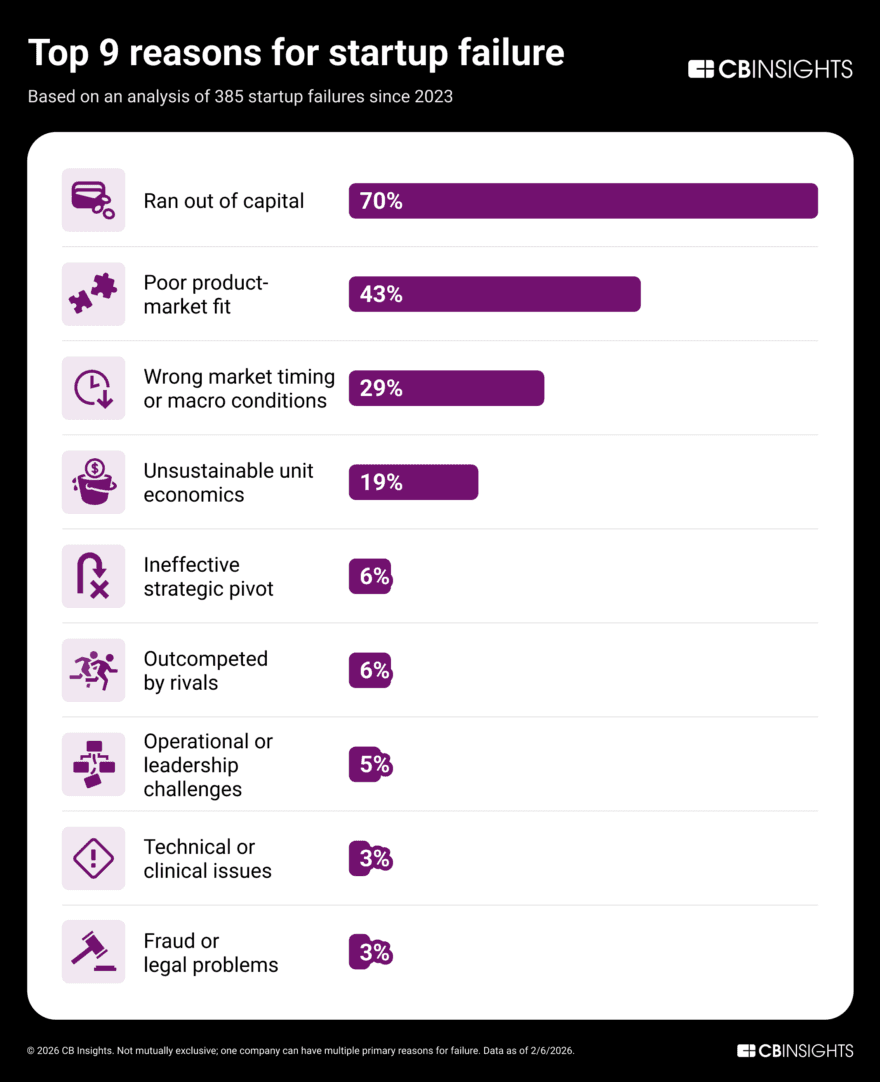
According to analysis by CB Insights in the report Startup Failure Reasons, startup shutdowns rarely have a single cause. The research examined 431 venture-backed companies that shut down since 2023 and analyzed public post-mortems, founder interviews, and shutdown announcements.
The data shows that 70% of startups eventually ran out of capital, but this is usually the final stage rather than the root cause. More revealing factors include:
Poor product-market fit — 43%
Bad timing — 29%
Unsustainable unit economics — 19%
(Alt text:The top 9 reasons startups fail)
These patterns suggest that many companies fail because they launch products before fully understanding market demand or customer needs.
This is why market research for small business plays such an important role. By identifying customer problems, validating demand early, and studying competitors, entrepreneurs can improve their chances of achieving strong product-market fit before investing heavily in growth.
In practice, conducting market research for small business helps founders answer the most important question early: Does the market actually want this product?
Practical Steps for Conducting Market Research for Small Business
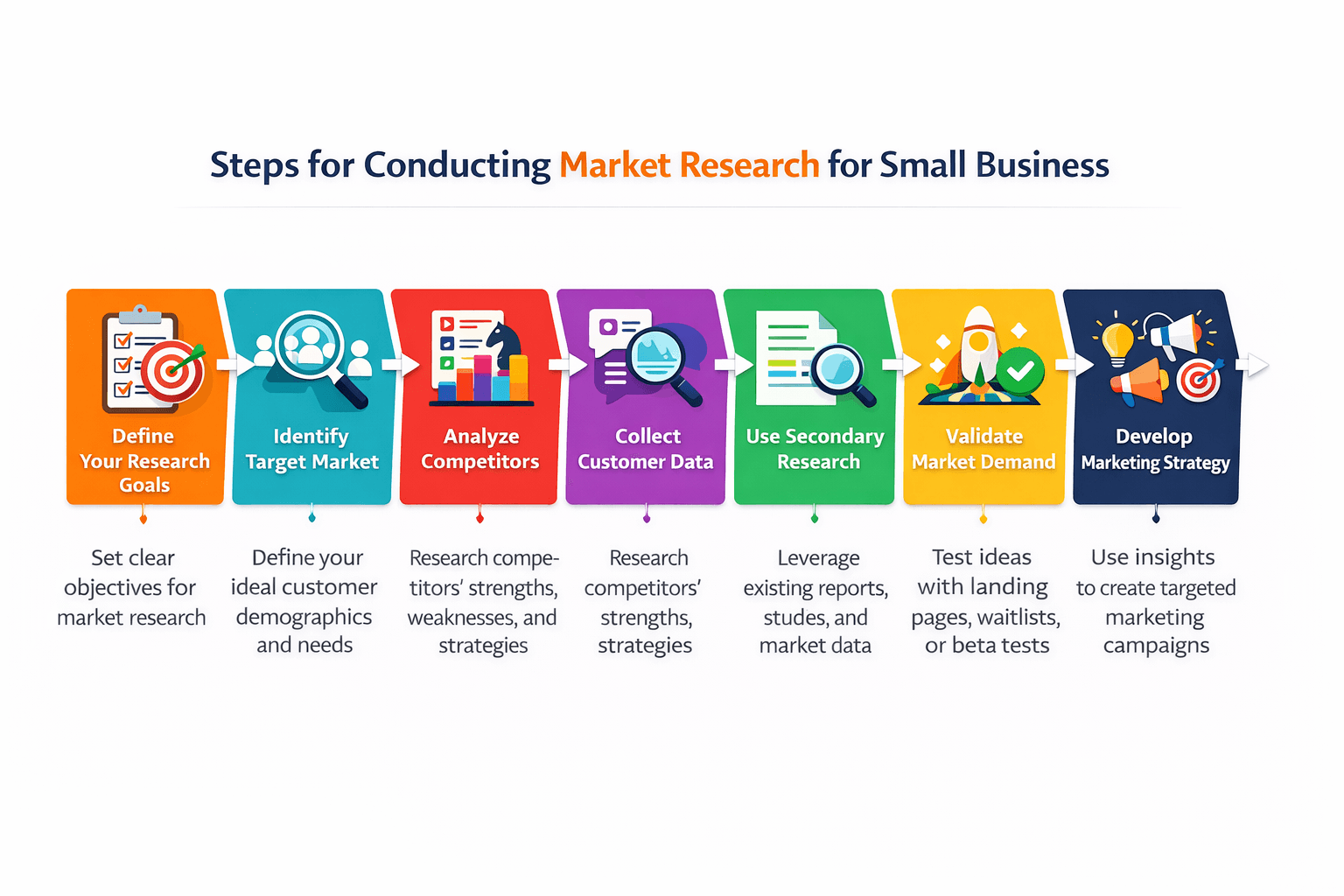
Understanding how to conduct market research for small business doesn't require complicated frameworks. The process can be broken into several practical steps.
(alt text:Steps for Conducting Market Research for Small Business )
1. Define Your Research Goals
Start by identifying exactly what you want to learn.
Common research goals include:
Understanding target customers
Testing product ideas
Evaluating pricing expectations
Measuring demand for a service
Clear objectives make the rest of the research process more efficient.
2. Identify Your Target Market
A key part of market research for a new business is defining who your customers are.
Important factors include:
Demographics (age, income, profession)
Location and regional demand
Lifestyle and interests
Buying motivations
Creating simple customer profiles helps businesses design products and marketing that resonate with real people.
3. Study Your Competitors
Competitive analysis is one of the fastest ways to understand the market.
Research competitors by analyzing:
Their pricing models
Product features
Customer reviews
Marketing channels
Messaging strategies
Reviews and social media comments can reveal what customers like—or dislike—about existing options.
4. Collect Primary Data From Customers
Primary research means gathering data directly from potential customers.
Small businesses can do this through:
Online surveys
Customer interviews
Feedback forms
Social media polls
Direct conversations often reveal insights that statistics alone cannot provide.
5. Use Secondary Market Data
Secondary research uses data that already exists.
Examples include:
Industry reports
Market trend studies
Government statistics
Consumer behavior research
Platforms like Google Trends and industry reports help businesses identify emerging opportunities.
6. Validate Demand Before Launch
For entrepreneurs starting a company, market research for a new business should include demand validation.
Some simple ways to validate ideas include:
Pre-launch landing pages
Waitlists
Beta testing groups
Early product preorders
These methods help determine whether customers are genuinely interested before significant investment.
7. Turn Research Into Marketing Strategy
The final step is applying research insights to marketing decisions.
Market research can guide:
Brand messaging
Pricing strategy
Advertising channels
Customer acquisition tactics
For a deeper look at translating insights into marketing strategy, resources like How to Market A Small Business explain how businesses turn research findings into practical marketing campaigns.
Using Customer Conversations as Modern Market Research
Traditional surveys are valuable, but many businesses now learn directly from everyday customer conversations.
Messaging platforms such as WhatsApp, Instagram, and website chat often reveal:
frequently asked questions
objections before purchasing
pricing concerns
real customer intent
As messaging becomes a primary business channel, companies increasingly analyze these conversations for insights.
For example, guides about WhatsApp automation for small businesses explain how automated messaging workflows can help businesses manage large volumes of inquiries while capturing patterns in customer questions and behavior.
Similarly, discussions around WhatsApp marketing automation strategies highlight how conversational data can reveal customer needs faster than traditional surveys.
These real-time insights allow businesses to adapt messaging, offers, and sales strategies more quickly.
More practical frameworks for managing high-volume customer conversations can be found across the Dealism blog’s resources on conversational sales and messaging automation.
How Dealism Helps Businesses Turn Conversations Into Market Insights
Instagram, and web chat can become overwhelming—especially when every inquiry might be a potential sale or valuable feedback.
Dealism isn’t just an automation tool—it’s an AI‑powered sales agent that turns everyday customer conversations into structured insights and revenue opportunities.
Unlike basic auto reply systems that send predefined texts, Dealism functions as a conversational AI sales agent that learns from your specific business context. It reviews your historical messages, product documents, FAQs, and knowledge base to build a personalized understanding of how your business communicates, what your offerings are, and how your best sales conversations unfold. With this foundation, Dealism can generate replies that naturally mirror your brand’s tone while advancing the conversation toward completion.
One key advantage is that Dealism doesn’t merely react to keywords—it interprets intent. For example, instead of simply replying “Thanks for your inquiry,” it can ask clarifying questions, provide tailored product recommendations, and guide customers along a logical path from inquiry to purchase. This is core to how to make WhatsApp automation truly effective for small businesses—turning casual chats into conversion‑focused exchanges.
Another strength is in its flexible workflow design. You can operate Dealism in:
Autopilot mode: where it independently handles routine inquiries, qualifies leads, sends follow‑ups, and responds 24/7 — freeing up your time without constant manual oversight.
Copilot mode: where it assists human agents by suggesting replies, highlighting intent signals, and recommending next steps, so your team can focus on closing deals rather than typing repetitive responses.

Because Dealism continuously learns from both your knowledge documents and new conversations, it doesn’t just stay static—it evolves. Over time, it improves accuracy, understands customer preferences more deeply, and even refines its persuasive approaches based on what works best for your business segment.
In short, Dealism transforms ordinary customer conversations into a source of structured market insights, better sales engagement, and consistent brand‑aligned communication—making it particularly valuable for small teams who want AI that sells for you rather than just automates responses.
Building a Smarter Small Business With Ongoing Market Research
Market research should never be treated as a one-time activity. Customer needs evolve, competitors adapt, and market trends change quickly.
By consistently gathering insights—from surveys, industry data, and real customer conversations—small businesses can refine their products, marketing strategies, and positioning over time.
When done well, market research for small business becomes a competitive advantage. It helps entrepreneurs launch smarter, reduce risk, and build businesses that align closely with real customer demand.
The companies that succeed long-term are often those that listen to their customers the most—and turn those insights into better decisions.