
For most small and medium-sized service businesses, deals are not lost at the final step.
They are lost inside conversations.
WhatsApp messages stay unread. Instagram DMs get delayed. Website inquiries are replied to too late or without direction. Not because there are no leads—but because no one is actively driving the conversation toward action.
Most SMBs don’t have a lead problem.
They have a conversation execution problem.
In messaging-first businesses, your inbox is not customer support. It is your sales environment. And closing is not something that happens at the end of a process—it starts the moment a customer says “Hi”.
To consistently increase sales and get customers, every conversation must move from intent → clarity → action without delay or confusion.
Here are 10 closing techniques designed for real messaging-based selling.
1. Closing Starts from the First Message
There is no separate “closing stage” in WhatsApp or Instagram DM.
The first reply already determines whether the deal moves forward or dies slowly.
Every message must create momentum, not just response.
If the conversation doesn’t move forward immediately, the lead starts drifting away.
2. Qualify Before You Recommend Anything
Most businesses lose deals by rushing into solutions too early.
Before sending prices, packages, or booking links, you need clarity:
What exactly does the customer want?
How urgent is it?
What outcome are they expecting?
Without this, every recommendation becomes guesswork instead of precision.
Good closing is not persuasion. It is matching the right solution to the right intent.
3. Stop Using Scripts, Start Using Vibe Selling
Customers instantly recognize scripted replies.
And when they do, trust drops.
Vibe Selling is not about templates or pre-written responses. It is about:
reading intent in real time
adapting tone naturally
guiding without pressure
responding like a human, not a flowchart
If the conversation feels alive, decisions move faster.
If it feels automated, it dies.
4. Speed Is Not Support. It Is Revenue Timing.
In messaging-based selling, timing decides conversion.
When a customer sends an inquiry, their intent is at its peak in that exact moment.
If you reply late:
they compare alternatives
they lose urgency
they move on silently
The difference between winning and losing a deal is often not price or product.
It is response timing.
5. Reduce Friction in Every Message
Customers don’t need more information.
They need clearer decisions.
Long explanations, PDFs, and overloaded options create hesitation, not confidence.
Instead, structure your replies like decision paths:
Option A or B
Morning or afternoon
Basic or advanced
The easier it is to choose, the faster the deal moves forward.
6. Every Message Must Control the Next Step
A conversation without direction is not selling—it is chatting.
Every reply should naturally lead to action:
“Should I reserve this for you?”
“Do you want the fastest available slot?”
“Which option fits you better?”
If there is no next step, there is no progression.
7. Objections Are Missing Clarity, Not Rejection
When a customer says:
“Too expensive”
“Let me think”
“Not sure yet”
They are not rejecting your offer.
They are telling you something is unclear.
Your job is not to defend—it is to uncover what is missing and remove the confusion.
8. Turn Attention into Private Conversations Instantly
Attention is the most valuable moment in social selling—and the most wasted.
When someone comments on your Instagram post or Reel, that is not engagement.
That is the intent.
High-performing businesses don’t wait.
The moment a comment is made, they move the user into a private DM flow with a clear next step—such as a trial, booking link, or offer.
This instant transition from comment → DM → action is where most conversions are won.
If you delay it, the intent disappears.
9. Automate Replies Without Losing Decision Quality
Replying faster is not enough.
Most automation tools fail because they only send static responses—they don’t understand context or intent.
Real sales conversations require an execution layer that can:
understand what the customer wants
decide what to ask next
qualify urgency and intent
guide the conversation forward
follow up when needed
This execution shouldn't be limited to one channel. Whether it is WhatsApp, Instagram DM, or a live chat widget embedded on your website, your closing logic must stay consistent.
Modern systems don’t just automate replies.
They act as an intelligent copilot that keeps conversations moving—even when no human is available.
10. Follow-Up Is Where Most Revenue Actually Happens
Most lost deals are not real rejections.
They are incomplete conversations.
Customers get distracted. They pause. They forget to reply.
Without follow-up, intent disappears silently.
Follow-up is not persistence.
It is structured recovery of lost attention.
Why Most Businesses Still Fail at Closing
Most SMBs try to fix messaging chaos using tools like CRMs or chatbots.
But both miss the real problem.
CRMs store information, but don’t move conversations forward.
Chatbots reply, but don’t understand intent.
The result is the same: conversations exist, but nothing progresses.
The real issue is not communication.
It is execution inside conversations.
The Real Problem: Conversations Without Direction
In messaging-based businesses, every chat should naturally move through a flow:
intent → clarification → decision → action
But in reality, most conversations look like this:
customer asks → business replies → conversation fades
No structure. No decision. No closure.
That is where revenue disappears.
Turning Conversations into Revenue Systems
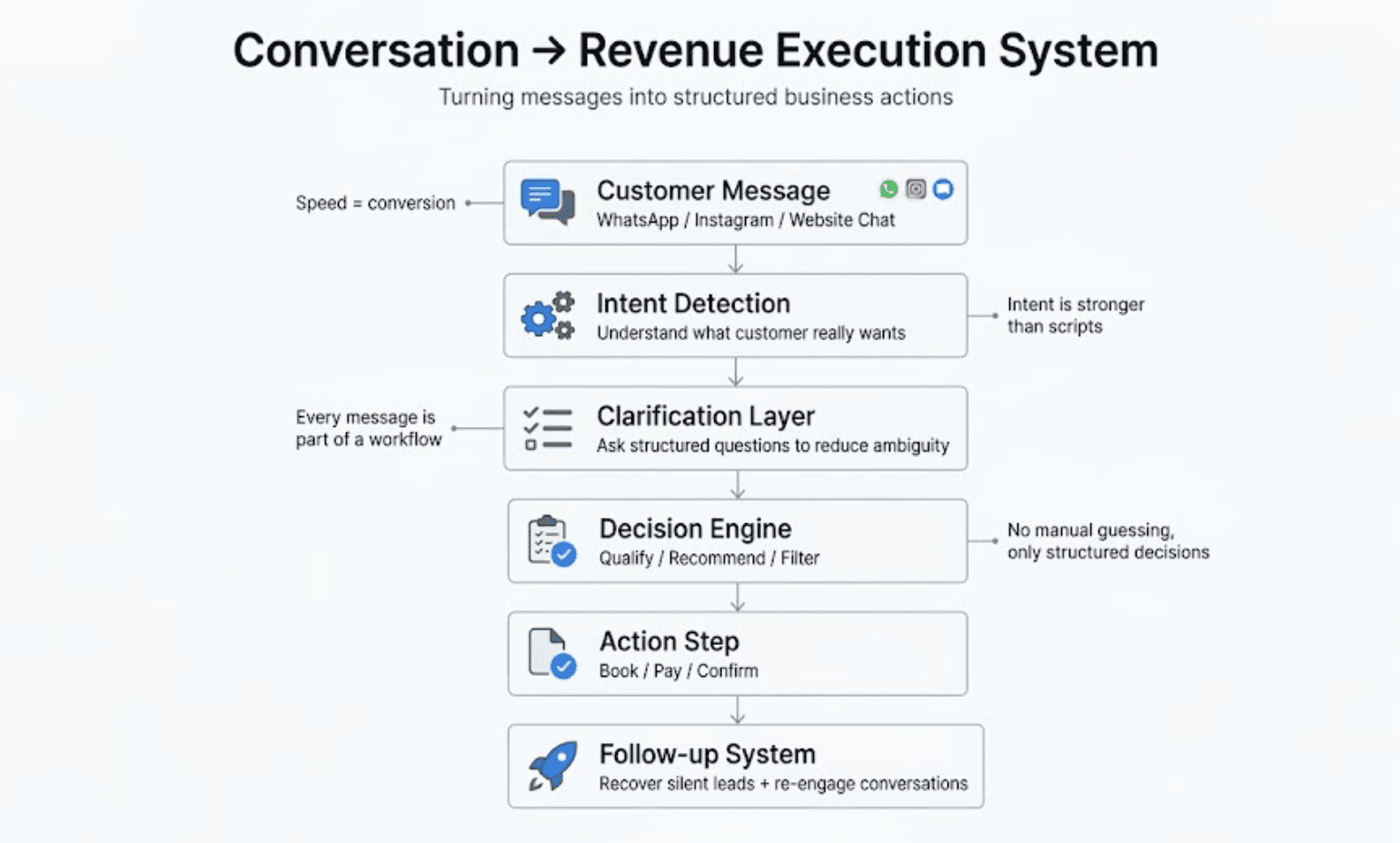
Relying on manual replies is no longer scalable. But replacing humans with rigid automation only makes things worse.
To truly increase sales and consistently get customers from WhatsApp, Instagram, and website chat, businesses need more than tools that respond.
They need systems that act.
When you shift from managing messy conversations to running structured workflows inside chats, closing stops being a personal skill.
It becomes a predictable business process.
Final Thought
You don’t need better sales scripts.
You don’t need more CRM dashboards.
You don’t need another chatbot.
You need conversations that don’t stall.
Because in messaging-based selling, the winners are not the ones who talk more.
They are the ones who turn every conversation into action.