An AI SDR is software that performs the work of a sales development representative — researching prospects, personalizing outreach, qualifying leads, and booking meetings — automatically and around the clock. Instead of a human rep manually sending the same 50 emails a day, an AI SDR generates and sends them, reads the replies, and decides what happens next. The best ones don't just blast messages; they hold a conversation and move a buyer toward a meeting or a sale.
That last point is where the category is changing fast. Most tools sold as an "AI SDR" in 2024 were really sequence senders with a language model bolted on. The 2026 version is an agent: it makes decisions, works across channels, and increasingly closes inside the chat rather than just handing off a calendar link. This guide explains what an AI SDR is, what an AI SDR agent actually does, how they compare to human reps, which tools lead on features, and where outbound automation is heading next year.
What is an AI SDR?
An AI SDR (artificial intelligence sales development representative) is an automated system that handles the top-of-funnel sales tasks a junior rep normally owns: building prospect lists, writing personalized first-touch messages, following up, answering basic questions, qualifying interest, and scheduling qualified leads with a human closer. It runs on large language models and your CRM data, so it can personalize at a scale no human team can match.
In plain terms: it's a tireless prospecting and qualification engine. It works nights, weekends, and holidays, replies in seconds instead of hours, and never skips a follow-up.
AI SDR vs. AI BDR
The two terms are used almost interchangeably, but there's a soft distinction worth knowing. An SDR (sales development rep) traditionally works inbound leads — people who already raised a hand. A BDR (business development rep) works outbound — cold prospects who've never heard of you. So you'll see "AI SDR" used for inbound qualification and "AI BDR" for cold outbound, though most vendors lump both functions under the AI SDR label. For the rest of this article, "AI SDR" covers both unless noted.
What is an AI SDR agent? (and how it differs from a basic AI SDR)
An AI SDR agent is the agentic evolution of the AI SDR. The difference comes down to autonomy and reasoning. A basic AI SDR follows a fixed playbook: send sequence step 1, wait, send step 2, stop on reply. An AI SDR agent sets sub-goals, decides which action to take next based on what the prospect just said, switches channels when one isn't working, and handles the back-and-forth of a real conversation instead of bailing out the moment a human responds.
Think of the difference this way:
Basic AI SDR: "Send the next email in the sequence."
AI SDR agent: "This lead asked about pricing and mentioned a deadline — answer the pricing question, surface the relevant plan, handle the objection, and propose two meeting times."
That shift matters because the hardest part of sales development isn't sending the first message — it's everything after the reply. An agent that can qualify, handle objections, and book the meeting inside the conversation removes the handoff gap where most leads go cold. Dealism's AI sales agent platform is built around this idea: goal-oriented agents that act in the moment of the conversation rather than just firing off a sequence and waiting.
How does an AI SDR work?
Under the hood, most AI SDRs run the same loop, whether for inbound or outbound:
Data and targeting. It pulls prospect data from your CRM, an enrichment database, or inbound form fills, and builds (or scores) a list that fits your ideal customer profile.
Personalization. Using that data plus a language model, it writes a message tailored to the person — their role, company, recent activity — rather than a generic template.
Multichannel outreach. It sends across email, LinkedIn, SMS, or messaging apps like WhatsApp and Instagram DM, and times follow-ups automatically.
Conversation and qualification. When the prospect replies, it interprets intent, answers questions, and asks qualifying questions to gauge fit and readiness.
Handoff or close. It books a meeting on a rep's calendar, routes a hot lead to a human, or — for agentic tools — keeps selling until the deal is ready.
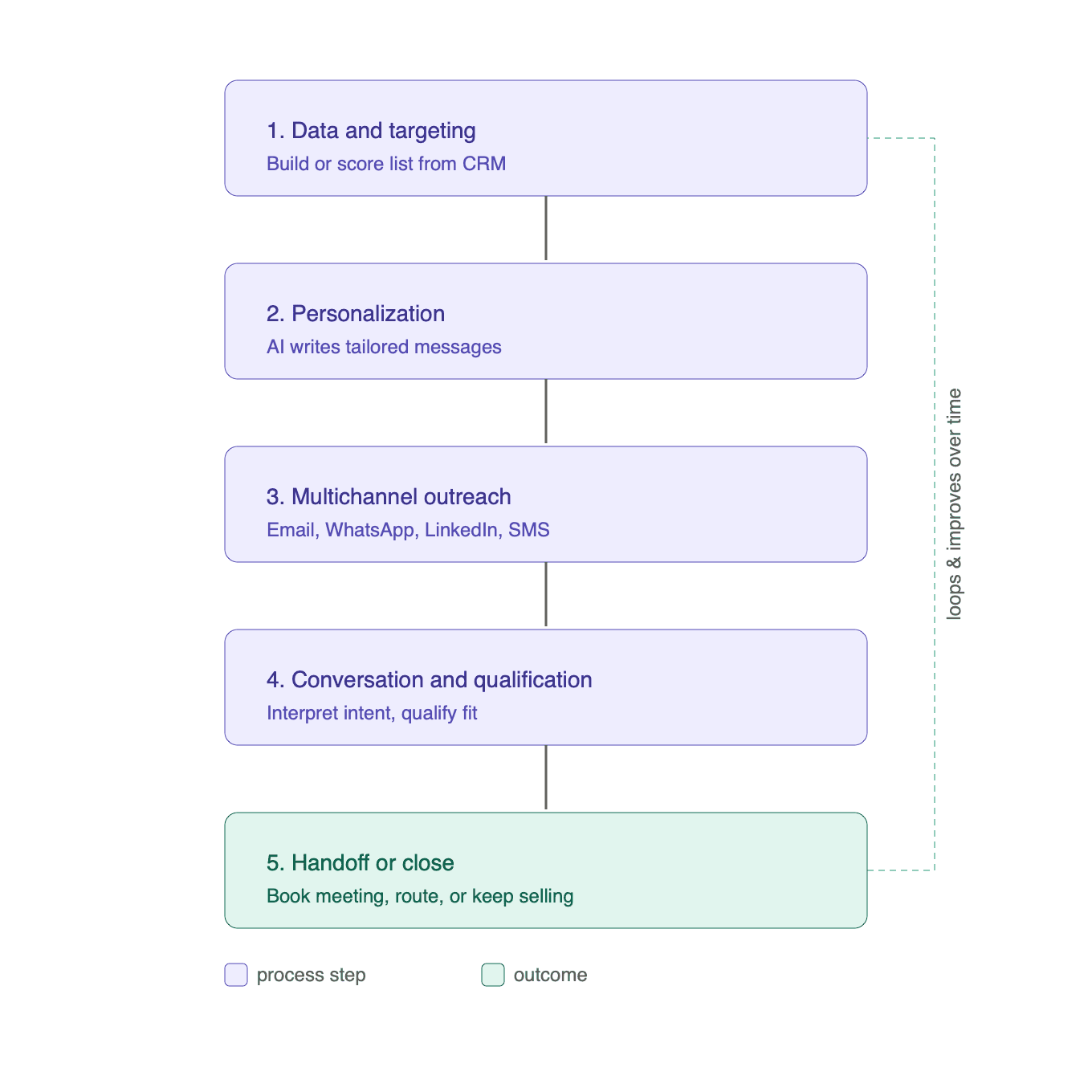
The system improves over time as it learns which messages and sequences actually convert. The quality of the whole loop depends heavily on your underlying data: garbage CRM data produces garbage outreach, no matter how good the model is.
AI SDR vs. human SDR
The honest answer to "should AI replace my SDRs?" is no — but it should change what they do. AI is unbeatable at volume, speed, and consistency; humans still win on complex conversations, relationship-building, and judgment. Here's how they stack up:
Criterion | AI SDR | Human SDR |
|---|---|---|
Cost | Subscription, often a fraction of one salary | Salary + benefits + tooling + ramp |
Speed to lead | Replies in seconds, 24/7 | Minutes to hours, business hours only |
Scale | Thousands of personalized touches at once | ~50–100 quality touches/day |
Consistency | Never forgets a follow-up, never has an off day | Varies by person, mood, and workload |
Ramp time | Live in days | Weeks to months to productivity |
Complex conversations | Good and improving; can stall on nuance | Strong — reads context, builds rapport |
Relationship-building | Limited | The core human advantage |
The cost gap is real: SaaStr's research puts the average SDR tenure at roughly 14 months, which means constant rehiring, ramping, and lost pipeline. An AI SDR doesn't churn. The winning model for most teams is hybrid: let AI handle the repetitive prospecting, qualification, and first replies, and free your humans for the conversations where rapport and creativity close deals — the kind of proven sales techniques that don't scale through templates.
AI SDRs for inbound vs. outbound
The same tool behaves differently depending on which motion you point it at:
Inbound AI SDR. Someone fills a form, starts a chat, or replies to a campaign. Speed is everything — research shows responding within the first five minutes dramatically raises the odds of qualifying a lead. An inbound AI SDR engages instantly, qualifies, and books before the lead cools off.
Outbound AI SDR (AI BDR). It works cold lists: enriching contacts, personalizing first touches, and running multi-step sequences across channels. The challenge here is relevance and deliverability — generic blasts get ignored or marked as spam, so personalization and sending discipline matter more than raw volume.
Most growing teams use both: the AI never lets an inbound lead sit, and it keeps the outbound engine running even when the team is asleep.
Which AI SDR has the best features? Tools compared (2026)
There's no single "best" AI SDR — the right one depends on whether you're enterprise or SMB, email-led or conversation-led. Here's how the leading tools compare on the features that actually differ:
Tool | Best for | Primary channel | Standout feature | Notable gap |
|---|---|---|---|---|
Artisan (Ava) | Outbound at scale | Large built-in B2B lead database | Email-centric; enterprise pricing | |
AiSDR | Email outbound + follow-up | Tight HubSpot workflow, fast setup | Salesforce support still maturing | |
11x (Alice) | Enterprise outbound | Email/voice | Voice + research-heavy outreach | Higher cost, heavier onboarding |
Qualified (Piper) | Inbound on your website | Website chat | Strong for high-traffic B2B sites | Built around inbound web traffic |
Dealism | SMBs selling in chat | WhatsApp, Instagram DM, LiveChat | DealOnca helps train and manage AI Customer Agents with business knowledge and conversation context | Built for conversational/SMB selling, not enterprise email-outbound |
A few buying notes:
If you're enterprise and email-outbound led, Artisan, AiSDR, and 11x are built for you — large databases, deep email sequencing, lots of integrations.
If your leads come through your website, Qualified's Piper is designed for inbound web traffic.
If you sell through conversations — WhatsApp, Instagram, live chat — and you're a small or mid-sized business, a conversational agent platform fits better than an email-outbound tool. For a broader landscape, see our roundup of the 10 best AI sales tools and what an AI sales assistant can do beyond prospecting.
Pricing varies widely — from around $17/month for entry messaging tools to $189+/month for enterprise platforms — so match the tool to your motion before you compare price tags.
Outbound automation trends for 2025–2026
Four shifts are defining where AI SDRs go next year:
From sequences to agents. The market is moving from rigid send-and-wait sequences to agentic systems that reason, decide, and handle a full conversation. "Set up a sequence" is becoming "deploy an agent with a goal."
Conversation-channel outreach. Email saturation is pushing outbound toward messaging — WhatsApp, Instagram DM, and SMS — where open and reply rates are far higher, especially outside North America. Selling in the channel where buyers actually respond is now a competitive edge, which is why a WhatsApp AI chatbot is becoming a core outbound tool rather than a support add-on.
Orchestration and coaching. Instead of one bot acting alone, teams are deploying a coordinated layer — an AI "director" that sets strategy, extracts what works from real conversations, and coaches the AI Customer Agents. This is the difference between automation and an actual sales operation.
Compliance and deliverability discipline. As regulators and inbox providers crack down on spammy automation, the winners will be tools that personalize genuinely and respect consent — quality of touch over quantity. Expect ROI conversations to center on conversion and deliverability, not raw send volume.
From a single bot to a team that closes — the dealism.ai approach
Most AI SDRs automate the sending. The harder, more valuable problem is everything that happens once a buyer replies — and doing it the way your best rep would. That's the gap dealism.ai is built to close.
Dealism brings together messaging automation, Unified Inbox, CRM, AI Agent, and an AI workspace (DealOnca) for small businesses that sell through conversation — with unlimited Active Contacts on the Free plan. DealOnca, its built-in "ChatGPT for sales," helps train and manage Agents, organize knowledge, summarize conversations, and support follow-up. The AI Customer Agent can use approved sales guidance and business knowledge to answer, qualify, recommend, book, and continue the conversation.
For a small business, the practical advantage is faster setup and consistent coverage without rebuilding every sales conversation as an outbound sequence. Train one Agent on your business knowledge, review how it handles real inquiries, and use it across the channels your customers already use. If outbound prospecting is your priority, Dealism's AI SDR and outreach agent can support that workflow as part of the same workspace.
Ready to compare it against your current stack? See Dealism's plans and pricing. Dealism’s free plan includes unlimited active contacts, unlimited workflows, one AI Customer Agent, core CRM and 50 AI credits you can claim every day.
FAQ
Will AI SDRs replace human SDRs?
No — they're reshaping the role, not deleting it. AI takes over repetitive prospecting, instant first replies, and qualification; humans focus on complex deals, relationships, and strategy. The most effective teams run a hybrid model.
How much does an AI SDR cost?
It ranges widely. Entry-level conversational tools start around $17–$99/month, while enterprise email-outbound platforms run $189/month and up. The relevant comparison isn't just price — it's cost per qualified meeting versus a human SDR's fully loaded cost (salary, benefits, ramp, and churn).
Are AI SDRs good for small businesses?
Yes, often more so than for enterprises — an AI SDR gives a small team 24/7 coverage and instant lead response without new headcount. SMBs that sell through WhatsApp, Instagram, or live chat get the most value from a conversational agent rather than an enterprise email-outbound tool.
Is AI SDR outreach compliant?
It can be, but compliance is on you. Respect consent and opt-out rules (GDPR, CAN-SPAM, and local regulations), personalize genuinely instead of mass-blasting, and protect deliverability. Reputable tools build in sending limits and consent handling — but the policies and lists you feed them still matter.