Published

Small businesses are not struggling because they lack customer messages.
They are struggling because conversations don’t turn into revenue decisions.
A lead messages you. You reply. The conversation continues for a few lines… then stops. No booking. No purchase. No follow-up.
In 2026, the cost of a reply is near zero, but the cost of a stalled conversation is a lost business. If your chat provider only “replies”, they are not solving your problem—they are just automating your silence.
What Is a Managed Live Chat Provider?
A managed live chat provider helps businesses handle customer conversations across channels such as:
Website chat widgets
Instagram messaging
WhatsApp communication
Other direct messaging platforms
On paper, they promise faster replies and better customer service.
In reality, most solutions fall into two outdated models:
1. Outsourced human chat teams
Expensive to scale
Inconsistent in quality
Limited understanding of business logic
2. Rule-based chatbot systems
Fast but rigid
Break when users go off-script
Cannot handle real intent ambiguity
Both approaches share the same limitation:
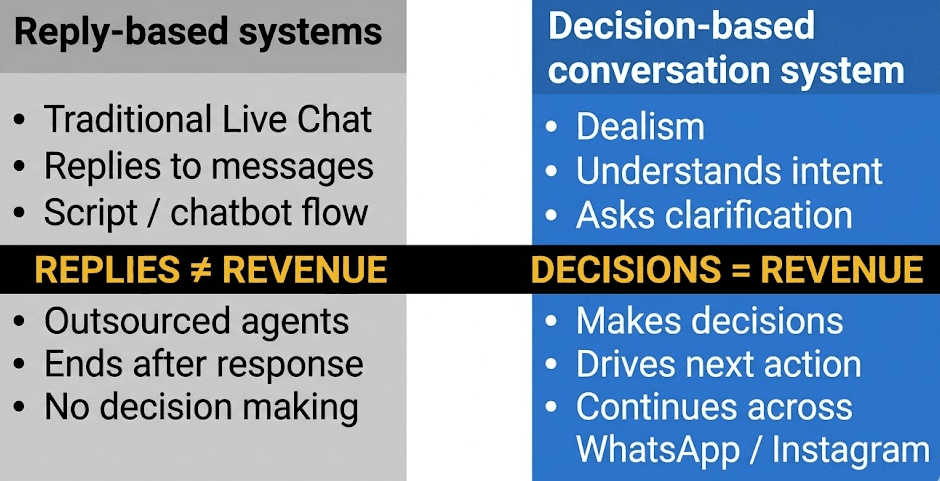
They can respond to messages, but they cannot drive decisions inside conversations.
The Real Problem: Replies Are Not the Issue. Stalled Conversations Are.
Most SMBs assume the problem is response speed.
It is not.
The real problem is:
Conversations are answered, but nothing moves forward.
Example:
A patient messages a dental clinic:
“My tooth hurts.”
A typical system responds:
“Please check our service list”
or“Select an option below”
Technically, the conversation continues.
But practically, nothing happens.
A system that actually works would ask:
“Is the pain constant or only when eating hot or cold food?”
“Do you need an appointment today or tomorrow morning?”
This is the real gap:
Not communication. But lack of judgment inside conversation flow.
Why Traditional Managed Live Chat Providers Fail SMBs
Small businesses don’t operate like enterprises.
They don’t have CRM teams, ticket pipelines, or structured sales ops.
They rely on:
Instagram DMs
WhatsApp inquiries
Website chat
But these are high-intent, unstructured conversations.
So businesses end up with two broken solutions:
Outsourcing support
Covers volume
But lacks context
Fails to qualify intent
Chatbots
Handles FAQs
But breaks under ambiguity
Feels robotic in real conversations
The result is the same:
Conversations are handled, but decisions are not made.
Introducing Dealism: Conversation Execution, Not Chat Management
Dealism is a conversation execution system—not a chatbot, not a CRM, not an outsourcing layer.
It is built on a simple principle:
Conversations are not support. Conversations are work.
Instead of only replying, Dealism:
understands intent
asks clarifying questions
qualifies leads
drives next actions
pushes toward booking or purchase
It runs directly inside:
Instagram DMs (Instagram)
WhatsApp (WhatsApp)
Website embedded chat
But the goal is not to “manage chats”.
The goal is to complete conversations with outcomes.
Core Capability: From Messages to Decisions
Most tools treat chat as communication.
Dealism treats chat as execution flow:
Input: messy human message
Process: intent understanding + clarification
Output: decision + action
This shifts the category entirely.
Instead of:
replying faster
It focuses on:
making decisions inside conversations
Instead of:
answering questions
It focuses on:
resolving intent
Instead of:
storing chats
It focuses on:
producing outcomes
Why This Matters for SMBs
SMBs don’t need more systems.
They need fewer lost opportunities.
What actually matters is:
fewer missed bookings
fewer abandoned inquiries
more completed actions
CRM tools record customers after the fact.
But most business loss happens before that point.
So Dealism sits earlier in the pipeline:
CRM stores what happened.
Dealism ensures something happens.
Vibe Selling: How Conversations Actually Move Forward
Dealism uses a method called Vibe Selling.
Not scripts. Not flows. Not templates.
But adaptive decision-making inside conversation.
Dimension | Traditional Chatbot | Dealism |
Interaction | Fixed replies | Adaptive conversation |
Logic | Rule tree | Intent-driven flow |
Ambiguity | Fails or escalates | Clarifies and continues |
Outcome | Answer messages | Drive actions |
The key difference:
Traditional systems respond to messages.
Dealism advances decisions inside messages.
New Expansion: Turning Attention Into Conversion Entry Points
Beyond core conversation execution, Dealism extends into two high-intent entry channels.
1. Instagram Comment → DM Conversion (Preventing Lead Leakage at Peak Intent)
Comments are one of the strongest signals of intent.
A user comments because they are interested—but still in a public, uncontrolled environment.
Most businesses lose that intent in the comment section.
Dealism changes this flow:
Comment → Private DM → Qualification → Action
When a user comments on Instagram (Instagram), Dealism can:
trigger instant DM outreach
respond with contextual messaging
include clickable action links (e.g. “Free Trial – Click Here”)
guide users into structured qualification flows
But the real value is not automation.
It is control over leakage.
This prevents your hottest leads from leaking into the comment section and moves them into a private, decision-based environment instantly.
Instead of losing intent in public threads, businesses capture it in private conversations where decisions actually happen.
2. Embedded Live Chat (Website → Bridge to Owned Conversations)
Most live chat systems fail in a critical way:
They are dead ends.
A visitor asks a question. The browser tab closes. The conversation is gone.
Most live chat widgets are “dead ends”—the lead vanishes when the browser tab closes.
Dealism changes this entirely.
A website is not a destination.
It is a bridge into owned messaging channels.
With a simple embedded snippet, businesses can:
start conversations directly from websites
continue them on WhatsApp or Instagram
maintain engagement beyond the browser session
This changes everything:
Dealism turns the website into a bridge to WhatsApp or Instagram, ensuring the business owns the contact, not just the session.
Traditional live chat ends with the page.
Dealism continues the conversation inside messaging systems like WhatsApp (WhatsApp) and Instagram.
So even if the user leaves:
the conversation does not end
the intent is not lost
the business still owns the relationship
Why This Is Not a Chatbot or CRM Replacement
Dealism is often misunderstood as automation.
It is not.
Chatbots respond
CRMs store
Outsourcing scales replies
Dealism does something different:
It executes decisions inside conversations.
It operates between first message and structured CRM entry:
where intent is still messy
where decisions are not made yet
where most businesses lose revenue
Final Takeaway
Managed live chat is usually positioned as a support layer.
But for SMBs, support is not the bottleneck.
The bottleneck is execution inside conversations.
That is where most systems stop.
Dealism starts there.
It turns:
conversations into decisions
decisions into actions
actions into revenue outcomes
Not bots. Not CRM.
Just conversation systems that actually get things done.