Imagine a homeowner finds your cleaning service on Google, visits your website, then sends a WhatsApp message: “Can you come this week, and how much does it cost?” This is no longer casual browsing. The customer is already moving from interest to action. But if the reply only gives a price, comes too late, or gives no clear next step, the buying path breaks.
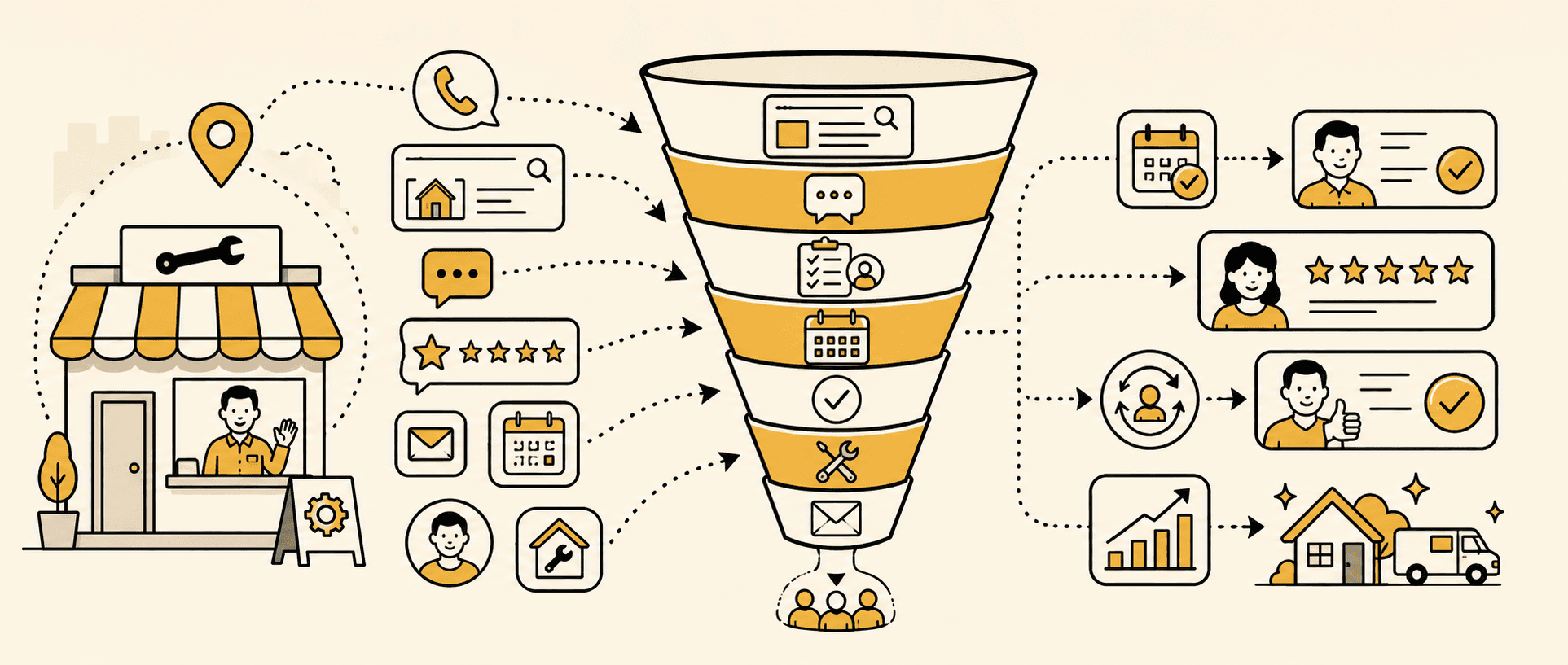
To handle this kind of gap, service providers need a simple way to understand where each customer is in the buying journey. This is where a sales funnel for local business becomes useful. It connects discovery, questions, trust, booking, and follow-up into one clear flow, helping local businesses turn scattered messages into quotes, consultations, and confirmed bookings.
What Is a Sales Funnel for a Local Service Business?
A sales funnel is the path that turns a stranger into a booked customer. For a local service business, this path is often messy. A customer may find you on Google, check reviews, visit your website, browse Instagram, and then ask about price or availability on WhatsApp.
The funnel helps you organize this journey into clear stages:
how the customer found you
what question is slowing them down
what information can build trust
what next step they should take
This matters because local services are not bought only by price. Customers also care about timing, trust, location, fit, and risk. A clinic, beauty studio, tutoring center, repair company, or home service provider must often explain before it can sell.
Sales Funnel Stages for Local Service Businesses
For local businesses, sales funnel stages are easier to understand when you connect them to real customer behavior. A customer does not always move from one page to another in a clean order. They may discover you on Google, check reviews, visit Instagram, ask a price question on WhatsApp, disappear for two days, and then come back ready to book.This is why Customer Chat Support matters: it helps the business keep context, answer at the right moment, and move each customer forward even when the journey is not linear.
Stage | Customer Signal | Business Response |
Awareness | Finds you through Google, ads, referrals, or social media | Make the service easy to understand |
Interest | Checks your website, reviews, or Instagram | Build trust with clear proof and examples |
Consideration | Asks about price, results, details, or availability | Answer clearly and qualify the need |
Decision | Wants to book, request a quote, or schedule a consultation | Give one simple next step |
Follow-up | Stops replying or says “I’ll think about it” | Re-engage with useful context |
Retention | Returns for support or another service | Create repeat bookings and referrals |
The key is not the stage name. The key is the signal. “How much is it?” may mean the customer is comparing options. “Do you have time this week?” may mean they are ready to act. A strong sales funnel helps local service providers respond based on intent, not just the surface question.
Why a Traditional Sales Funnel Builder Often Fails Local Service Conversations
A traditional sales funnel builder is useful for landing pages, forms, emails, and basic automation. It can help a customer leave their name, click a button, or enter a simple sequence. But for local businesses, the hardest part usually happens after that first contact.
A customer may already be interested. They checked your website, compared reviews, and sent a WhatsApp or Instagram message about price, timing, or service fit. At this point, the sales funnel does not break because the page is missing. It breaks because the conversation is not handled well.
Common weak points include:
slow replies when the customer is close to booking
price answers with no context, value, or next step
no follow-up after “I’ll think about it”
unclear handoff when a customer needs human judgment
This is why a local service funnel needs more than forms. It needs context, intent reading, and timely action.
Dealism fits this gap as an AI Vibe-Selling agent with AI sales strategy for WhatsApp, Instagram, and Web Chat. It helps read what the customer is asking, answer with business context, suggest the next step, and move warm leads toward booking, quote, consultation, or human follow-up.
How Dealism Turns Local Service Conversations Into Sales Actions
A small clinic, beauty studio, tutoring center, or repair service rarely has a sales team managing every inquiry. The owner may be serving customers, checking schedules, handling payments, and replying to WhatsApp or Instagram at the same time. In a traditional sales funnel, leads are often captured through forms, stored in a CRM, and followed up manually. For small local businesses, that process can become too heavy. When every message needs logging, tagging, updating, and chasing, the CRM becomes extra work instead of real sales support.
That is why the funnel needs to work inside the conversation. Dealism is designed for the place where local service leads actually appear: customer conversations. In WhatsApp, Instagram, and Web Chat, this AI sales agent can understand context, clarify needs, and help move the customer toward a real action.
If you want to learn more,please explore our guide page
Funnel Problem | How Dealism Helps |
Customers ask repeated questions | AI Sales Agent replies using FAQs, service details, pricing rules, and business knowledge |
Leads come from different channels | Inbox keeps WhatsApp, Instagram, and Web Chat conversations easier to manage |
Customer intent is unclear | Agent asks clarifying questions before suggesting booking, quote, or consultation |
High-intent leads are mixed with routine messages | Sales Strategy and lead scoring help identify which leads need faster attention |
Leads stop replying after the first chat | Automated follow-up helps restart the conversation with useful context |
Some cases need human judgment | Copilot and Autopilot support human-in-the-loop control |
Product or service information changes | Dealism's built-in "ChatGPT for sales" can help sync updated knowledge across agents for larger teams |
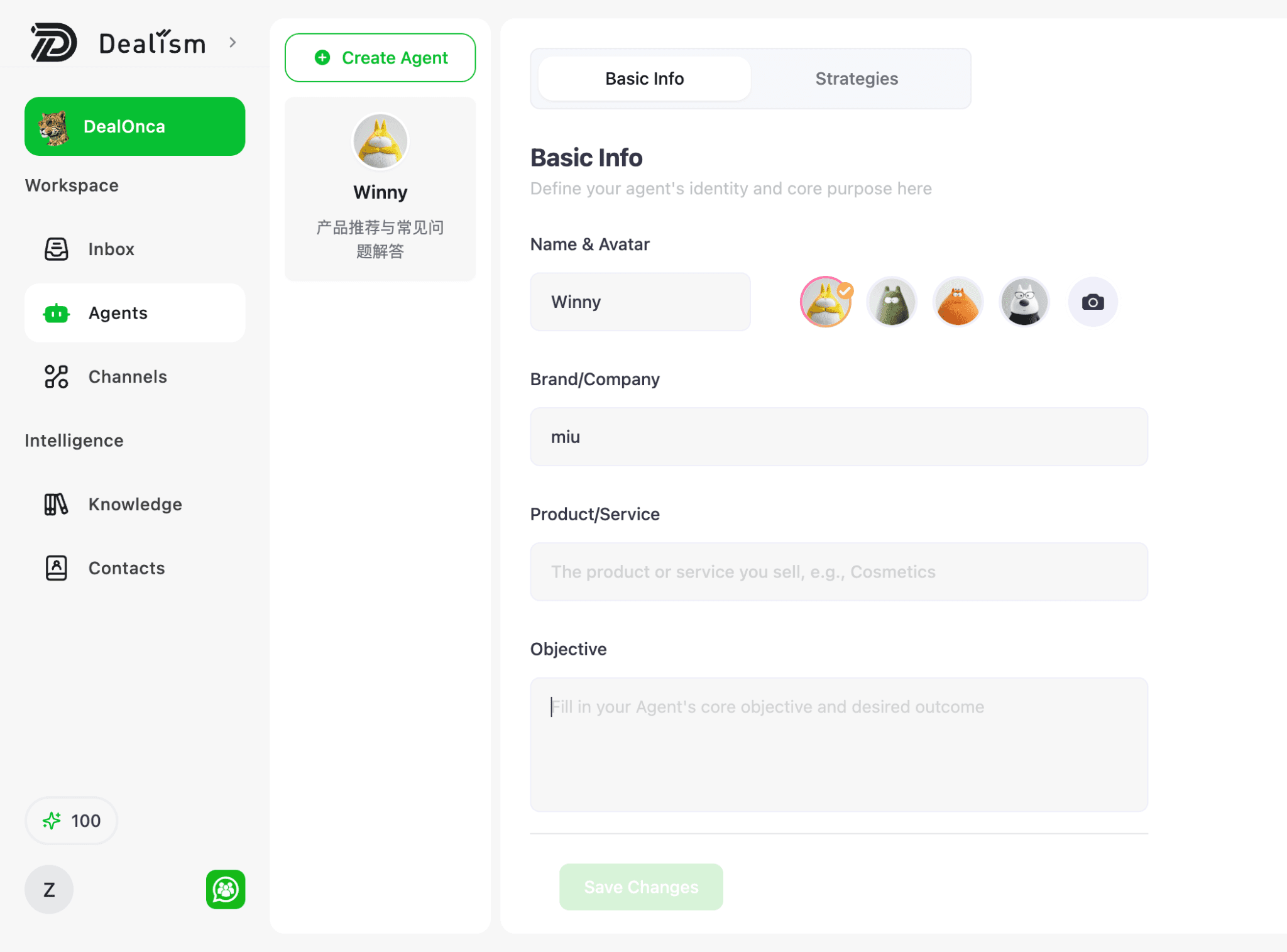
This is the difference small operators care about. They do not only need a place to store contacts. They need help deciding what to say next, when to follow up, and when a real person should step in.
For example, a price question may need a service match, not just a number. An Instagram comment may need a private DM path before it becomes a real inquiry. A silent lead may need a soft reminder, not another generic promotion. Dealism helps turn these moments into action, so the sales funnel can keep moving.
Conclusion
A useful sales funnel for local business earns its value at the moment a customer asks for help. That moment is often fragile. The owner may be serving clients, managing schedules, checking payments, and replying between tasks. If every inquiry still needs manual sorting, CRM updates, and delayed follow-up, the lead can cool down before the business has a real chance to convert it.
Dealism gives this kind of funnel an execution layer inside the chat itself. As an AI Vibe-Selling Agent for WhatsApp, Instagram, and Web Chat, it helps understand context, clarify customer needs, use business knowledge, and guide the next step: booking, quote, consultation, follow-up, or human handoff. If your service business already gets serious questions in chat, Dealism helps turn those messages into sales actions instead of leaving them as another inbox to manage.