
Best Marketing Tools for Small Businesses in 2026
Small businesses operate in an increasingly digital and competitive environment. Business owners often need to attract customers, manage campaigns, and respond to inquiries while handling daily operations.
Marketing tools help simplify these tasks by automating workflows, improving efficiency, and providing useful insights. From content creation platforms to SEO tools and AI-powered communication systems, the right marketing stack allows small businesses to compete with larger companies without large teams or budgets.
This guide explores the most important marketing tools for small business and how they support customer acquisition, engagement, and long-term growth.
Why Small Businesses Need Marketing Tools
Limited time and resources
Small business owners often manage marketing alongside sales, customer service, and daily operations. Marketing tools automate repetitive tasks such as scheduling social media posts, sending email campaigns, and responding to common inquiries with auto reply systems, allowing owners to focus more on strategy and customer relationships.
Competing with larger brands
Large companies typically have dedicated marketing teams and bigger budgets. Online marketing tools for small businesses help smaller teams compete by providing access to analytics, automation, and campaign management features that make marketing more efficient and data-driven.
Improving customer acquisition and retention
Effective marketing requires both attracting new customers and maintaining relationships with existing ones.
Marketing tools for small businesses help businesses:
discover potential customers through SEO and analytics
nurture leads through email marketing
manage contacts with CRM platforms
engage customers through messaging channels
Together, these tools create a more consistent and efficient customer journey.
Types of Marketing Tools for Small Businesses
Small businesses use different marketing tools to manage content, attract customers, and maintain relationships.
Content creation tools help businesses produce blog posts, graphics, and marketing visuals quickly. Design platforms and AI writing tools allow teams to create consistent content without large creative resources.
SEO and analytics tools help businesses attract organic traffic. They support keyword research, competitor analysis, and website performance tracking to improve search visibility.
Social media marketing tools simplify managing multiple platforms. Businesses can schedule posts, monitor engagement, and track performance from a single dashboard.
Email marketing tools help build subscriber lists and run campaigns such as newsletters or automated email sequences to nurture leads and retain customers.
CRM tools organize customer information and track sales pipelines, helping businesses manage leads and relationships.
Conversational marketing tools manage customer interactions on messaging platforms like Instagram, WhatsApp, and website chat, allowing businesses to respond quickly and automate common inquiries.
Best Marketing Tools for Small Businesses
Small businesses rely on a variety of tools to manage marketing efficiently.
The following tools cover different areas of marketing, including content creation, SEO, email marketing, CRM, and conversational marketing.
Each tool solves a different problem in the marketing workflow.
Canva — Visual Content Creation for Non-Designers
For many small businesses, creating visual content quickly is essential. Canva makes it possible to design professional marketing assets without hiring a designer.
It provides thousands of ready-to-use templates that can be customized for different platforms, making it especially useful for businesses managing multiple marketing channels.
Common use cases
creating social media graphics and posts
designing promotional banners or ad creatives
producing simple brand assets like presentations and flyers
The main advantage of Canva is accessibility. Even teams with no design background can produce consistent visual content for websites, social media, and marketing campaigns.
Mailchimp — Email Marketing and Customer Retention
Email marketing remains one of the most reliable channels for maintaining relationships with customers. Mailchimp is widely used by small businesses because it combines list management, campaign automation, and analytics in one platform.
It helps businesses build email audiences and keep customers engaged over time.
Common use cases
sending newsletters to subscribers
running automated welcome or onboarding sequences
promoting products, updates, or seasonal campaigns
Mailchimp is particularly useful for businesses that rely on repeat customers, such as ecommerce stores, service providers, or subscription businesses.
SEMrush — SEO and Search Marketing Insights
Search engine optimization is a long-term strategy for attracting new customers. SEMrush helps businesses understand how people search online and how competitors generate traffic.
The platform provides detailed data about keywords, rankings, and competitor strategies.
Common use cases
identifying high-value keywords for content marketing
analyzing competitor websites and SEO strategies
optimizing blog posts or landing pages for search visibility
For small businesses focused on organic growth, SEO tools like SEMrush make it easier to discover opportunities and track ranking performance.
HubSpot — CRM and Marketing Automation Platform
Managing customer relationships becomes more complex as a business grows. HubSpot provides a centralized platform for tracking leads, organizing contacts, and monitoring sales activity.
It connects marketing efforts with sales pipelines so teams can see how leads move from first contact to purchase.
Common use cases
organizing customer and prospect databases
tracking deal pipelines and sales activity
integrating marketing campaigns with CRM data
HubSpot is often used by businesses that want to bring marketing, sales, and customer management into a single system.
Dealism — AI Conversational Marketing and Sales Agent
Many small businesses now receive customer inquiries through messaging platforms such as Instagram, WhatsApp, or website chat. Managing these conversations manually can quickly become overwhelming, especially for small teams.
Dealism focuses specifically on this problem by turning customer conversations into structured sales interactions.
Instead of functioning like a simple chatbot, Dealism uses AI to understand user intent and guide conversations toward meaningful outcomes.

Key capabilities
automatically responding to incoming messages
identifying customer intent and qualifying potential leads
guiding users toward booking, purchasing, or requesting services
managing conversations across multiple messaging platforms
By managing conversations automatically, tools like Dealism help small businesses turn everyday messages into opportunities for sales or bookings. User stories from different industries—from local home service and Beauty clinics to coaching services—show how Dealism enables small businesses of all types to capture leads and drive conversions efficiently.
How to Choose the Right Marketing Tools
Define your marketing goals
Before selecting marketing tools, businesses should first clarify their primary objectives. Some businesses prioritize generating website traffic, while others focus on increasing sales or improving customer engagement.
Choosing tools that directly support these goals ensures that marketing investments produce meaningful results.
Consider ease of use
Small teams benefit most from tools that are intuitive and easy to implement. Complex systems often require training and ongoing management, which may not be practical for smaller organizations.
Tools that offer simple interfaces and automation features allow teams to adopt them quickly and start seeing results sooner.
Evaluate cost and scalability
Budget is always an important factor for small businesses. Marketing tools should provide strong value while remaining affordable.
At the same time, businesses should consider whether a tool can scale as the company grows. Platforms that support integrations and advanced features make it easier to expand marketing operations over time.
The Future of Marketing Tools for Small Businesses
Marketing tools for small businesses are evolving quickly. Tasks that once required multiple platforms and manual work are increasingly handled through intelligent automation. Three major trends are shaping this shift: AI-powered automation, conversational marketing, and AI-driven sales agents.
AI-Powered Marketing Automation
AI is transforming how small businesses run marketing operations. Modern tools can automate campaign creation, audience segmentation, follow-ups, and performance optimization. This allows small teams to manage complex marketing workflows with far less manual effort.
Conversational Marketing
Messaging platforms such as WhatsApp, Instagram DMs, and website chat are becoming key customer communication channels. Instead of navigating websites or forms, customers prefer to ask questions and interact directly through chat. Conversational marketing tools help businesses guide these interactions from inquiry to purchase in real time.
AI Sales Agents
The next step in marketing technology is AI sales agents. Unlike basic chatbots, these systems can understand conversation context, respond naturally, and move prospects toward decisions.
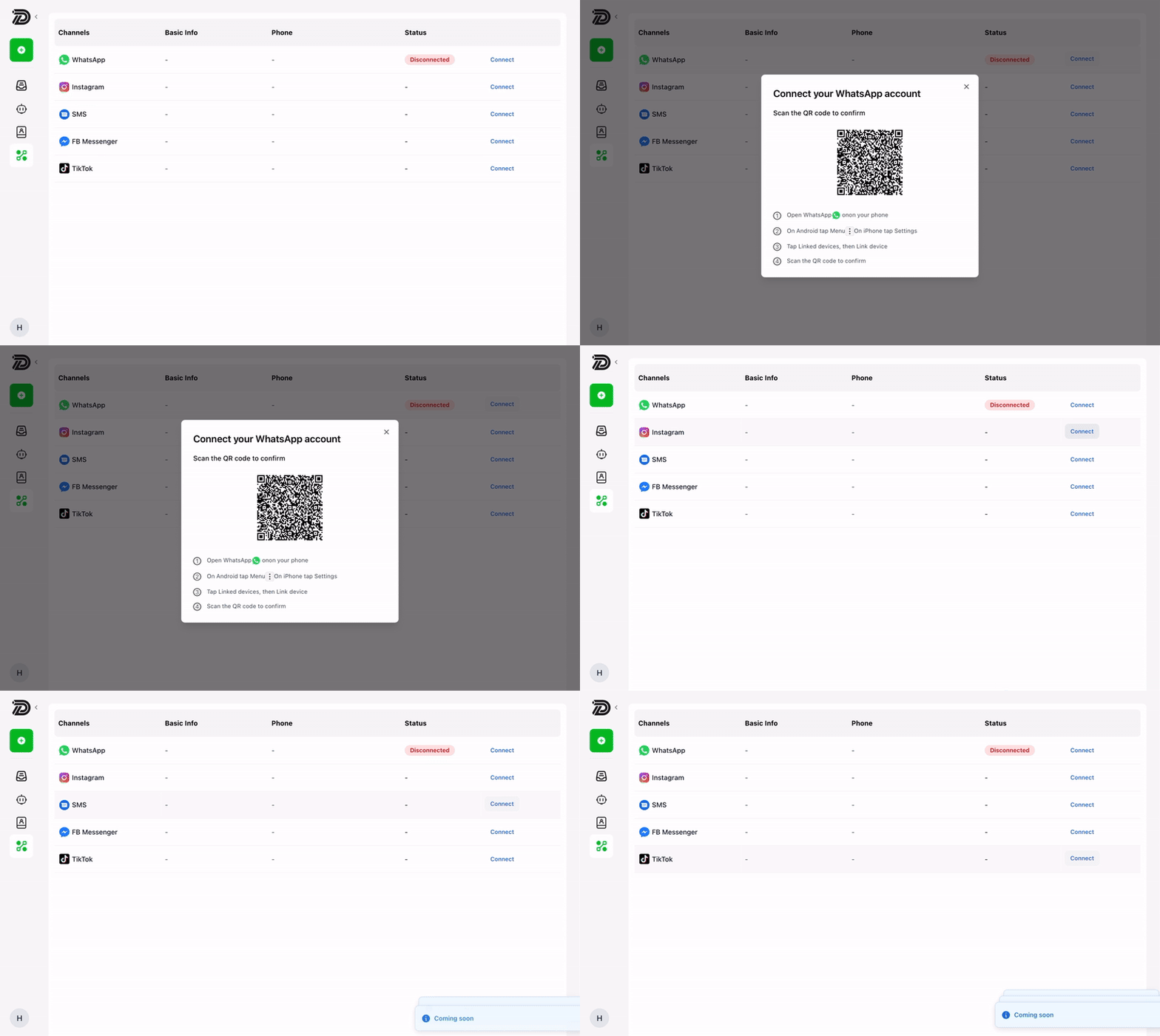
Dealism.ai exemplifies this evolution. It operates across WhatsApp, Instagram, and web chat, using AI to interpret customer intent, clarify needs, and guide actions without requiring large sales teams or complex CRM systems. Dealism isn’t just a messaging tool—it acts like a proactive teammate that executes workflows, automates follow-ups, and adapts conversations based on context. For small businesses, this makes it a complete solution: combining automation, conversational intelligence, and decision-driven interactions to scale engagement and conversions efficiently.
This integrated approach ensures that small businesses don’t just send messages—they turn every interaction into a meaningful, conversion-focused workflow. Start a free Dealism.ai trial and test AI Agents inside your inbox today.
Final Thoughts
Marketing tools help small businesses work more efficiently and compete in a digital marketplace. By combining content creation, SEO, CRM, and conversational marketing tools, small teams can attract customers, manage relationships, and support steady growth. As automation and AI continue to evolve, businesses that adopt these technologies will be better equipped to streamline marketing, improve customer engagement, and turn everyday interactions into new opportunities.
Read more:
Best WhatsApp Marketing Tool for Shopify