Published

Most businesses don’t lose customers because they lack messages.
They lose them because conversations don’t turn into execution.
A lead messages you on WhatsApp or Instagram. Someone replies. The conversation moves forward a few lines… then stops. No booking. No purchase. No follow-up.
This is not a communication problem.
This is an Execution Gap.
And “Managed Chat” exists to close it.
But the meaning of managed chat has fundamentally changed—from replying to messages to running business execution inside conversations.
1. What Is Managed Chat?
Managed chat is a system that structures and guides customer conversations so they consistently lead to outcomes such as:
bookings
qualified leads
purchases
scheduled actions
Traditionally, this was handled by managed live chat agents—humans responding inside dashboards.
Today, the category is shifting toward a new model:
👉 AI-managed conversational execution systems
The difference is simple:
Old model: manage replies
New model: manage outcomes
2. The Real Problem: The Execution Gap
Across SMBs, conversations fail in a predictable pattern:
The business responds quickly
The customer asks a few questions
The chat slows down
No decision is made
The lead disappears
Speed is not the issue.
Clarity is.
Qualification is.
Follow-up is.
What’s missing is not conversation.
👉 What’s missing is execution inside conversation.
This missing layer is what we call the Execution Gap.
And in practice, this gap is invisible to most businesses because it does not look like a “technical problem.” It looks like normal daily chat behavior—people replying, customers asking, then silence.
But at scale, this becomes a revenue leak.
Every unanswered follow-up, every unqualified lead, every abandoned chat is not a communication failure—it is a broken decision path inside the conversation flow.
3. Why Traditional Managed Live Chat Breaks Down
Most traditional managed chat systems(add blog link: Live Chat Outsourcing: What It Is, Costs, and How It Works) optimize for one metric:
Response time
But for service-driven SMBs—clinics, education providers, beauty studios—this creates structural limitations:
Leads are answered, but not qualified
Conversations are reactive, not directional
Agents repeat the same information daily
No structured follow-up mechanism exists
Chats end without decisions
The system is designed to “respond.”
But not to “decide.”
4. Managed Chat Has Evolved Into an Execution Layer
Managed chat is no longer just a communication layer.
It is becoming a business execution layer inside messaging platforms.
This means:
Conversations are not endpoints
They are workflows
Every message is part of a decision process
At this point, chat is no longer just a channel.
It becomes the place where intent is interpreted, options are filtered, and actions are triggered.
👉 In modern SMBs, chat is effectively replacing the front desk, the sales call, and in some cases even the CRM entry point.
5. Introducing Dealism: Conversation-to-Execution System
Dealism is an AI Vibe-Selling Agent platform designed for execution inside conversations.
It operates inside WhatsApp, Instagram, and embedded web chat.
But it is not:
a CRM system
a chatbot
a rule-based automation tool
Instead, it functions as an execution layer between conversation and business outcome.
Different Systems, Different Layers
To clarify positioning:
CRM → records what happened
Chatbot → responds based on rules
Dealism → moves the conversation toward execution
👉 It does not replace these systems.
👉 It operates above them.
6. Vibe Selling: How Decisions Actually Happen in Chat
Most traditional systems assume sales is linear.
In reality, conversations are not linear—they are emotional, contextual, and uncertain.
This is where Vibe Selling comes in.
Vibe Selling is not scripting.
It is decision guidance through conversation.
It includes:
1. Intent Understanding
Is the user comparing, exploring, or ready to book?
2. Natural Clarification
Instead of pushing links, the system asks context-aware questions:
“Is this your first time with this service?”
“Are you looking for pricing or availability first?”
3. Contextual Matching
The system aligns:
user intent
service type
appropriate next step
👉 The goal is not to push a sale.
👉 The goal is to reach the correct decision naturally.
7. From Messy Chats to Structured Execution
Managed chat systems solve operational breakdowns that most SMBs experience daily:
Leads drop off without follow-up
Staff answer but don’t qualify
Conversations are repeated endlessly
Multi-language chats reduce clarity
No system exists for “bringing leads back”
The deeper issue is not messaging volume.
It is lack of structured decision flow inside conversations.
8. Chat Is Becoming the Primary Business Interface
For most SMBs, messaging apps are already where business happens:
WhatsApp inquiries
Instagram DMs
Website chat entries
But these channels are still treated as support tools.
That assumption is outdated.
👉 Chat is now the primary interface of revenue.
And more importantly, it is becoming the first and last touchpoint in the entire customer journey—meaning decisions are increasingly made without ever leaving the chat environment.
9. New Entry Points into Managed Chat
Managed chat is expanding beyond inboxes into acquisition channels.
Instagram Comment-to-DM Flow
A comment on a post or Reel can automatically trigger a private conversation.
Example flow:
User comments “How much?”
System triggers DM
Qualification + offer + booking link follows
This turns engagement into structured pipeline entry.
Embedded Website Chat (No App Required)
A lightweight script embedded on a website allows visitors to:
start a WhatsApp conversation
open Instagram DM flow
enter a managed chat session immediately
This removes friction between interest and conversation.
10. The Shift: From Support to Execution Infrastructure
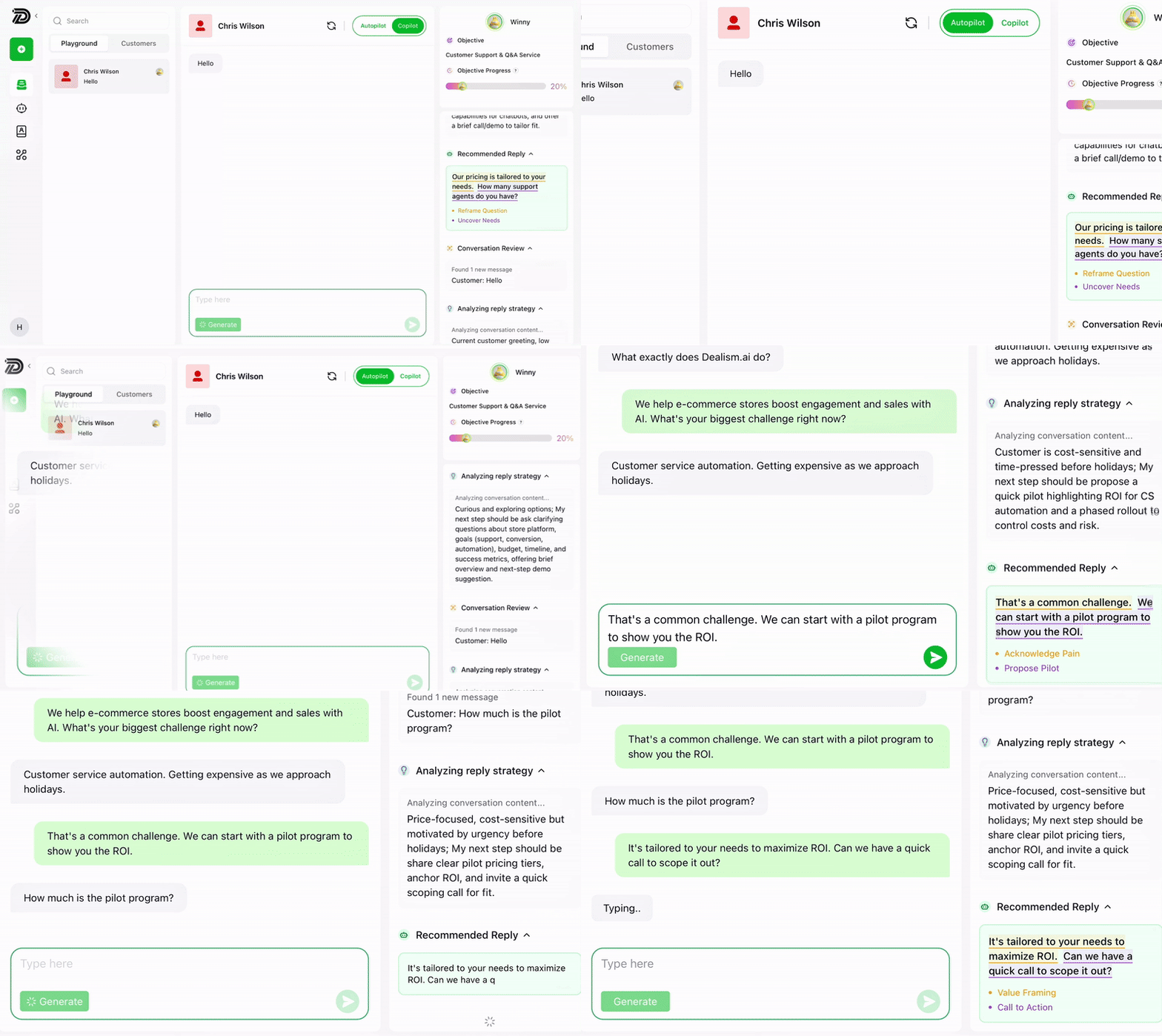
Managed chat is no longer a support function.
It is becoming infrastructure.
The shift can be summarized simply:
Old world: Chat = support
New world: Chat = system of execution
Businesses are not struggling with communication.
They are struggling with turning communication into outcomes.
And once you see chat as a system—not a channel—the entire structure of sales, support, and follow-up begins to change.
Conclusion: The Future of Managed Chat
Managed chat is evolving into something fundamentally different from its original definition.
It is no longer about:
replying faster
outsourcing chat agents
or installing live chat widgets
It is about building a system where:
👉 conversations become decisions
👉 decisions become actions
👉 actions become revenue
Dealism represents this shift.
Not as a chatbot.
Not as a CRM.
But as an execution layer for modern conversational business.