You post a Reel. Someone comments: “Wait, which one did you get?”
Nice. That is not a buying journey yet.
You still need to help that person find the product you actually recommend, understand whether it is the right fit, and get to the correct partner, storefront, or product link without making them dig through six old posts and a very chaotic bio page.
That is what this setup is good at:
Post → product question → helpful DM → one quick choice → approved link → checkout or next step
This is for creators who make content first and monetize product recommendations second: books, beauty, home, fitness, travel, fashion, food, tools, or curated picks. Let’s keep it useful and not weirdly salesy.
What you are actually building
You are not building a robot that sends partner links to everyone who watches a video.
You are building a small shopping handoff. Someone raises their hand because they need help; you continue the useful part privately, then send them to the relevant retailer, storefront, or brand page.
Here is the whole flow:
Your post shows one real product moment.
The person can use your Story or bio link if they already know what they want.
If they need help choosing, they comment one keyword or DM you.
They get the promised list or product link first.
You ask one question only if it helps them choose.
They get the relevant approved link—or a clear “this one is not for you.”
That is it. Let the link handle the easy decision. Let the conversation help with the harder one 👇
Step 1: Pick one post with one product decision
Choose a Reel or post where people are likely to have one clear question. Not “shop my whole life.” Not 27 products in one carousel. One product decision.
Good examples:
“The three books that got me back into reading.”
“The travel bag I use when I only want to bring one thing.”
“Which skincare product I would start with if I was a beginner.”
“Everything in my Sunday reset kit.”
The rule: one content problem, one promised next step.
If your post compares two books, help people choose between those two books. If it is about a travel collection, share the collection. People should not have to guess why your DM arrived.
Step 2: Make the ask optional—and painfully clear
Some people will tap your bio link and buy. Great. Let them.
Do not force every interested person through a DM just because you can. A DM is for the person who is still deciding.
Try a CTA like this:
“The exact link is in my bio. Comment BOOKS if you want help choosing one.”
“Everything from this Reel is linked in my bio—DM PICKS if you want my short list.”
“Comment TRAVEL and I’ll send the version I would buy first.”
“The product list is in my Story. If you are stuck between options, send me HELP.”
Short keywords win. They are easier to remember, easier to type, and easier to map to one useful recommendation.
Your public reply can stay tiny:
Sent it—check your DMs ✨
The comment reply is just reassurance. The DM does the useful job.
Step 3: Deliver first. Ask questions second.
This is the bit people often get backwards.
If someone asks for your reading list, send the reading list in the first message. If they ask for your travel picks, send the travel picks. Do not make them complete a five-question quiz before you give them the thing your post promised.
Try this:
Hey! Here’s the list from the Reel ✨ Some links may be sponsored or may earn me a commission. Are you looking for the book, the full list, or help choosing?
Buttons:
Get the book
See the full list
Help me choose
That is enough. Transparency stays close to the recommendation, and the person gets value before they are asked to do any extra work.
Step 4: Ask one question that actually changes the recommendation
If someone taps Help me choose, do not turn the DM into a personality test.
Ask one simple question that changes what you would send next.
If you recommend… | Ask… |
|---|---|
Books | “Are you looking for something practical, inspiring, or easy to get through?” |
Skincare | “Are you trying to keep it simple, or solve one specific concern?” |
Travel gear | “Are you packing carry-on only, or do you need room for longer trips?” |
Fitness products | “Is this for home workouts, the gym, or travel?” |
Home picks | “Are you replacing one thing, or starting from scratch?” |
Then send the approved recommendation and partner link:
Based on that, I’d start with this one: [approved product link]. It is the pick I would choose for someone who wants a simple place to begin.
No fake urgency. No “only two left” unless the retailer provides and approves that information. No invented product claims. Just a good recommendation and a clear next step.
TRY IT WITH YOUR BUSINESS
The trigger, first DM, follow-up question, and handoff logic are already mapped. Make it yours, then test it on one high-intent post.
The creators you know are all using the same path
Not the same private automation. Not the same affiliate network. Not the same brand deal.
But the public path is familiar: content makes someone curious, a product recommendation earns trust, and a profile, Story, storefront, or retailer link gives that interest somewhere to go next. The commercial arrangement can vary: a paid brand partnership, a storefront programme, affiliate commission, a performance deal, or another approved creator arrangement.
Our research library maps public Bio Link Bridge paths for Brooke Monk, Harper Zilmer, CaseOh, and Kat Stickler. Those examples support public profile links and first-level destinations only. They do not tell us what happens inside private DMs, affiliate dashboards, or brand contracts.
Kat’s public link hub makes the link-first part easy to see: it points people to Stur, LTK, an Amazon Storefront, YouTube, and her own site. Different followers arrive with different intent. The links give them sensible doors; a conversation is only useful when someone needs help deciding which door to take.
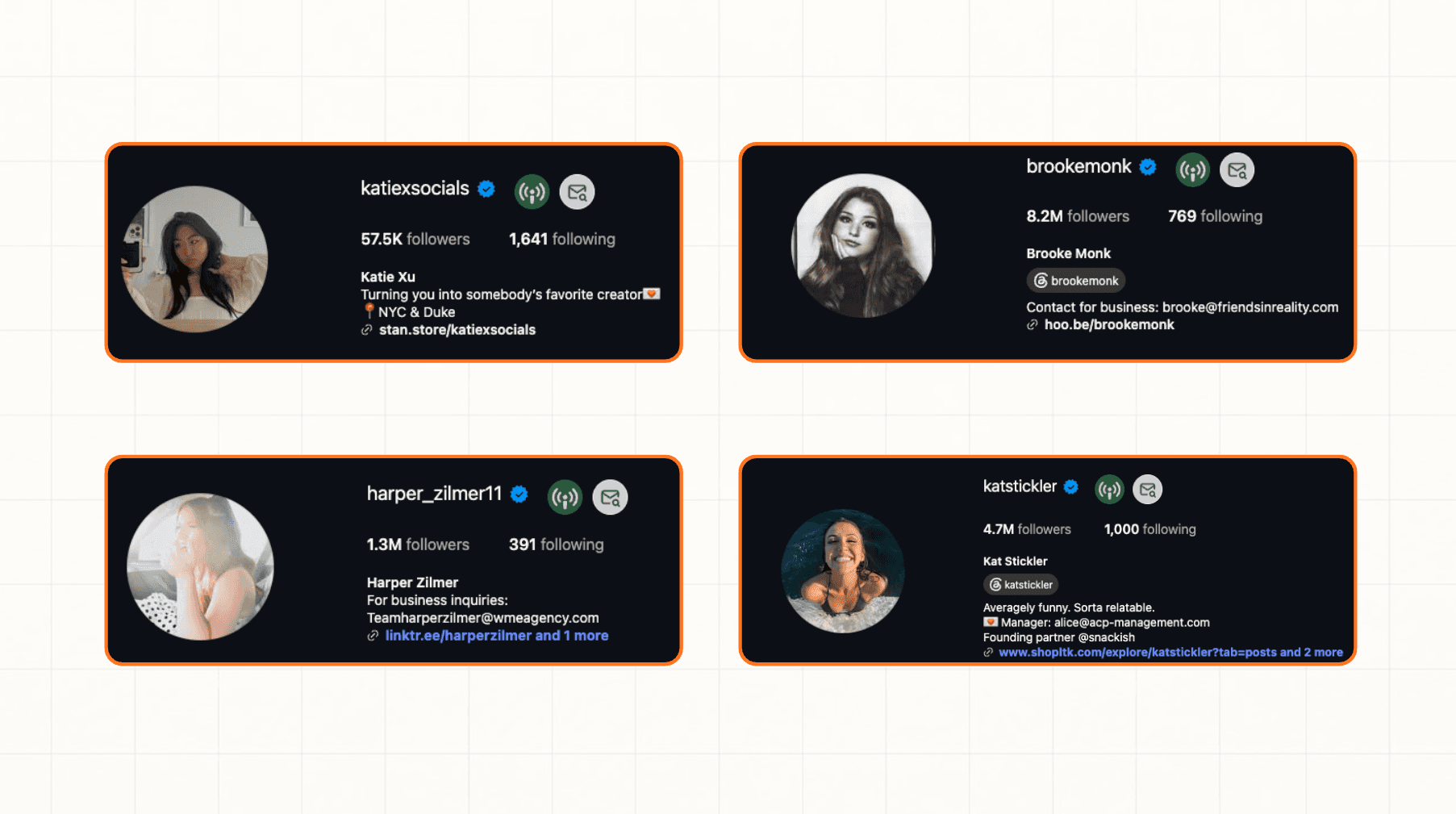
We mapped how Kat Stickler’s public content, Story links, and bio destinations create multiple paths for a follower to go deeper.
Where an AI agent actually helps
Your agent is not your retailer’s customer support team.
It cannot confirm a third-party store’s stock, delivery date, return policy, product safety, final price, or purchase status. It also cannot track creator revenue unless that data lives in the relevant retailer, storefront, affiliate, or campaign platform.
Its job is narrower—and still useful:
Send the approved list, product page, or affiliate link.
Explain what the creator has publicly approved as a recommendation.
Ask one helpful preference question when a person cannot decide.
Share the appropriate approved disclosure when the recommendation is sponsored, compensated, or commissionable.
Route retailer-specific support questions to the retailer or brand.
Hand sensitive, sponsorship, partnership, or creator-management questions to a human.
A simple agent brief
Objective
Help followers find the creator’s approved recommendation. Keep the response honest, useful, and low-pressure.
You can
Explain the creator’s approved product list, categories, and use cases.
Share the relevant approved destination.
Use the approved disclosure for a sponsored, compensated, or commissionable recommendation, where applicable.
Ask one question to choose between approved options.
Say when the agent does not have enough information to recommend something.
You cannot
Invent a product claim, medical benefit, price, discount, inventory level, shipping promise, or retailer policy.
Give individualized medical, financial, legal, or safety advice.
Claim to see a follower’s purchase, click, or affiliate conversion.
Pretend that a creator uses this automation or endorses a product unless that is verified and approved.
Keep the measurement honest
Dealism can help you see conversation activity and link delivery. It is not the source of truth for creator revenue.
Track the full path in the right places:
Instagram: content reach, comments, profile visits, and Story-link taps where available.
Dealism: keyword triggers, first-DM delivery, replies, recommendation paths, links sent, and handoffs.
Retailer, storefront, affiliate, or campaign dashboard: clicks, attributed orders, campaign reporting, commission, reversals, and payout where available.
The useful questions are simple:
Which product posts create the most “which one?” questions?
Which keywords lead to actual replies rather than silent DMs?
Which recommendation paths get a link click?
Which questions keep repeating because the content or link page is unclear?
Those answers help you make better content and better recommendations.
A good link gets someone there. A good creator recommendation helps them choose.
See how Kat’s public link-first setup turns relatable content into multiple next steps.
Explore Kat’s account analysis →
The takeaway
Content-first creators do not need to become a storefront.
Make the Reel useful. Let the direct link handle the simple purchase. Use a DM only when someone wants help choosing. Then give them an honest recommendation, an affiliate disclosure, and the right place to buy.
That is a creator-friendly recommendation path: helpful first, monetization second.
Research note
This playbook is based on the IG-AUT-01 evidence brief and public account paths. The creator examples support public-facing content, profile, CTA, and first-level destination observations only. They do not establish private automation, DM workflows, commercial terms, performance, conversion rates, or revenue attribution.
ABOUT THE AUTHOR
Brenda Liang
Hi, I’m Brenda, a Content & Growth Researcher at Dealism. I research how small businesses use messaging, AI, and better sales processes to turn customer conversations into clear next steps—from qualification and recommendations to booking and conversion. Let's explore! 😉

Every reply is a Deal in the making.
Dealism replies the second they message, sounds completely human, and quietly closes deals in the background.