Publicado

What Is a WhatsApp Bot?
A WhatsApp bot is a conversational system that operates inside messaging environments such as WhatsApp, designed to handle customer interactions, respond to inquiries, and guide users toward actions such as booking, purchasing, or support resolution.
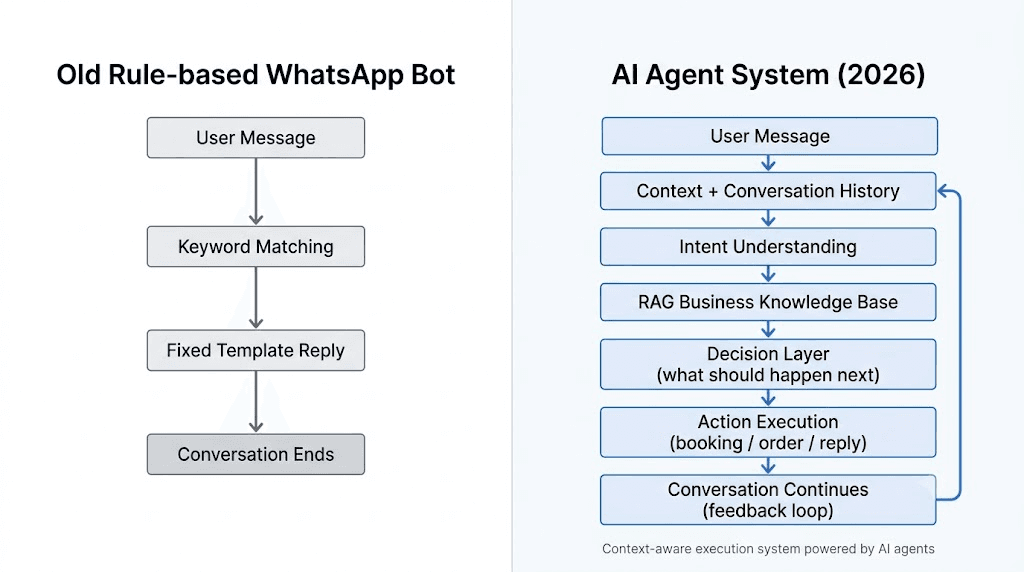
In its earliest form, this system was built entirely on rule-based logic.
Each interaction followed a fixed structure:
if a user message matched a predefined keyword or pattern → the system returned a predefined response.
This made early automation predictable, but also fundamentally brittle in real-world conditions.
Because real customer conversations are not structured.
Users rarely express intent in clean, single-purpose messages. Instead, they combine multiple questions, shift topics mid-sentence, or express urgency, hesitation, and context all at once.
Traditional bots were not designed for this type of communication.
They were designed for control.
Not interpretation.
What Makes WhatsApp Bot Features Different in 2026?
In 2026, the defining shift is not in messaging capability—but in decision-making responsibility inside the conversation.
The system is no longer judged by how accurately it replies.
It is judged by whether it can correctly move a conversation forward.
This marks a structural transition:
Rule-based systems operate on deterministic execution logic:
“If X → then Y”
AI agent systems operate on contextual interpretation logic:
“Given this message, conversation history, and business constraints → determine the next best action”
This difference may sound subtle, but in practice it changes the entire role of WhatsApp automation.
It is no longer a messaging layer sitting on top of a business.
It becomes an execution layer embedded inside the business itself.
And once this shift happens, success is no longer measured by response speed or message volume.
It is measured by whether intent survives the conversation.
Core (Table-Stakes) WhatsApp Bot Features
Even in 2026, foundational automation capabilities still exist—but they no longer define competitiveness.
They function as infrastructure primitives rather than intelligence layers.
Rich Media & Message Types
WhatsApp systems support structured formats such as buttons, lists, images, documents, and location sharing. These elements reduce ambiguity in communication and standardize how information is exchanged between users and businesses.
Automated Replies & Keyword Triggers
Keyword-based automation still exists for handling repetitive or predictable queries. However, its role is increasingly limited to routing, fallback handling, or low-level support tasks rather than core conversation logic.
Message Scheduling & Broadcasts/Blasts
Broadcast systems enable businesses to distribute announcements and lifecycle messaging at scale. While still useful for engagement, they do not contribute to conversational decision-making or intent resolution.
Business Hours & Away Messages
Operational messaging rules ensure consistent responses during offline periods. These features exist primarily to maintain service reliability rather than improve conversation intelligence.
AI-Powered WhatsApp Bot Features — The 2026 Differentiators
The real shift in 2026 is not automation—it is interpretation under constraint.
Modern systems are no longer evaluated by whether they can generate responses, but by whether those responses are grounded, context-aware, and business-aligned.
Natural Language Understanding (NLP/NLU)
Instead of relying on keyword matching, modern systems interpret meaning across unstructured and multi-intent messages. This allows them to operate in real conversational environments where users rarely express needs in clean, linear form.
Contextual, Conversational Replies (LLM-based)
Conversation history is no longer treated as isolated messages. Instead, systems maintain continuous memory across interactions, allowing responses to evolve naturally as intent becomes clearer over time.
Multilingual Support
Advanced systems can operate across languages without losing semantic accuracy, enabling consistent experiences across geographically and linguistically diverse customer bases.
RAG-Grounded Business Knowledge
To prevent hallucination and uncontrolled generation, modern systems rely on Retrieval-Augmented Generation (RAG). Instead of “knowing everything,” the system is constrained by verified business data such as pricing rules, service definitions, and internal documentation.
To move beyond rigid, tree-based automation, modern conversational systems rely on real-time intent classification and contextual disambiguation.
Instead of triggering static responses based on keywords, AI systems interpret emotional tone, urgency, and conversational history to decide how a dialogue should evolve.
This is where modern conversational commerce platforms such as Dealism reflect a broader architectural shift. Rather than functioning as template-driven automation tools, they operate as execution layers that dynamically adjust responses based on user intent and business constraints, ensuring that conversations progress naturally toward actionable outcomes rather than mechanical replies.
Sales & Lead Features — Features That Move Revenue, Not Just Reply
At this stage, WhatsApp automation is no longer a messaging problem.
It becomes a revenue progression system.
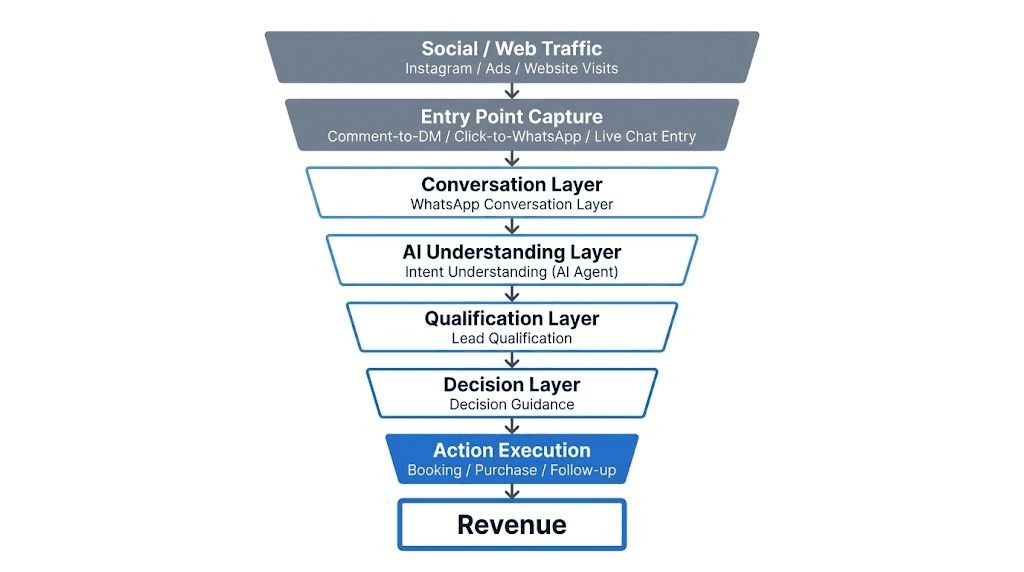
The key question is not whether messages are handled correctly, but whether conversations consistently move from intent → clarity → decision.
Lead Qualification & Scoring
Modern systems no longer treat incoming messages as simple inquiries.
Each message is interpreted as a bundle of signals—intent strength, urgency level, and conversion probability.
Instead of responding uniformly, the system dynamically prioritizes conversations that are more likely to convert, while deprioritizing low-intent interactions.
This turns the inbox from a communication stream into a structured opportunity pipeline.
Appointment Booking & Contextual Disambiguation
Booking is no longer a separate step outside the conversation.
It is embedded inside the conversation flow.
However, the key shift in 2026 is not scheduling—it is clarification before scheduling.
Before offering time slots, the system first resolves ambiguity:
what service is needed, which category it belongs to, and what level of urgency applies.
Only after this contextual resolution does the system proceed to confirmation.
This prevents mis-bookings and reduces operational friction in service-heavy industries such as clinics, education, and consulting.
Abandoned Cart Recovery & Order Continuity
In commerce-driven workflows, intent rarely disappears—it decays.
Modern systems are designed to detect this decay and re-engage users based on behavioral signals rather than fixed timers.
At the same time, post-conversion communication is no longer passive.
Order updates, delivery tracking, and follow-up messaging are treated as continuous conversational extensions rather than isolated notifications.
Conversational Entry Point Capture (Social + Web)
In 2026, conversion rarely starts inside WhatsApp.
It starts elsewhere.
Modern systems treat external engagement surfaces as intent generators:
Social media comments
Instagram posts and Reels
Website visits and landing page behavior
These signals are converted into structured conversation entries.
Social-to-private transitions allow a public interaction to immediately become a private dialogue.
Lightweight web handoffs replace traditional live chat systems, allowing users to continue the same conversation inside WhatsApp or Instagram without losing context or restarting intent.
Integration & Management Features
Real-Time Data Synchronization & Webhooks
Modern WhatsApp systems are not standalone tools.
They operate as synchronization layers between conversation and business infrastructure.
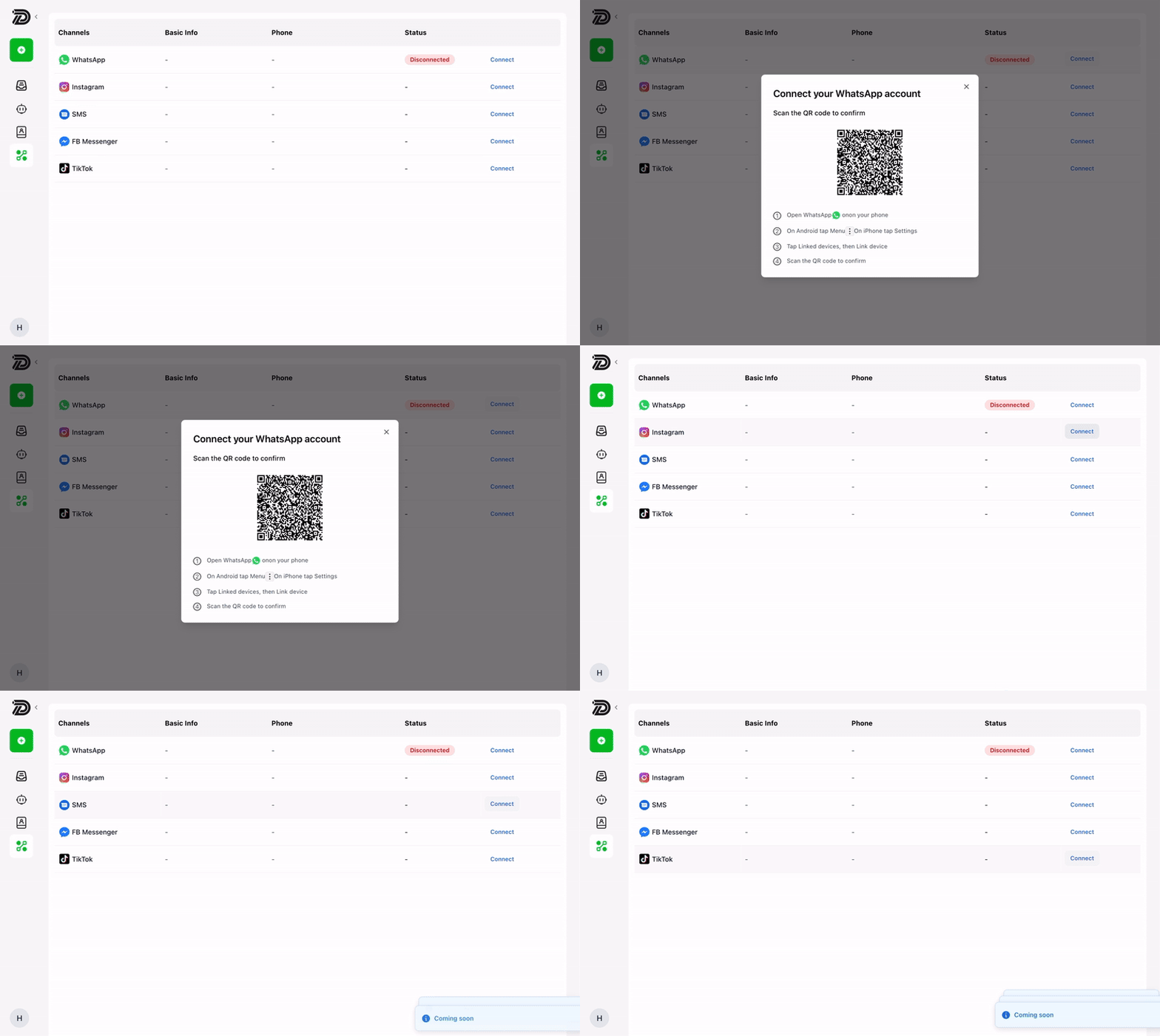
Through real-time webhooks, customer actions and conversation states are continuously synced with external systems such as Shopify, CRMs, calendars, and internal databases.
This ensures that conversations are always grounded in real-time business truth.
Context-Preserved Human Handoff
Automation does not eliminate human involvement—it restructures it.
When escalation is required, human agents do not restart conversations.
Instead, they receive structured context packets:
user intent summary
conversation history
detected urgency level
recommended next action
This eliminates the “repeat your issue” problem that breaks most traditional support systems.
Multi-Channel Continuity
Modern conversational systems are not channel-specific.
Users can start on Instagram, continue on WhatsApp, and complete actions via web chat.
The system maintains a unified memory layer across all channels, ensuring continuity regardless of entry point.
Channels become surfaces.
The conversation becomes the system.
Analytics & Conversion Leakage Diagnostics
Instead of tracking superficial metrics such as reply speed or message volume, modern systems analyze structural failure points in the conversation flow.
The focus shifts to:
where users drop off
where intent weakens
where decisions fail to form
This turns analytics into a diagnostic tool rather than a reporting dashboard.
WhatsApp Business App vs. API — Infrastructure vs. Execution Layer
The difference between the WhatsApp Business App and the API is not feature depth.
It is architectural purpose.
The Business App assumes manual operation.
It is designed for human-led conversations with lightweight automation support.
The API, however, operates as an execution layer.
It enables systems that combine:
real-time data synchronization
workflow automation
AI-driven conversation logic
external system integration
In this model:
The App is a communication interface.
The API is an operational infrastructure.
Modern AI agent systems—such as Dealism’s architectures—sit on top of the API layer, treating conversations as executable workflows rather than static message threads.
Must-Have Features Checklist for 2026 — System Diagnostic Layer
A production-ready WhatsApp system is no longer evaluated by what it includes, but by what it prevents from breaking.
This checklist is designed as a diagnostic framework for identifying revenue leakage:
Tier 1 — Revenue-Critical (System Failure Risk)
Can it interpret multi-intent messages without losing meaning?
Does it maintain full context continuity across long conversations?
Does it actively guide users toward decisions instead of passive replies?
Can it prioritize high-intent leads dynamically?
Tier 2 — Conversion Optimization Layer
Can conversations be initiated from external sources (social/web)?
Does escalation preserve full context for human takeover?
Can it complete actions (booking, orders) without external switching?
Tier 3 — System Intelligence Layer
Does it identify where users lose momentum?
Does it detect conversion leakage points?
Can it connect conversation outcomes to business systems?
This reframes evaluation from feature presence to failure prevention.
FAQ — Decision Clarity Layer
Are rule-based WhatsApp bots still useful in 2026?
Yes, but only for structured, low-complexity tasks such as routing, basic FAQs, or fallback handling. They are no longer suitable for handling full customer journeys.
Do I need AI if I already have WhatsApp automation?
If your conversations involve ambiguity, multiple intents, or sales progression, rule-based automation is insufficient. AI becomes necessary when decision-making inside the conversation matters.
What is the role of WhatsApp Business API in modern systems?
The API is the foundational layer that enables real-time integration, workflow automation, and AI-driven conversational systems. It is not a feature upgrade—it is a structural requirement.
Why do most WhatsApp systems fail in real business use?
Because they optimize for message response rather than intent progression. When conversations are treated as static exchanges instead of evolving workflows, revenue breaks down.
How should businesses decide whether they need an AI agent instead of traditional WhatsApp automation?
Traditional WhatsApp automation is sufficient when customer interactions are simple, repetitive, and fully structured, such as basic FAQs or routing inquiries. However, when conversations involve ambiguity, multiple intents, or require guiding users toward decisions such as bookings or purchases, rule-based systems quickly reach their limits.
An AI agent becomes necessary when the goal is not just to respond to messages, but to actively interpret intent, resolve uncertainty, and move conversations toward measurable business outcomes without requiring rigid user input.
Final Perspective
The evolution of WhatsApp systems in 2026 is not about adding features.
It is about re-architecting how conversations connect to business execution.
In modern systems, conversations are no longer endpoints.
They are operational inputs that continuously drive decisions, actions, and revenue outcomes.
The effectiveness of a system is therefore not measured by communication capacity, but by its ability to prevent intent from collapsing anywhere in the customer journey.