
Your AI answers a customer in three seconds. The conversation closes without a human joining. The dashboard marks it as automated.
Did the AI actually solve the problem?
Maybe. But the customer may also have received an incomplete answer, left the chat, contacted you again on WhatsApp, or waited for a follow-up that never happened.
The most useful AI customer support metrics do not simply count replies, closed conversations, or conversations that never reached a person. They show whether the customer achieved the outcome they wanted—and what happened when AI could not finish the job.
For a small business, start with four questions: Was the request completed? Did the customer return with the same problem? Was the answer accurate? If a person took over, did they receive enough context and a clear next step?
Want to see how this works with real customer conversations? Create your Dealism account and start with one clear conversation type. Then use the scorecard below to check whether the AI is helping customers move forward—not simply reducing visible messages.
The Quick Answer: What Should You Measure?
Use this as a starter scorecard. You do not need to track every possible customer service KPI on day one.
Metric | What it tells you | Warning sign |
Verified resolution rate | How often AI genuinely completes the customer's request | Conversations close, but outcomes cannot be confirmed |
First-contact resolution | How often the issue is solved in the first interaction | Customers need another conversation to finish the same task |
Repeat contact rate | How often customers return about the same issue | “Resolved” conversations create more work later |
Handoff quality | Whether AI transfers the right context at the right time | The customer has to explain everything again |
Completed action rate | Whether the promised next step actually happened | AI gives an answer but no booking, update, or follow-up is completed |
Answer accuracy | Whether replies match approved business information | Prices, policies, availability, or promises are wrong |
Customer effort and satisfaction | How easy and useful the interaction felt | The answer is technically correct but difficult to use |
Human correction rate | How often a person must change or undo the AI's work | The same types of mistakes keep recurring |
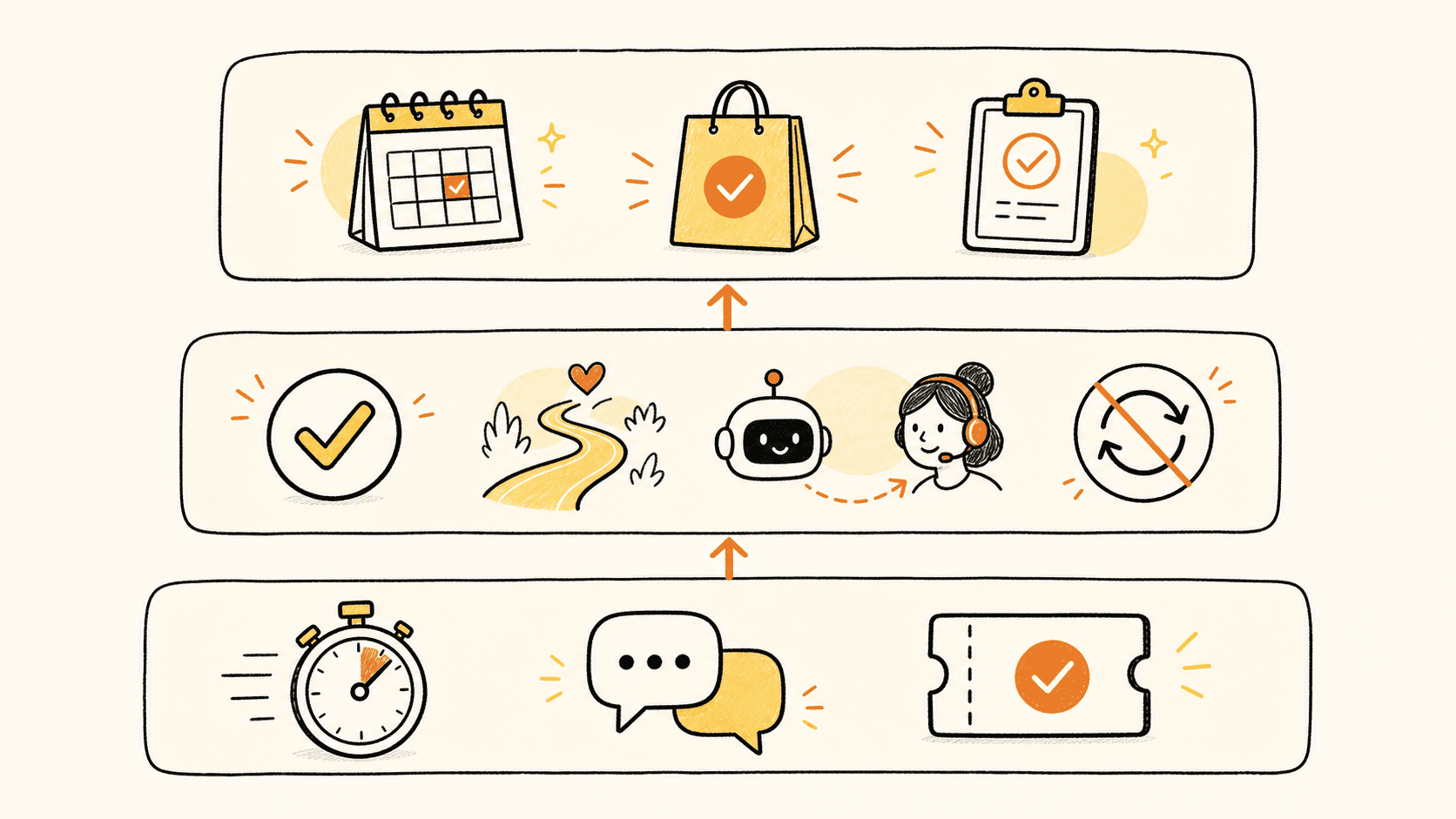
The principle behind the table is simple: measure outcomes first, quality second, and speed third.
A Closed Conversation Is Not Always a Resolved Problem
Four terms often appear together in AI support reports:
Response: The AI sent a message.
Deflection: The customer did not reach a human during that journey.
Containment: The conversation stayed inside the automated experience.
Resolution: The customer's actual request was completed correctly.
A customer can be deflected or contained without being helped. They may abandon the conversation, search elsewhere, open a new chat, or move to another channel. That is why optimizing only for containment can make a dashboard look better while the customer experience gets worse.
Zendesk's definition of automated resolution rate excludes abandoned chats, incomplete answers, unresolved closures, and repeat contacts. This is a useful standard even if you do not use Zendesk: a conversation should count as resolved only when the customer received a correct answer or completed the necessary action and did not need follow-up support for the same issue.
This also clarifies the difference between a simple chatbot and an agent. A chatbot might provide a policy link; an agent may collect missing information, recommend a next step, and prepare a useful handoff. See our guide to AI agents versus chatbots.
8 AI Customer Support Metrics That Matter
1. Verified Resolution Rate
Verified resolution rate is the percentage of AI-handled conversations where the customer's problem was genuinely solved.
Use this formula:
Verified resolution rate = verified AI resolutions ÷ total AI-handled conversations × 100
Define what “resolved” means for each common request:
A business-hours question is resolved when the correct hours are provided.
An appointment request is resolved when the appointment or correct booking step is confirmed.
A product question is resolved when the customer receives accurate information and knows what to do next.
A refund exception may require approval; explaining the standard policy alone is not resolution.
Do not include abandoned conversations, generic replies, or conversations that were automatically closed after inactivity. If possible, verify the outcome through customer confirmation, a completed business action, or the absence of a repeat contact within a defined period.
2. First-Contact Resolution
First-contact resolution, or FCR, measures how often a request is fully resolved during the customer's first interaction.
FCR = issues solved on the first contact ÷ total eligible issues × 100
“Fully” matters. A fast reply does not count if the customer must return to finish the task. Salesforce's explanation of first-contact resolution applies it across phone, email, SMS, chatbots, and other channels. For messaging support, choose a window such as 72 hours or seven days; a return about the same issue means the first contact failed.
Segment FCR by request type. Store hours and order-status questions should not be judged against the same target as complaints, policy exceptions, or complicated service recommendations.
3. Repeat Contact Rate
Repeat contact rate catches problems that a closure metric misses.
Repeat contact rate = customers returning about the same issue ÷ customers whose conversations were marked resolved × 100
To calculate it, match the customer, the underlying intent, and the time window. Do not count an unrelated new question as a failed resolution.
For a small business, a weekly manual check is enough to start. Look for phrases such as “I already asked,” “that didn't work,” or “I'm still waiting.” A rising rate usually points to missing knowledge, an incomplete action, or an unowned handoff.
4. AI-to-Human Handoff Quality
Handoff rate tells you how often AI involves a person. Handoff quality tells you whether that transfer was useful.
A low handoff rate is not automatically good. If the AI keeps a complex or emotional request for too long, the business may save a transfer while losing the customer's trust. Strong automation should preserve the human touch in customer support by recognizing where judgment matters.
Score every reviewed handoff on four questions:
Did the AI recognize that a person was needed?
Did it transfer an accurate summary of the customer's goal and relevant details?
Did it identify the owner and unfinished next step?
Could the human continue without asking the customer to repeat information?
Give one point for each “yes.” A four-point handoff is strong. A one-point handoff may technically reach a person while leaving everyone to restart the conversation.
5. Completed Action Rate
Many support conversations are requests for an action: send a document, update a booking, check availability, prepare a quote, confirm a status, reach the correct person, or receive follow-up.
Completed action rate = successfully completed actions ÷ conversations requiring an action × 100
This separates “the AI said the right thing” from “the business moved the request forward.” A promised follow-up is incomplete until an owner and next step exist.
This becomes especially important when a business is managing customer conversations at scale. More volume creates value only when actions, ownership, and outcomes remain clear.
6. Answer Accuracy and Groundedness
An AI reply should be checked against the business information it is supposed to use.
Accuracy asks whether the answer is correct. Groundedness asks whether the answer is supported by an approved source, such as a product catalog, pricing page, policy, schedule, or uploaded knowledge file.
Microsoft's agent metrics reference separates answer quality, groundedness, instruction following, and citation accuracy. A small business can use a simpler review:
Sample 20 conversations.
Mark key claims correct, incomplete, unsupported, or wrong.
Record the source the AI should have used and fix repeated gaps.
Prioritize errors involving prices, refunds, guarantees, appointment availability, eligibility, health-related information, deadlines, and anything else customers may act on.
7. Customer Effort and Satisfaction
CSAT asks whether the customer was satisfied. Customer effort asks how easy it was to get help.
Both matter because a correct answer can still require repeated details, unnecessary steps, or an unclear handoff.
Keep the survey short:
“Did this solve your question?”
“How easy was it to get the help you needed?”
“Is there anything you still need?”
Compare AI-only conversations, AI-assisted human conversations, and human-only conversations separately. A blended score can hide a weak AI journey that humans are repairing later.
8. Human Correction Rate
Human correction rate measures how often staff members edit, override, retract, or repair an AI answer or action.
Human correction rate = AI conversations requiring correction ÷ reviewed AI conversations × 100
The reasons matter more than the headline number. Tag corrections as wrong facts, missing context, tone issues, incorrect recommendations, policy exceptions, bad handoff timing, or incomplete actions.
This turns corrections into training material. It also helps a team evaluate customer service automation tools based on actual conversation quality rather than the longest feature list.
Supporting Metrics That Should Not Lead the Dashboard
Response time, conversation volume, containment, automation rate, and handling time help explain workload, but become misleading when treated as final outcomes.
A fast first response is valuable, but not if the full resolution takes three days. A high automation rate is efficient, but not if customers repeatedly return. A low handoff rate saves staff time, but not if the AI prevents customers from reaching someone who can help.
Zendesk's broader guide to AI service quality metrics recommends connecting efficiency measures with resolution, satisfaction, repeat contacts, accuracy, and customer effort. That combination is more honest than celebrating a single percentage.
A Simple 30-Day Scorecard for Small Businesses
Start with a spreadsheet and a weekly review. Do not wait for perfect data.
Week 1: Define “Resolved” for Common Requests
List your five to ten most common intents and the observable outcome that completes each one: “document delivered,” “appointment confirmed,” “availability verified,” “qualified request assigned,” or “human owner accepted the case.”
Week 2: Review 20–30 Conversations
Sample every active channel. Label each conversation resolved by AI, resolved after human help, transferred but open, inaccurate, abandoned, or requiring repeat contact.
Do not let the AI be the only judge. Check customer replies, business records, and completed actions.
Week 3: Track Repeats and Handoffs
Look for customers who return about the same issue. Review handoffs for summary quality, ownership, and whether the human had to start over.
Segment your busiest channel first. A business using WhatsApp automation should distinguish a new question from a return to the same unresolved thread.
Week 4: Fix One Failure Pattern
Choose the most common failure—not the most impressive feature to add. Possible fixes include:
adding missing information to the knowledge base;
changing when the AI transfers to a person;
recording an owner whenever follow-up is promised;
shortening a confusing response;
asking one additional qualifying question;
preventing the AI from answering a high-risk request.
Review the same metrics next month; trends matter more than one result.
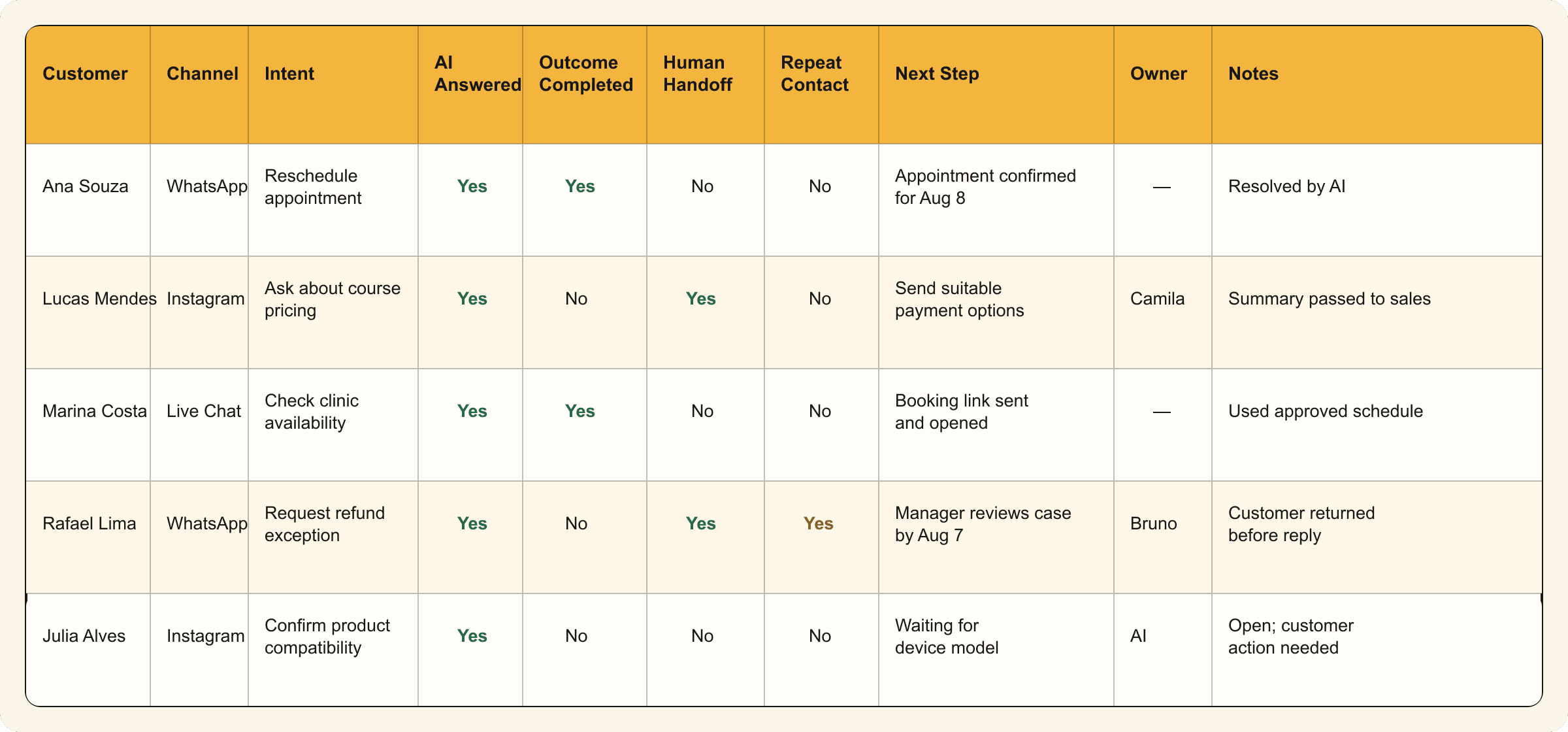
Use these spreadsheet columns:
Customer | Channel | Intent | AI Answered | Outcome Completed | Human Handoff | Repeat Contact | Next Step | Owner | Notes
How to Measure Handoff Quality Without a Helpdesk
Many small businesses work through WhatsApp, Instagram, and website chat instead of a ticketing system. The same principles apply.
For a weekly sample, record:
why the AI transferred the conversation;
the customer's current goal;
information already collected;
unanswered questions;
the responsible person;
the next action and due time;
whether the customer repeated information.
The goal is to make each handoff deliberate and easy to continue—not eliminate it.
For example, an AI customer agent for local services might answer service-area questions and collect job details before transferring a complicated quote. A clinic's AI customer agent might handle general service and scheduling questions while sending clinical, sensitive, or exceptional requests to staff. The appropriate handoff rate will differ, but both businesses can measure whether context and ownership were preserved.
Turn Metrics Into Better Conversations
Metrics only help when they change what happens next. Improve the system in this order:
Find the failing intent instead of judging all conversations together.
Fix missing or outdated source information.
Define what AI may complete and what needs approval.
Transfer based on risk, uncertainty, value, emotion, or judgment—not only a failed keyword match.
Give every open conversation an owner or automated next step.
Use human corrections to improve the agent.
Compare the next period by intent and channel.
Do not chase a universal “good” rate. Store-hours questions and refund exceptions should not share a target. Compare similar requests and do not force AI to keep work it should transfer.
Where Dealism Fits
Dealism is designed for small businesses that manage customer and sales conversations through Instagram, WhatsApp, and Live Chat. It can answer questions using business information, understand intent, recommend the next step, summarize conversations, support follow-up, and bring in a person when judgment matters.
These capabilities support measurement: summaries clarify outcomes, preserved context improves handoffs, clear next steps expose action completion, and contextual follow-up makes unfinished work harder to lose.
An AI reply alone is still not proof of resolution. Ask whether the customer received an accurate answer, completed the next step, or reached the right person with context intact.
Start with one clear conversation type and define what success means before increasing automation. This gives you a useful baseline and makes weak answers, unnecessary handoffs, and unfinished customer journeys easier to spot.
Frequently Asked Questions
What is a good AI customer support resolution rate?
There is no universal percentage. Define resolution strictly, establish a baseline by request type, and compare similar conversations. A lower verified rate is more useful than a high number that counts abandonment as success.
What is the difference between resolution and deflection?
Deflection means the customer did not reach a human during that journey. Resolution means the customer's actual problem was solved. A customer can be deflected because AI helped them, but also because they gave up or moved to another channel.
Is a lower escalation rate always better?
No. A low escalation rate is harmful if AI keeps requests that require empathy, approval, sensitive information, or human judgment. Measure whether escalation happened for the right reason and whether the human received useful context.
How long should the repeat-contact window be?
Match the window to the request: 48–72 hours for simple questions and seven days or more for longer processes. Keep it consistent.
Can a small business track these metrics without a helpdesk?
Yes. Use a spreadsheet, a weekly sample, clear outcome labels, and a repeat-contact check. Twenty consistently reviewed conversations beat a sophisticated dashboard built on weak definitions.
How do you measure AI-to-human handoff quality?
Check whether the AI transferred at the right time, passed an accurate summary, recorded unfinished work, assigned an owner, and prevented the customer from repeating information. Score those elements consistently across a weekly sample.
Should CSAT be measured separately for AI and human conversations?
Yes. Separate AI-only, AI-assisted human, and human-only journeys. A blended score can hide weak automation that human agents are repairing later.
Measure Whether the Customer Moved Forward
The goal of AI customer support is not to generate the most replies or keep the most customers away from humans. It is to help customers reach a useful outcome with less effort.
Start with verified resolution, repeat contact, handoff quality, completed actions, and accuracy. Treat speed and volume as supporting information. Fix one recurring failure at a time and keep a clear path to a person when AI should not decide.
The best AI customer support metrics answer one practical question: after the conversation ended, was the customer actually further forward?


