Para pequenas e médias empresas (PMEs) que utilizam o comércio focado em mensagens na América do Norte, Europa, América Latina e Sudeste Asiático, o WhatsApp se transformou em uma vitrine digital essencial.
No entanto, capturar a demanda nos canais de mensagem apresenta um grande gargalo operacional: a latência. Como os consumidores modernos tratam as interfaces de chat como espaços de interação em tempo real, um atraso substancial na resposta a uma consulta recebida causa a perda imediata do cliente em potencial. Dados do setor destacam frequentemente que a intenção de um lead pode cair rapidamente em poucos minutos, transformando o que deveria ser uma venda orgânica em um chat sem resposta.
Embora a automação baseada em regras tenha oferecido um ponto de partida estruturado, as expectativas dos clientes evoluíram junto com os avanços da inteligência artificial conversacional. Em vez de navegar por menus rígidos, muitos usuários agora esperam experiências de mensagens que pareçam naturais e que permitam concluir tarefas em uma única conversa. Pesquisas da Meta e Bain também destacam a crescente importância das mensagens comerciais, à medida que os consumidores preferem cada vez mais interações conversacionais ao longo da jornada do cliente.
Este guia fornece uma avaliação objetiva e estruturada dos Agentes de IA para WhatsApp—sistemas de software autônomos desenvolvidos para entender a intenção em linguagem natural, conectar-se com os dados da empresa e auxiliar na execução de fluxos de trabalho voltados ao cliente.
Nas seções a seguir, explicaremos como funcionam os Agentes de IA para WhatsApp, como eles se comparam aos chatbots tradicionais, exploraremos casos práticos de uso empresarial, analisaremos as principais plataformas e discutiremos como as PMEs podem escolher a abordagem de implantação ideal.
1. O que é um Agente de IA para WhatsApp?
Um Agente de IA para WhatsApp é uma camada de automação que geralmente combina Modelos de Linguagem de Grande Porte (LLMs) com recursos como Geração Aumentada de Recuperação (RAG), chamadas de ferramentas e integrações externas. Ao contrário dos sistemas legados, ele não depende estritamente de palavras-chave predefinidas ou árvores condicionais estáticas. Em vez disso, ele busca interpretar o significado real por trás das mensagens do usuário, consultar bases de conhecimento empresariais conectadas e coordenar fluxos de trabalho de várias etapas diretamente na interface do chat.
Uma Avaliação Condicional: Chatbots vs. Agentes de IA
Para manter uma visão objetiva do mercado, é útil categorizar a infraestrutura conversacional com base em seu modelo operacional principal, em vez de rotular uma estrutura como inerentemente superior a outra:
Dimensão Operacional | Fluxos baseados em regras e CRMs compartilhados (ex: ManyChat, Wati, Respond.io) | Sistemas de Conversação Agênticos (ex: Dealism, Botpress) |
Tecnologia Principal | Árvores de decisão condicionais, correspondência estrita de palavras-chave, direcionamento manual | LLMs, modelos de incorporação semântica, infraestrutura de RAG dinâmica |
Estilo de Interação | Estruturado, guiado por botões; ideal para navegação linear e previsível | Fluido, aberto; desenvolvido para lidar com variações na linguagem humana e no contexto |
Sincronização de Dados | Mapeamento manual de dados por meio de webhooks pré-configurados | Busca semântica automatizada em documentos, atualizações dinâmicas no CRM |
Caso de Uso Principal | Triagem de suporte ao cliente em alto volume e direcionamento para equipes humanas | Execução autônoma de fluxos de trabalho (qualificação, agendamento, vendas contextuais) |
Abordagem de Implementação | Desenho visual de fluxo mapeando cada etapa potencial do usuário | Alimentação centralizada de base de conhecimento combinada com instruções declarativas do sistema |
A Visão Prática: As ferramentas baseadas em regras continuam sendo altamente eficientes para direcionamento simples de chamados e disparos de marketing em massa, onde atendentes humanos realizam as etapas finais de fechamento. Por outro lado, os Agentes de IA são mais adequados para cenários que exigem execução assíncrona autônoma, em que se espera que o sistema esclareça intenções ambíguas e conduza o cliente em direção a um objetivo transacional de forma independente.
2. A Estrutura Técnica: Uma Explicação Simples
Um Agente de IA para WhatsApp de nível corporativo combina várias camadas de software para processar dados em tempo real. Para equilibrar a clareza técnica para desenvolvedores com a acessibilidade para gestores de negócios, podemos detalhar a estrutura técnica usando analogias do dia a dia:
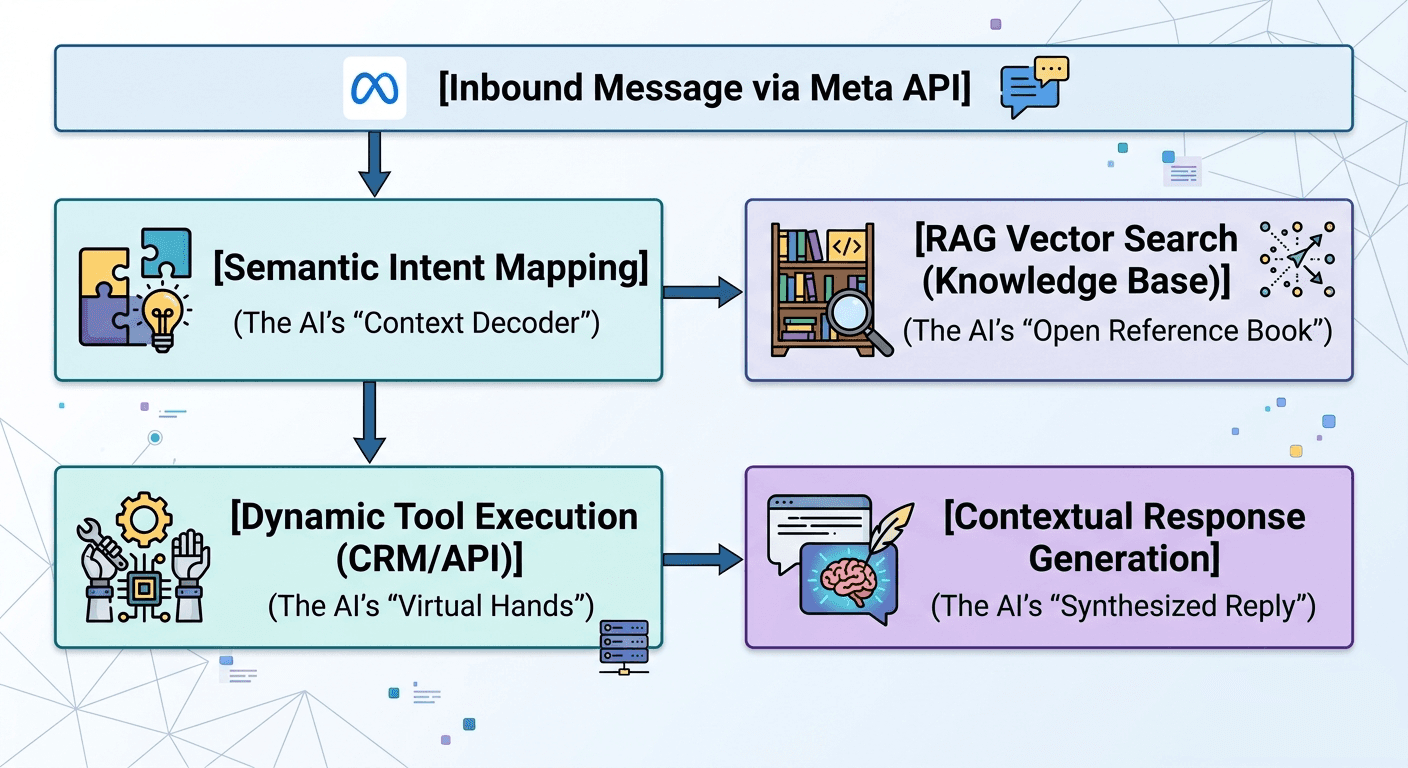
1. O Portal: Meta WhatsApp Business API
Todas as automações comerciais seguras direcionam seu tráfego de entrada e saída por meio da API oficial da Meta Cloud. Essa configuração é fundamental para manter a conformidade regulatória, liberar o selo oficial de verificação da empresa e suportar altos volumes de mensagens sem os riscos operacionais associados a soluções não oficiais de raspagem de tela (scraping).

2. O Decodificador de Contexto: Mapeamento de Intenção Semântica
O Conceito Técnico: Modelos de incorporação (embeddings) traduzem o texto do usuário em coordenadas de vetores multidimensionais para calcular a proximidade semântica.
A Analogia Simples: Pense nisso como o Decodificador de Contexto da IA. Em vez de procurar por palavras exatas como "custo", ele mede o significado conceitual de uma frase. Ele reconhece que "Quanto eu te devo?" e "Você pode compartilhar as tabelas de preços da empresa?" compartilham o mesmo objetivo comercial, permitindo que o sistema acompanhe a conversa de forma fluida ao longo de várias interações.
3. O Livro de Consulta Aberto: Geração Aumentada de Recuperação (RAG)
O Conceito Técnico: Dados operacionais não estruturados são divididos em partes, indexados em um banco de dados vetorial e inseridos no contexto do LLM com base em pontuações de similaridade.
A Analogia Simples: Pense no RAG como dar à IA um Livro de Consulta Aberto. Modelos de IA puros são propensos a "alucinações"—gerando detalhes de produtos incorretos ou preços falsos quando estão incertos. Para mitigar esse risco, o RAG permite que a IA recupere primeiro os parágrafos exatos dos manuais ou políticas da clínica enviados por você, garantindo que a resposta gerada permaneça estritamente limitada a fatos verificados.
4. As Mãos Virtuais: Chamadas de Ferramentas e Integrações de API
O Conceito Técnico: Parâmetros de chamada de função permitem que o LLM gere retornos em formato JSON estruturado para acionar APIs REST externas.
A Analogia Simples: Isso funciona como as Mãos Virtuais da IA. Se um usuário solicita um horário de agendamento, o agente não apenas gera texto; ele interage ativamente com a infraestrutura externa—como um CRM, Calendly ou um banco de dados interno de prontuários—verifica a disponibilidade em tempo real, reserva o horário e envia um cartão de confirmação interativo nativo do WhatsApp de volta ao cliente.
3. Por que os Agentes de IA Geram Receita
Uma implementação conversacional bem-sucedida não é apenas uma tecnologia isolada; ela representa um funil completo de aquisição e crescimento. Para entender como um agente impulsiona as métricas financeiras, mapeamos toda a jornada do usuário, desde a descoberta inicial até a retenção:
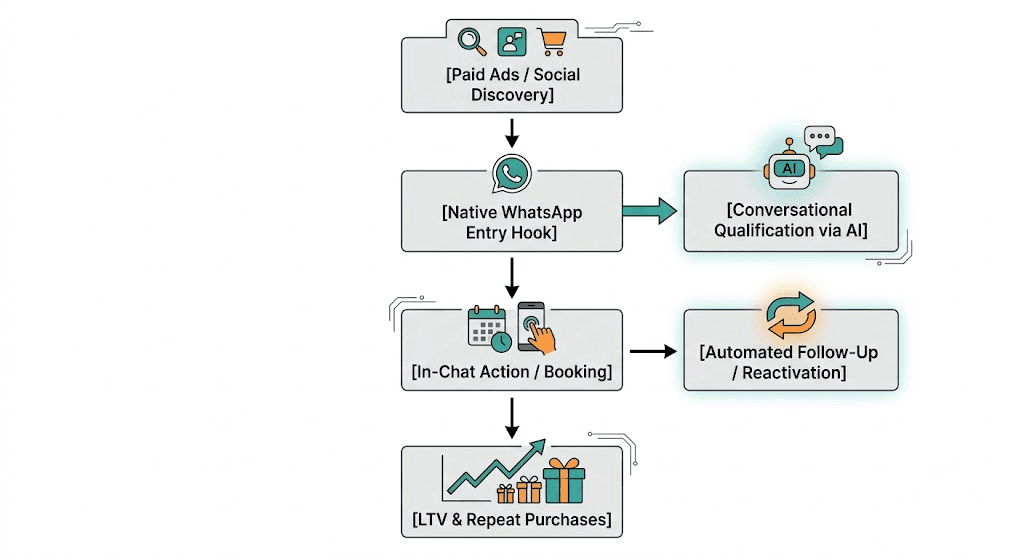
Descoberta e Entrada Sem Fricção: Um cliente em potencial clica em um anúncio direcionado nas redes sociais ou usa um gatilho de comentário para mensagem direta no Instagram. Em vez de carregar um site externo, o link abre imediatamente uma conversa nativa no WhatsApp.
Qualificação Conversacional: O agente de IA analisa a mensagem recebida, registra as informações do cliente e conduz uma conversa natural para extrair dados importantes (ex: limites de orçamento, necessidades específicas, prazos).
Ação no Chat e Pagamento: Uma vez qualificado, o agente aciona uma API externa para enviar um catálogo nativo ou um link de pagamento seguro (via Stripe, PayPal ou processadores locais), permitindo que o usuário conclua a reserva ou o pagamento sem sair da conversa.
Nutrição Contextual e Reativação: Se o usuário abandonar a conversa antes do pagamento final, o agente usa sua memória de curto prazo para iniciar uma sequência de acompanhamento direcionada algumas horas depois, abordando diretamente o ponto específico de hesitação.
Ciclo de Retenção: Após uma transação bem-sucedida, o agente monitora o uso regular ou os ciclos de serviço (ex: o intervalo de retorno de 6 meses de uma clínica odontológica) para acionar mensagens personalizadas de reativação, aumentando o valor do tempo de vida do cliente (LTV).
Por que os Ciclos de Receita Conversacional São Importantes
A geração de leads tradicional costuma forçar os clientes a passar por várias etapas: clicar em um anúncio, esperar uma página de destino carregar, preencher um formulário e aguardar um contato de retorno. Cada etapa adicional introduz uma fricção que pode reduzir as chances de conversão.
Em contrapartida, um Agente de IA para WhatsApp mantém a descoberta, a qualificação e a ação dentro de uma única conversa. Em vez de alternar entre várias páginas ou esperar por respostas manuais, os clientes podem tirar dúvidas, receber respostas contextualizadas e concluir a próxima etapa imediatamente. Para muitas PMEs, reduzir essa fricção conversacional costuma ser mais impactante do que simplesmente aumentar os investimentos em publicidade.
4. Casos de Uso por Setor
Para ilustrar o valor prático desse Ciclo de Receita, exploramos como diferentes setores adaptam a automação conversacional aos seus fluxos de trabalho operacionais específicos.
1. Saúde e Bem-Estar: Automação de WhatsApp para Clínicas
Clínicas médicas, odontológicas e de estética frequentemente lidam com uma alta carga administrativa e perda de agendamentos devido a respostas demoradas.
Triagem e Agendamento: Integrar um chatbot de IA para marcação de consultas permite que as clínicas atendam às solicitações de entrada 24 horas por dia, 7 dias por semana. O agente esclarece as necessidades de triagem do paciente, verifica a cobertura de planos de saúde e atualiza uma integração centralizada de CRM com o WhatsApp para garantir que a equipe médica humana tenha os registros completos antes da consulta.
Nota Prática de Cuidado: No setor de saúde, sistemas automatizados nunca devem oferecer diagnósticos clínicos ou prescrever tratamentos. O escopo de atuação deve limitar-se estritamente ao suporte administrativo, coordenação de triagem e logística de agenda.
2. Educação Digital e Treinamento Profissional: Escalando Funis de Academias
Escolas online, bootcamps de formação profissional e redes de mentoria costumam registrar perdas significativas de potenciais alunos ao direcioná-los por páginas de inscrição longas na web.
Esclarecimento de Currículo: Os potenciais alunos muitas vezes precisam de informações precisas sobre módulos específicos (ex: "O módulo 3 aborda normas específicas de conformidade em nuvem?"). O agente consulta a ementa do curso da escola via RAG para entregar respostas precisas instantaneamente.
Alinhamento de Valor: Se um usuário hesitar em relação ao valor da mensalidade, o agente pode ser configurado para apresentar soluções alternativas, como opções de parcelamento flexíveis ou turmas em meio período, ajudando a reter o cliente potencial na conversa.
3. Serviços de Alto Valor e Comércio Social Consultivo
Para fabricantes sob medida, prestadores de serviços especializados ou de alto padrão, o fluxo tradicional de checkout automatizado muitas vezes não é suficiente, pois as decisões de compra exigem confiança e negociação humana.
Funis de Comentário para Mensagem Direta (DM): Muitas empresas utilizam gatilhos de automação social para transformar interações em comentários em conversas privadas e estruturadas. O agente qualifica o escopo do projeto ou as preferências do usuário antes de gerar um link de pagamento digital personalizado diretamente no aplicativo de mensagens.
Um Padrão Comum Entre os Setores
Embora a saúde, a educação e os serviços profissionais tenham fluxos de trabalho diferentes, eles compartilham desafios conversacionais parecidos. Os clientes geralmente desejam respostas imediatas, orientação personalizada e um caminho simples para agendar ou comprar. Os Agentes de IA estão sendo cada vez mais adotados porque conseguem padronizar essas conversas repetitivas, permitindo que as equipes humanas se concentrem em situações que exigem julgamento, negociação ou conhecimento especializado.
5. Onde os Agentes de IA para WhatsApp Falham na Prática (Análise de Realidade)
Nenhum sistema de automação é perfeito. Implementar IA conversacional envolve lidar com pontos reais de falha operacional. Compreender esses riscos é essencial para estruturar um fluxo de trabalho resiliente:
1. Base de Conhecimento Fragmentada (Degradação do RAG)
A Falha: Se a documentação interna da sua empresa estiver desatualizada, contraditória ou mal formatada, o agente inevitavelmente fornecerá respostas confusas. Por exemplo, se uma tabela de preços antiga estiver em conflito com uma nova política promocional no banco de dados vetorial, o sistema RAG pode recuperar a informação incorreta.
A Mitigação: Implemente uma rotina rigorosa de governança de dados. Trate a base de conhecimento da sua IA como um manual de operações vivo—limpe, revise e verifique regularmente a precisão dos documentos disponibilizados para o banco vetorial.
2. Instabilidade de Integração e Tempo Limite de API (Falhas de Chamada de Ferramenta)
A Falha: Serviços web externos, calendários e sistemas de CRM ocasionalmente passam por instabilidades ou atualizações estruturais. Se um endpoint de agendamento de terceiros demorar mais de 5 segundos para responder a uma chamada, o fluxo de execução do agente de IA pode travar, resultando em falhas de envio ou erros silenciosos.
A Mitigação: Configure respostas padrão para tratamento de erros. Se uma solicitação de API expirar, instrua o agente a responder de forma amigável: "No momento, estou enfrentando uma pequena lentidão de conexão com nosso sistema de agendamento, mas já registrei seus dados e confirmarei seu horário em breve."
3. Alta Ambiguidade nas Mensagens do Usuário (Incompatibilidade de Intenção)
A Falha: A comunicação humana é naturalmente complexa. Os clientes frequentemente enviam mensagens fragmentadas, usam gírias ou fazem várias solicitações conflitantes em um único texto (ex: "Na verdade, cancela isso, vamos ver na quarta-feira, não, espera, quanto custa a primeira opção mesmo?"). Isso pode fazer com que o rastreamento de contexto do agente perca a referência.
A Mitigação: Estabeleça limites rígidos de confiança de intenção. Se o índice de confiança do mecanismo semântico cair abaixo de uma porcentagem específica (ex: 75%), o agente deve ser programado para fazer uma pergunta de esclarecimento em vez de tentar adivinhar: "Para garantir que eu entendi perfeitamente, você gostaria de alterar seu agendamento atual ou verificar o preço base?"
6. Estratégia de Arquitetura: Matriz Desenvolver vs. Contratar (Build vs. Buy)
Ao estruturar a infraestrutura conversacional, líderes de desenvolvimento e gestores precisam avaliar os prós e contras de longo prazo entre criar estruturas de orquestração personalizadas ou adotar plataformas de aplicação especializadas.
Métrica de Avaliação | Opção A: Orquestração Personalizada Open-Source | Opção B: Plataformas de Aplicação Prontas |
Estrutura Tecnológica Típica | n8n, Flowise, LangChain, LLMs open-source, provedores de armazenamento vetorial | Plataformas de aplicação dedicadas (ex: Dealism, Botpress Enterprise Cloud) |
Custo Inicial de Engenharia | Mais alto; exige muitas horas de desenvolvedores para estruturar a infraestrutura personalizada | Mais baixo; modelos de assinatura mensal previsíveis de SaaS ($50 - $300/mês) |
Tempo Médio de Implantação | Geralmente de 3 a 6 semanas para desenvolvimento, testes internos de segurança e aprovação da API | Geralmente de 1 a 3 dias desde a configuração inicial até a operação real da empresa |
Manutenção de Longo Prazo | Alta; a equipe interna precisa gerenciar atualizações de API, descontinuação de modelos e falhas de infraestrutura | Baixa; os fornecedores da plataforma cuidam da gestão da infraestrutura e das atualizações da Meta |
Perfil Operacional Ideal | Empresas com restrições específicas de segurança local (on-premise) ou necessidades de conformidade de dados muito específicas | PMEs em crescimento focadas em reduzir o tempo de lançamento no mercado e maximizar o retorno financeiro imediato |
*Nota: Não inclui as taxas de conversação oficiais da Meta, que variam dinamicamente com o volume de mensagens.
Gerenciando o Risco de Débito Técnico
Embora as configurações de orquestração personalizadas (como n8n ou código Python próprio) ofereçam grande flexibilidade sobre o fluxo de dados, elas trazem responsabilidades de manutenção de longo prazo complexas para equipes pequenas. O ambiente da WhatsApp Business API da Meta passa por atualizações estruturais periódicas. Quando ocorre uma alteração simples de estrutura nos endpoints, um sistema personalizado pode falhar silenciosamente se não for atualizado continuamente.
Para empresas cujo foco principal está na entrega de serviços e não na engenharia de software sob medida, utilizar uma camada de aplicação pronta de um fornecedor costuma trazer maior estabilidade operacional e um retorno sobre o investimento mais claro. No entanto, os líderes operacionais devem atentar para o fato de que as taxas da plataforma SaaS e as taxas de conversação nativas da Meta são cobradas separadamente; empresas de médio porte com alto volume de mensagens devem projetar os custos totais incluindo a assinatura do software e o consumo da API baseado em volume.
7. Melhores Plataformas de Agentes de IA para WhatsApp em 2026
Não existe uma plataforma de Agente de IA para WhatsApp única que seja ideal para todas as empresas. O mercado em 2026 está estruturado em três categorias principais de arquitetura. Escolher a plataforma certa exige analisar além das promessas de marketing para entender como o foco operacional da ferramenta se alinha ao tamanho do seu negócio e aos seus recursos técnicos.
Resumo: Panorama de 2026 de um Relance
Antes de detalhar as opções de arquitetura, use esta matriz para avaliar os recursos básicos:
Plataforma | Ideal Para | Criador Sem Código (No-Code) | Motor de Agente de IA | API Oficial do WhatsApp |
Dealism | Automação de Vendas e Receita | ✅ | ✅ | ✅ |
Botpress | Desenvolvedores Técnicos | ❌ | ✅ | ✅ |
Respond.io | Caixa de Entrada Compartilhada Omnicanal | ✅ | Limitado | ✅ |
Wati | Triagem de Suporte Tradicional | ✅ | Limitado | ✅ |
ManyChat | Funis de Marketing Estruturados | ✅ | Limitado | ✅ |
n8n | Orquestração de Fluxos Personalizados | ❌ | Depende | ✅ |
7.1 CRMs Compartilhados Omnicanais (Focados em Suporte e Atendimento Humano)
Foco Operacional Central: Centralização de caixas de entrada multicanal (WhatsApp, Instagram, Telegram), distribuição de atendimentos humanos e envio de mensagens em massa de alto volume.
Essas plataformas priorizam fluxos de trabalho operados por pessoas, em vez de execução assíncrona totalmente autônoma. Elas funcionam como uma camada de comunicação organizada e não como um operador independente de IA, sendo ideais para equipes de suporte ao cliente estruturadas que precisam de um painel compartilhado confiável para triar, organizar e responder manualmente aos chats recebidos.
Respond.io: Plataforma omnicanal de conversação com o cliente. Destaca-se na gestão de caixas de entrada compartilhadas e na colaboração entre atendentes humanos, oferecendo recursos simples baseados em modelos auxiliados por IA para respostas rápidas.
Wati: Desenvolvida especificamente em torno da API do WhatsApp Business. Oferece ótimas ferramentas de disparo em massa, fluxos de direcionamento tradicionais e automações leves para equipes focadas em suporte que já operam no WhatsApp.
7.2 Construtores de Fluxo Linear (Focados em Regras e Marketing)
Foco Operacional Central: Criação visual de fluxos, gatilhos de palavras-chave baseados em regras e sequências estruturadas de acompanhamento de marketing.
Muito eficientes para campanhas de marketing estruturadas e lineares, onde as respostas dos clientes são totalmente previsíveis. No entanto, são menos otimizados para lidar com diálogos de vendas consultivas dinâmicos e abertos. São ideais para criadores de conteúdo, e-commerces com alto volume transacional e marcas que distribuem cupons digitais padronizados.
ManyChat: Conhecido principalmente pela automação de mensagens no Instagram e Facebook Messenger, mas também oferece suporte ao WhatsApp. Continua sendo uma referência de mercado para funis de marketing estruturados com botões e fluxos rígidos baseados em regras.
7.3 Plataformas de Conversação Agêntica (Focadas em Autonomia e Receita)
Foco Arquitetural Central: Execução operacional autônoma orientada por análise dinâmica de contexto, memória de estado de curto prazo e profunda integração com ferramentas externas.
Desenvolvidas especificamente para gerenciar conversas fluidas de tom humano. Em vez de travar quando um usuário digita uma mensagem confusa ou fora de ordem, esses sistemas utilizam LLMs para compreender a intenção subjacente e orientar o diálogo de volta aos objetivos comerciais principais. São indicadas para empresas de serviços (clínicas, escolas de cursos livres, consultorias B2B) que buscam automatizar completamente a qualificação de leads, o esclarecimento de dúvidas e a marcação de compromissos.
Dealism: Projetado especificamente para PMEs focadas em automação de vendas conversacionais, além do suporte ao cliente tradicional. Combina Agentes de IA autônomos com fluxos de trabalho de CRM integrados, qualificação de leads, vendas contextuais e modelos de conversação multilíngues para transformar conversas em resultados comerciais reais.
Botpress: Desenvolvido para equipes técnicas que desejam controle detalhado sobre sua arquitetura de IA. Suporta orquestração avançada de LLM e integrações profundas com APIs de desenvolvedor externas, sendo uma escolha robusta para projetos personalizados liderados por técnicos.
n8n: Uma plataforma de automação de fluxo de trabalho de código aberto altamente flexível. É voltada para operadores técnicos que preferem projetar fluxos de IA personalizados usando seus próprios LLMs hospedados, bancos de dados vetoriais e sistemas de dados proprietários.
8. FAQ Operacional: Conformidade, Custos e Limites de Segurança
P: O uso de um Agente de IA viola as políticas do WhatsApp da Meta?
R: Utilizar um provedor oficial da API do WhatsApp Business da Meta ajuda a garantir que sua infraestrutura técnica esteja em conformidade com os termos de desenvolvedor da Meta, mas a infraestrutura por si só não garante imunidade contra penalidades na conta. A aplicação de conformidade da Meta atua em duas camadas distintas: alinhamento de infraestrutura e comportamento operacional.
Mesmo utilizando a API oficial, uma conta comercial pode sofrer restrições operacionais, banimento de modelos de mensagem ou rebaixamento de nível de envio se algum dos seguintes limites for ultrapassado:
Altas Taxas de Bloqueio por Usuários: Se o seu Agente de IA enviar mensagens de marketing não solicitadas ou apresentar respostas repetitivas e irrelevantes que levem os usuários a clicar em "Denunciar Spam" ou "Bloquear", os sistemas de monitoramento da Meta reduzirão a classificação de qualidade da sua conta para "Baixa" e restringirão os limites de envio.
Disparo de Modelos Não Aprovados: Iniciar conversas utilizando modelos pré-escritos que burlam o processo de aprovação oficial da Meta, ou classificar incorretamente mensagens promocionais como "Utilidade", resulta no cancelamento sistemático desses modelos.
A Estratégia Prática: A conformidade técnica do canal é garantida pela API, mas a segurança operacional é mantida unicamente ao garantir um alto índice de satisfação do usuário, estabelecer regras claras de transferência para atendimento humano e evitar completamente contatos frios e não solicitados.
P: Qual é a estrutura real de custos da API do WhatsApp Business da Meta?
R: O modelo de precificação da Meta mudou ao longo do tempo e atualmente diferencia as conversas por categorias, incluindo Marketing, Utilidade, Autenticação e Serviço. Os preços variam de acordo com a categoria da mensagem, a região e as políticas de faturamento mais recentes da Meta.
Marketing: Mensagens iniciadas pela empresa usadas para divulgar promoções, ofertas ou comunicados.
Utilidade: Atualizações transacionais, confirmações de reservas ou avisos pós-compra.
Autenticação: Códigos de verificação de alta segurança e senhas de uso único (OTPs).
Serviço: Qualquer conversa iniciada pelo usuário (mensagem de entrada do cliente).
Para funis orgânicos de vendas e suporte de entrada, a empresa geralmente paga apenas por uma única taxa de janela de conversa de Serviço. Essa taxa cobre mensagens bidirecionais ilimitadas entre o cliente e o seu agente de IA dentro de um período contínuo de 24 horas, tornando a qualificação de leads em alto volume muito econômica. Muitos fornecedores de plataforma incluem essas taxas da Meta diretamente nos pacotes de assinatura do software.
P: Como evitar de forma precisa que um LLM invente preços incorretos (alucinação)?
R: O controle de alucinações é realizado combinando Instruções de Sistema Rígidas com uma arquitetura RAG. Em implementações profissionais, as instruções do sistema do agente definem limites operacionais explícitos e inegociáveis:
"Você é um assistente operacional que representa nossa empresa. É estritamente proibido discutir quaisquer modelos de preços, faixas de desconto ou prazos de projetos personalizados que não estejam explicitamente detalhados no contexto da documentação de suporte fornecida. Se um usuário perguntar sobre um serviço que não consta na documentação disponível, você deve responder imediatamente: 'Não tenho essa informação específica no momento, mas vou verificar com o responsável para confirmar isso para você.' Em nenhuma circunstância adivinhe ou crie valores numéricos."
P: Como funciona a transferência para atendimento humano quando a IA encontra um problema?
R: Implementações de IA bem-sucedidas dependem de uma arquitetura operacional híbrida com intervenção humana (human-in-the-loop). Quando o agente detecta gatilhos específicos de comportamento—como alta insatisfação do usuário, várias falhas consecutivas de identificação da intenção ou uma solicitação direta como "Quero falar com um atendente"—ele executa uma função automatizada de transferência.
A conversa é enviada imediatamente para uma fila de atendimento em aberto no painel compartilhado da equipe, um aviso prioritário é enviado para os atendentes e o agente de IA interrompe suas respostas automáticas para aquele usuário até que um operador humano reinicie o fluxo automatizado manualmente.
P: Quando um Agente de IA para WhatsApp Não é a Opção Ideal?
R: Nem toda empresa precisa de um Agente de IA desde o primeiro dia. Empresas com baixo volume de mensagens, processos de consultoria altamente personalizados ou informações de produtos que mudam constantemente podem se beneficiar mais de automações mais simples ou caixas de entrada compartilhadas tradicionais. Em muitos casos, as empresas começam com fluxos de trabalho baseados em regras e, gradualmente, introduzem conversas baseadas em IA conforme a complexidade operacional cresce. A escolha da solução certa deve basear-se nos objetivos de negócios, recursos disponíveis e expectativas dos clientes, e não apenas em tendências de tecnologia.
P: Preciso da API do WhatsApp Business para usar um Agente de IA?
R: Sim. Para operações comerciais reais, os Agentes de IA geralmente se conectam por meio da API oficial do WhatsApp Business. Embora o aplicativo WhatsApp Business tradicional suporte respostas automatizadas básicas, recursos avançados como integração com CRM, automação de fluxos de trabalho complexos, conversas inteligentes com IA e envio de mensagens em alto volume exigem acesso à API por meio da Meta ou de um Provedor de Soluções de Negócios (BSP) autorizado.
9. Considerações Finais
Seja escolhendo uma plataforma sem código ou desenvolvendo uma solução personalizada, o objetivo principal permanece o mesmo: reduzir o tempo de resposta, melhorar a experiência do cliente e direcionar as conversas para resultados de negócios mensuráveis.
Para a maioria das PMEs, o melhor Agente de IA para WhatsApp não é necessariamente o mais complexo tecnicamente, mas aquele que se integra perfeitamente aos fluxos de trabalho, orçamento e capacidade operacional da empresa.