Knowledge
Updated
5 min read
One question, one clear answer
Focused FAQ entries are easier to maintain and less likely to conflict than a long document containing many unrelated answers.
What makes a useful FAQ
A strong FAQ uses the words customers actually use, answers one intent, and gives the direct answer before extra detail. It should be specific enough that the Agent does not need to guess.
FAQ best practices
Ask one question: split “What does it cost and can I cancel?” into separate pricing and cancellation questions.
Answer immediately: start with yes, no, a price, a time, or the required action when possible.
Add conditions: include plan, region, currency, eligibility, deadline, or exception.
Provide the next step: link to the relevant page or explain who the customer should contact.
Avoid duplicates: combine wording variants that have the same answer instead of creating conflicting copies.
Keep promises accurate: do not use “always,” “instant,” or “guaranteed” unless that is truly the business policy.
Add and review FAQ knowledge
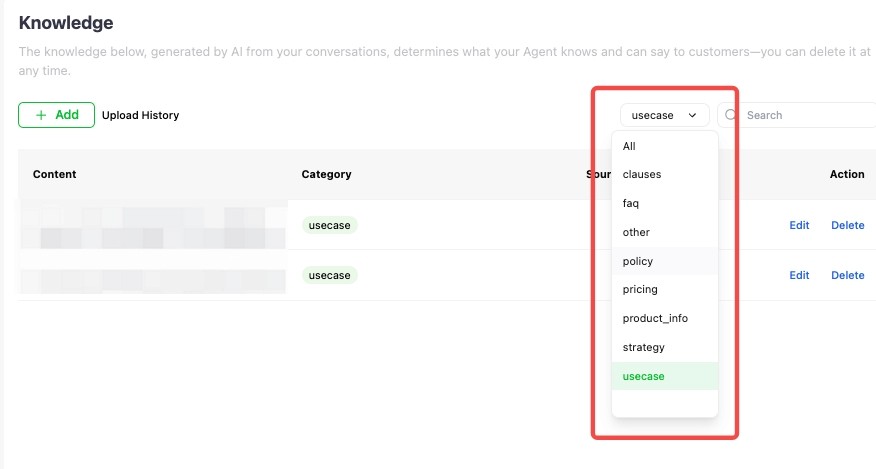
Open Knowledge and select Add. Add a clean file or link containing the FAQ. After it appears, use the category filter to review entries categorized as faq, and use Search to check for an existing answer before adding another.
Test and maintain FAQs
Test each FAQ with the exact question, a natural wording variation, and one follow-up question. Confirm that the Agent gives the same core answer without inventing exceptions. Edit the FAQ when the business rule changes and delete obsolete versions.
If correct FAQ knowledge is present but the answer is still wrong, see Agent is not using new knowledge.